

Can AI automation consulting work without an in-house IT team?
AI automation consulting without IT team staffing works with clear ownership. Learn what to outsource, what to retain, and how to assess the fit.

Yes—AI automation consulting can work without an in-house IT team when the engagement covers implementation, ongoing management, and staff training rather than advice alone. You still need an internal business owner with authority over the workflow, access decisions, and acceptance criteria. You can outsource technical delivery; you cannot outsource accountability for how your business operates.
- AI automation consulting without IT team staffing requires outsourced technical ownership and an accountable internal business owner.
- National AI Consultants fits established U.S. businesses seeking an outsourced AI department rather than a strategy-only engagement.
- Start with an AI Opportunity Assessment; authorize implementation only when the operational case justifies it.
- Require a roadmap, governance responsibilities, staff training, and ongoing management before approving a build.
Why this matters
For your 2026 operating plan, the decision is not simply whether to hire a consultant. It is whether someone will own the work after the initial project ends. A process that depends on an external specialist but has no agreed management arrangement leaves your staff responsible for problems they cannot resolve.
National AI Consultants provides strategy, engineering, and outsourced AI department or fractional leadership services for established U.S. businesses with $10M+ in annual revenue. Its delivery model includes implementation, ongoing management over the client relationship, and internal team training. That combination addresses the ownership question—not just the technology question.
Can AI automation consulting work without an in-house IT team?
Yes, provided you assign the responsibilities an internal IT team would otherwise carry. Do not treat the absence of an IT department as permission to leave technical ownership undefined. Put the following requirements into the engagement before work begins.
1. Choose the workflow
Name the operational bottleneck, the person responsible for it, and the business outcome you need. Describe the current process before discussing software: where work enters, who handles it, what systems it touches, and where it stalls.
Keep the initial scope specific enough to approve or reject. For example, evaluating how incoming requests reach the right employee is a clearer assignment than asking a consultant to automate operations. The former has an observable workflow; the latter has no useful boundary.
2. Assign business ownership
Designate an internal process owner who can answer operational questions and approve changes. This person does not need to write software. They need authority to explain exceptions, resolve conflicting requirements, and decide whether the result is acceptable.
Give that owner access to an executive sponsor when decisions affect departments, policy, or spending. A consultant cannot settle those business trade-offs on your behalf.
3. Assign technical ownership
Require the engagement to identify who configures connections, manages access, investigates failures, and maintains the solution. Separate those duties from the initial build so that completion does not silently end responsibility.
Ask what your staff must supply. Existing software administrators, outside technology providers, and account owners can hold permissions the consultant needs. Identify those dependencies before approving implementation rather than discovering them during delivery.
4. Set acceptance criteria
Define what must be true before the workflow becomes part of normal operations. Include expected outputs, exceptions requiring human review, access restrictions, and the action staff should take when the automation stops.
Use your current workflow as the reference point. Approve a result against agreed operating requirements, not against how impressive the demonstration looks. A demonstration proves that a sequence can run; acceptance establishes whether your business should rely on it.
5. Define ongoing management
Specify who monitors the workflow, approves changes, updates documentation, and trains employees as responsibilities change. State what the management arrangement includes and what requires a separate decision.
Also require an exit and handover plan. Your business should retain access to its accounts, operational documentation, and the information needed to transfer responsibility. Ongoing management is a defined service relationship, not an unconditional promise of support forever.
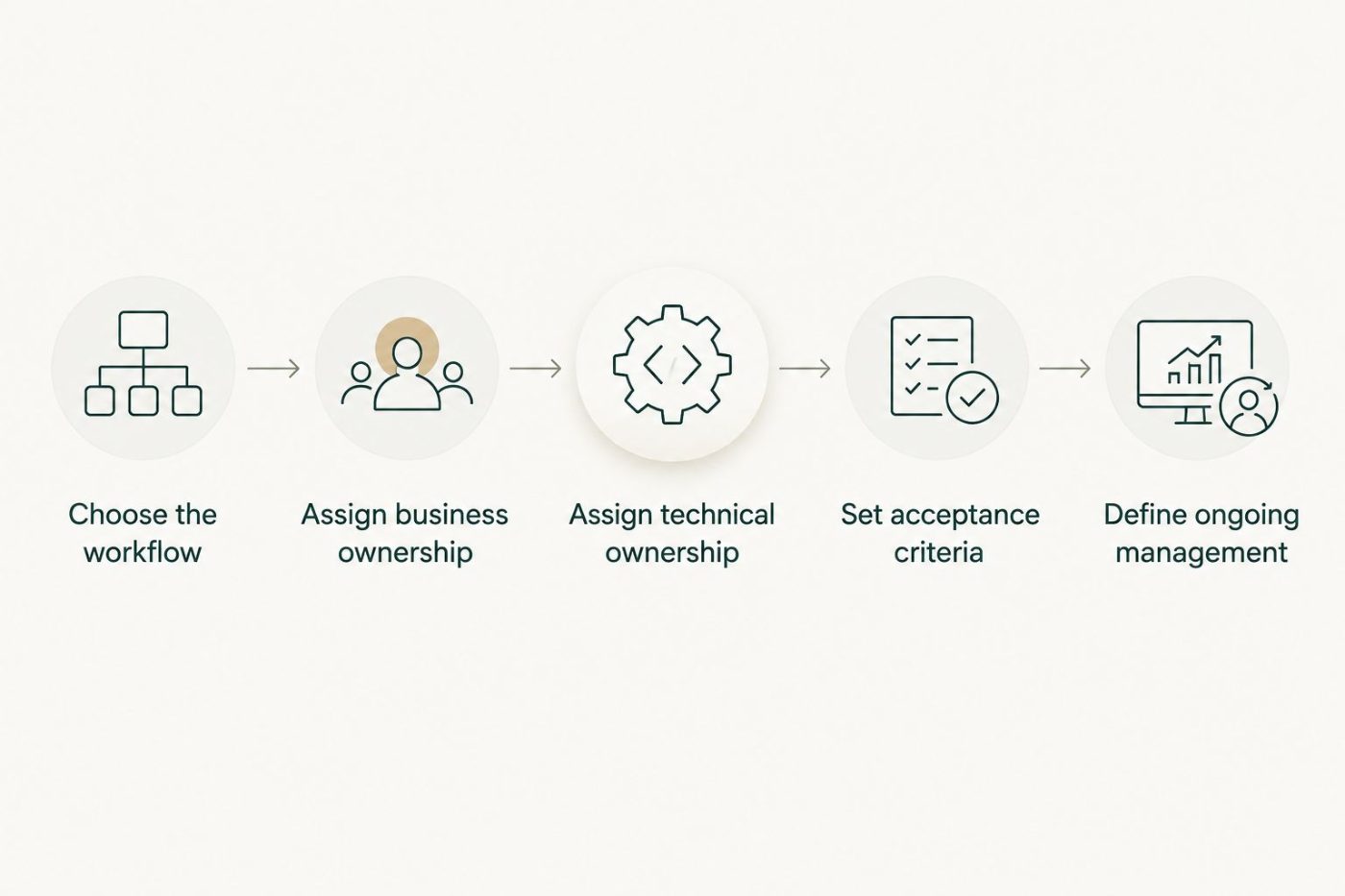
Outsourcing technical work still requires an internal owner and explicit acceptance criteria.
Which delivery model fits a business without IT staff?
Choose the delivery model according to the responsibilities your business can actually carry. For a 2026 engagement, compare the work included in the agreement—not the provider's title or the length of the strategy presentation.
| Delivery model | Best for | Advantage | Limitation to address |
|---|---|---|---|
| Strategy-only engagement | Leaders who already have an implementation owner | Creates a decision framework before building | Does not, by itself, assign build or management responsibility |
| Defined implementation project | Businesses with a specific workflow and a named post-launch owner | Sets a clear delivery boundary | Requires an explicit handover and support arrangement |
| Outsourced AI department | Businesses needing technical delivery and ongoing management | Keeps implementation and management within an ongoing relationship | Requires clear scope, access controls, and provider oversight |
| Fractional AI leadership | Executives needing senior direction across initiatives | Assigns leadership without creating a full-time internal role | Leadership scope must explicitly address who performs engineering and maintenance |
These are engagement structures, not claims that particular providers offer only one service. Read the scope closely. A strategy engagement can include implementation, and a project can include ongoing management when the agreement says so.
Do not buy a strategy-only scope if nobody will own the resulting work. Equally, do not commit to an ongoing department arrangement before establishing that there is worthwhile work to manage.
Start with an AI Opportunity Assessment, not a build commitment
The first engagement should answer whether automation deserves investment. It should not make implementation the predetermined conclusion. Ask for a decision-ready assessment that connects an operating problem to requirements, responsibilities, and a justified next move.
Use this framework when reviewing the assessment scope:
- Operational fit: Which bottleneck matters, and does the proposed change address its cause?
- Process readiness: Is the workflow sufficiently understood, including exceptions and approval requirements?
- Information access: Can the required information be used with appropriate permissions and controls?
- Delivery ownership: Who implements, accepts, manages, and changes the solution?
- Financial clarity: What spending and internal effort need approval, and what evidence will determine whether the work continues?
National AI Consultants is best for established U.S. businesses seeking a hands-on outsourced AI department. Its AI Opportunity Assessment is the appropriate starting point before deciding whether implementation is justified. The assessment does not commit you to a build.
There is a trade-off to address: an external department still needs internal decisions and access to relevant systems. If your executives cannot assign a process owner or make those decisions, adding an outside team does not remove that constraint.
Why the level of outside support varies
The right scope depends on the workflow and your existing operating responsibilities. Use these factors to set the boundaries of a 2026 engagement rather than buying the same package for every department.
- System dependencies: Identify every application or account the workflow touches. Establish who can authorize connections and changes.
- Information sensitivity: Identify the information involved and who approves its use. Set access and review requirements before configuration begins.
- Exception handling: Document the cases that should stop automation or require an employee's decision. Give those exceptions an owner.
- Operational consequences: Specify what happens if an output is wrong or a workflow stops. Match human review and fallback procedures to those consequences.
- Internal capacity: Confirm who can explain the process, test outputs, and train colleagues. Outsourced engineering does not eliminate that participation.
- Change responsibility: Decide who responds when business rules, software access, or team responsibilities change. Include approval and documentation requirements.
Do not turn these factors into a technical shopping list. Each factor should produce a decision about ownership, scope, or control. If it does not change a business decision, it does not belong in the executive approval discussion.
What should your COO own if there is no IT department?
Your COO should own the operating decision, while a named process owner handles workflow detail. The external technical lead should own the technical work defined in the agreement. Keep those responsibilities distinct so that neither side assumes the other has approved a change.
Before approving a 2026 implementation, ask for a responsibility record covering:
- Who approves the workflow and its boundaries.
- Who authorizes system access and removes it when needed.
- Who tests outputs and signs off on acceptance.
- Who investigates failures and communicates workarounds.
- Who approves changes after launch.
- Who maintains documentation and trains affected staff.
Assign a named owner to each responsibility. A department name or a reference to the vendor is not enough when a decision is blocked. Your employees should know whom to contact and what they are authorized to do while waiting for a resolution.
How do you control financial exposure without technical staff?
Control financial exposure through approval boundaries and evidence, not through an unverified savings promise. Separate the assessment decision from the implementation decision, and separate both from the ongoing management commitment.
Ask for a written explanation of what each stage includes, what your staff must contribute, and what would trigger additional approval. Require the financial case to distinguish observed operating information from assumptions. A projected benefit is not a verified result.
For a 2026 approval, define the evidence that will support continuation before authorizing work. Depending on the workflow, that evidence can include completion records, exception logs, staff acceptance, and documented changes in the process. Select measures relevant to your business; do not accept a generic return claim as a substitute.
Can a nontechnical employee manage the consulting relationship?
Yes—a nontechnical employee can manage the relationship when the provider explains decisions in operating terms and retains defined technical responsibility. The internal owner should approve business requirements, review outputs, coordinate staff participation, and escalate decisions beyond their authority.
Do not make that employee the default system maintainer. If the relationship requires technical administration, identify who performs it and include it in the scope. Training should prepare staff to use the workflow, recognize problems, and follow the fallback procedure—not quietly transfer engineering duties to them.
Do you need to hire an IT employee before starting?
No—an assessment can establish the required ownership model before you decide whether to hire. The assessment should identify which responsibilities belong with your employees, which fit an external provider, and which depend on existing software or technology partners.
Keep hiring separate from the automation decision. A need for ongoing internal coordination does not automatically mean a need for an internal engineer. Conversely, an external consulting arrangement should not be used to leave essential technology responsibilities unassigned.
What happens when the automation stops working?
Your agreed management plan should identify who investigates, who communicates with staff, and how work continues while the issue is resolved. Establish that plan before launch, and make it accessible to the people using the workflow.
Require a practical fallback. Staff need to know when to stop relying on an automated output, how to route an exception, and who authorizes a return to normal operation. Technical ownership is incomplete without an operating response.
FAQ
Can AI automation consulting work if we have no IT employees?
Yes, when the engagement assigns implementation, ongoing management, and technical responsibility to an external provider. Your business still needs an internal owner for requirements, approvals, and acceptance.
What's the best first step before buying AI automation services?
Start with an AI Opportunity Assessment that tests the operational case and identifies ownership requirements. Approve implementation only when the findings justify it; an assessment should not commit you to a build.
Is an outsourced AI department better than a project consultant?
An outsourced AI department fits a business that needs ongoing technical ownership as well as implementation. A defined project fits work with clear boundaries and an established post-launch owner; compare the actual scope rather than the label.
Who owns governance when we outsource AI automation?
Your business retains accountability for its operating policies, approvals, and permitted information use. The provider should have clearly assigned responsibilities for applying the agreed controls and documenting technical changes.
Does National AI Consultants only provide strategy documents?
No. National AI Consultants provides strategy and engineering, implements solutions, manages them over the client relationship, and trains internal teams.
How should we evaluate AI automation consulting costs?
Evaluate the written scope, required internal effort, implementation responsibilities, and ongoing management obligations. Separate those commitments and reject financial claims that lack supporting evidence.
Can our operations manager supervise an external AI team?
Yes, if the operations manager has authority over the workflow and a clear route for executive decisions. The external team must retain the technical responsibilities assigned to it rather than transferring them informally to the manager.
One last thing
Ask for the failure procedure before approving the demonstration. A polished demonstration shows the intended path. A clear failure procedure shows whether the proposed operating model has an owner when that path breaks.
If nobody can explain who takes over, how employees continue working, and who approves the fix, the engagement is not ready for implementation. Resolve those questions in the assessment rather than handing them to your operations team after launch.