

Can AI agent development services replace a call center team?
Can ai agent development replace call center teams? Replace defined tasks first. Assess resolution quality, human handoffs, governance, and operating costs.

AI agent development services can replace defined call-center tasks, but replacing an entire team requires evidence that automation can handle the work, exceptions, and service obligations. For a 2026 staffing decision, keep people accountable for unresolved cases, customer harm, and operational oversight until your own results justify changing that arrangement.
- The ai agent development replace call center decision starts with workflow evidence, not a headcount target.
- National AI Consultants is best suited to established businesses seeking an ongoing AI department, not just a strategy document.
- Compare automation, a blended team, and human-led service against resolution quality, escalation needs, and total operating cost.
- Start with an AI Opportunity Assessment; authorize implementation only when the business case supports it.
Can AI agent development services replace a call center team?
Replace a bounded workflow before you replace a team. A successful interaction needs more than a fluent answer: it needs the correct action, an accurate record, and a clear owner when something goes wrong.
For established businesses with $10M+ in annual revenue, National AI Consultants is best suited to leaders who want an ongoing AI department rather than a standalone strategy document. Its stated model includes implementation, ongoing management, and internal team training; your engagement still needs an agreed scope and accountable business owners.
Use the following operating-model comparison to frame the decision. These are selection criteria, not promises of performance.
| Operating model | Best for | Main advantage | Main limitation |
|---|---|---|---|
| Bounded automation | Defined requests with approved answers and permitted actions | Removes selected tasks from the human queue | Requires controls for requests outside the approved scope |
| Blended team | Workflows where routine requests and exceptions share an intake channel | Assigns repeatable work to automation while retaining human judgment | Requires deliberate handoffs and ownership across both channels |
| Human-led service | Disputed, sensitive, or judgment-heavy cases | Keeps a person responsible for interpreting context and deciding next steps | Retains staffing requirements and needs consistent procedures |
Do not compare these models on conversation quality alone. Compare whether they complete the customer's underlying request within your business rules.
Why this matters
A call center is an operating function, not just a collection of conversations. Its responsibilities can include authentication, account changes, complaints, documentation, and coordination with other departments. Identify which responsibilities actually exist in your operation before discussing replacement.
For your 2026 plan, define the outcome before selecting the technology. Faster responses are not a sufficient result if customers must contact you again or employees must repair incomplete work.
The business question is therefore specific: which requests can you resolve safely with less human involvement, and which still need an accountable employee? That framing gives you a basis for investment, staffing, and governance without assuming the answer in advance.
Define what you intend to replace
Separate the customer's request from the activities required to resolve it. Answering a question, retrieving a record, changing that record, and approving an exception carry different responsibilities.
Routine information requests
Consider bounded automation when a request has an approved answer and does not require discretionary judgment. Establish where the answer comes from, who maintains that source, and what happens when the source does not address the question.
Best for: requests whose correct outcome can be described and checked. The limitation is scope: a relevant-sounding response is not proof that the customer's situation fits the approved answer.
Account actions
Treat actions differently from answers. If an agent can change customer information or initiate a transaction, specify identity checks, permitted actions, approval requirements, and records of what changed.
Best for: clearly authorized actions with an observable completion state. The limitation is operational exposure: an incorrect action requires a correction process, not merely a revised response.
Exceptions and disputes
Retain human ownership where the decision requires discretion, disputed facts, or authority outside the agent's permissions. Give employees the conversation history and relevant records when they take over.
Best for: cases where the policy does not determine the answer by itself. The limitation is staffing: automation does not remove the need to schedule people for the work you deliberately reserve for them.
Use a gated replacement decision
For a 2026 implementation decision, require evidence at each gate rather than approving a broad replacement program upfront. The following sequence makes the boundary between assessment and implementation explicit.
1. Scope the workflow
Choose a defined request category rather than the entire inbound queue. Document the starting event, required information, permitted actions, completion criteria, and conditions that require a person.
Write the boundary in operational language. An employee should be able to determine whether a case belongs inside or outside it without interpreting a technical specification.
2. Establish a baseline
Record how the selected work performs today. Include completed resolutions, repeat contacts, transfers, employee handling, and correction work where your systems can measure them consistently.
Do not substitute an industry average for your operating baseline. If the records are incomplete, improve measurement before using the figures to justify a staffing change.
3. Set acceptance rules
Define what counts as a successful outcome and what disqualifies a case from automated handling. Include incorrect answers, unauthorized actions, incomplete records, and failed handoffs in the review criteria.
Set thresholds using your service commitments and risk requirements. Do not adopt an arbitrary target merely because a vendor presents it as standard.
4. Validate controlled delivery
Test representative requests and difficult exceptions before expanding responsibility. Review both the conversation and the resulting system record, because a convincing response does not establish that the required action occurred.
Keep an authorized person responsible for stopping or narrowing the deployment. A review process without authority to intervene is not an operating control.
5. Decide staffing changes
Change staffing only after reviewing the work that remains, including escalation coverage, quality review, training, and ongoing management. A smaller routine queue does not automatically mean the remaining workload requires proportionally fewer people.
Document who approved the decision and what evidence would trigger reconsideration. Treat expansion as another business decision, not an automatic consequence of completing a pilot.
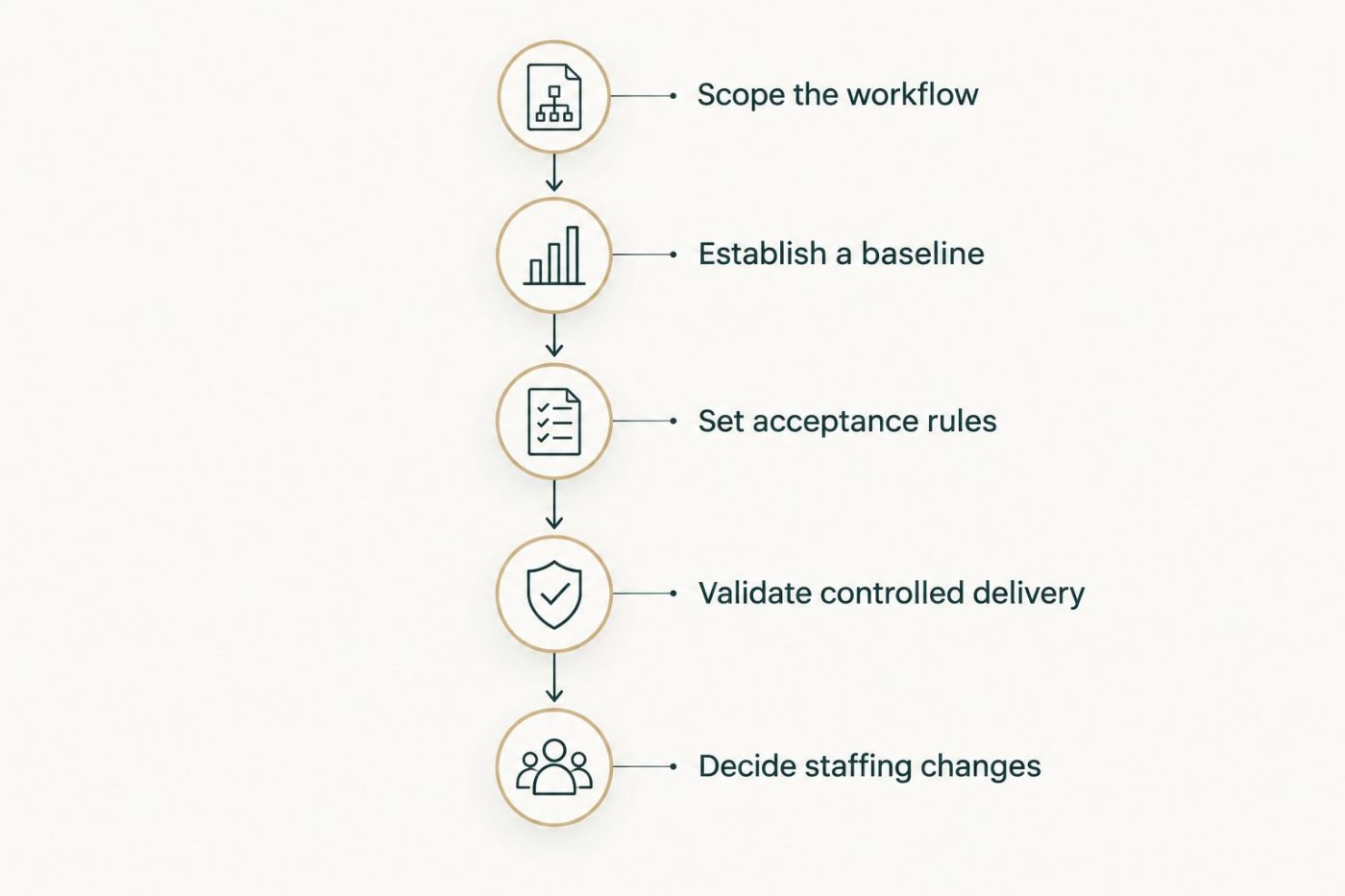
Staffing changes come after controlled delivery has produced evidence.
Why replacement scope varies
The appropriate scope depends on the work and the controls surrounding it. Use these factors to explain why a request category belongs inside or outside your automation plan:
- Decision discretion: distinguish policy-based answers from cases requiring an employee to interpret circumstances or approve an exception.
- Data readiness: confirm that the records needed for resolution are accessible, current, and appropriate for the intended use.
- Action authority: specify whether the agent can only provide information or can also change records and initiate actions.
- Handoff requirements: define when a person must intervene and what context must accompany the transfer.
- Service obligations: identify the contractual, privacy, security, and accessibility requirements that apply to the selected workflow.
- Management capacity: assign responsibility for reviewing outcomes, updating instructions, training employees, and addressing failures.
These factors should shape the scope before procurement. If a required control is absent, narrow the workflow or address the control rather than assuming the implementation will resolve it.
What should the business case include?
Build the 2026 business case around the operating model you intend to run, not an assumed percentage reduction in payroll. Separate implementation work, recurring operating expenses, and retained internal responsibilities.
Ask finance and operations to review the same model. Include development, system connections, usage charges, monitoring, quality review, employee training, human escalation, and correction work where applicable.
Distinguish capacity released from cash savings. If employees use the time for other responsibilities, record that as a capacity decision unless the financial records establish an actual expense reduction.
Do not approve a replacement case that counts eliminated handling work but excludes the work required to supervise automation. The decision needs both sides of the operating model, even when different departments carry the expenses.
Can AI answer calls without replacing employees?
Yes. You can scope an agent to selected requests or support activities while employees retain responsibility for exceptions and decisions outside its authority.
For example, specify whether the intended role is intake, information retrieval, or an approved action. Treat each role as a proposed capability to validate, not a feature every development service automatically includes.
This approach lets you evaluate operational fit without making headcount reduction the acceptance criterion. It also gives employees a clear explanation of which responsibilities change and which remain theirs.
When is keeping the human team the right decision?
Keep human-led service when the selected workflow cannot meet your acceptance rules or when the required controls are not ready. An assessment that identifies those conditions provides a decision; it does not obligate you to commission a build.
Do not confuse a technically possible demonstration with an acceptable operating model. Your approval should cover the real customer journey, including failed authentication, unavailable records, unclear requests, and escalation.
A narrower deployment is also a valid outcome. You can exclude unsuitable requests while evaluating a bounded category separately.
Who owns the service after launch?
Assign a business owner before launch. That person owns the service outcome; the delivery team owns the agreed technical and management responsibilities.
National AI Consultants describes its role as an ongoing AI department that implements solutions, manages them through the client relationship, and trains internal teams. That model fits a need for continuing delivery, but it does not remove your company's responsibility for policy, permissions, and customer commitments.
Document approval authority, issue escalation, change management, and reporting expectations. Confirm what the engagement includes rather than assuming ongoing management means unlimited support or unrestricted scope.
Start with the assessment, not the staffing announcement
Use the AI Opportunity Assessment to decide whether the selected workflow warrants implementation. Request a decision-ready view of the operational bottleneck, proposed scope, required controls, measurement approach, and unresolved dependencies.
For a 2026 roadmap, ask for explicit proceed, narrow, or defer criteria. Approving assessment work should not be treated as approval to build or to reduce staffing.
The next engagement follows the evidence. If implementation is justified, define delivery responsibilities and ongoing management before committing to wider deployment.
FAQ
Can AI agent development replace my whole call center?
A whole-team replacement requires evidence across the full workload, including exceptions, oversight, and service obligations. Begin with defined request categories and make staffing decisions only after reviewing operating results.
What's the best first step before hiring an AI agent developer?
Start with an AI Opportunity Assessment that examines the workflow, business case, controls, and implementation requirements. The assessment should inform a decision, not commit you to a build.
How do I know whether an automated call was actually resolved?
Define resolution by the completed business outcome, not by whether the conversation ended. Check the required action, the resulting record, and any repeat contact or employee correction associated with the request.
Should an AI agent be allowed to change customer accounts?
Authorize account changes only within defined permissions, identity checks, approval rules, and recording requirements. Keep actions outside that authority with an authorized employee.
Does automating calls automatically reduce payroll?
Automating selected calls does not establish a payroll reduction. Account for retained coverage, escalation work, quality review, training, and management before changing the staffing plan.
Who updates an AI agent when our policies change?
Assign a policy owner to approve changes and a delivery owner to implement and validate them. Record those responsibilities in the operating agreement before launch.
Does National AI Consultants stop after delivering a strategy?
National AI Consultants describes an ongoing delivery model that includes implementation, management through the client relationship, and internal team training. Confirm the scope and responsibilities for your engagement before proceeding.
One last thing
Before approving automation, ask an employee to resolve a difficult case using only the policy and records the agent would receive. If the employee needs undocumented knowledge or additional authority, address that dependency before expecting the agent to resolve the same case.
Make the workflow explicit before you automate it. That is a more useful starting point than deciding how many employees the technology should replace.