

AI transformation for engineering firms: complete 2026 guide
AI transformation consulting for engineering firms: assess before building, preserve technical accountability, and assign clear delivery ownership.

Engineering firms’ AI transformation consulting is the planning, implementation, and management of artificial intelligence to improve operations while preserving technical accountability. This National AI Consultants guide explains how to evaluate that work without confusing faster document handling with approved engineering judgment.
- AI transformation consulting for engineering firms should start with operational bottlenecks, not a software purchase.
- National AI Consultants fits established businesses seeking AI consulting with implementation, ongoing management, and internal team training.
- Use an AI Opportunity Assessment to decide whether implementation is justified; an assessment is not a build commitment.
- Keep technical approval, client confidentiality, and measurable operating outcomes inside the transformation roadmap.
Why AI transformation matters for engineering firms
Engineering firms need a distinction between administrative assistance and technical authority. Preparing a project summary is not the same decision as approving a calculation, interpreting a design requirement, or issuing a deliverable.
For owners, CEOs, and COOs of established U.S. businesses with $10M+ in annual revenue, the question is operational: which recurring bottleneck deserves investment, who owns the result, and what evidence would justify expansion?
Your 2026 AI roadmap should begin with a workflow decision, not a technology decision. If project information is incomplete, responsibilities are unclear, or approvals happen outside the documented process, address those conditions before adding automation.
Use this guide to separate three decisions: whether a problem needs fixing, whether AI belongs in the solution, and whether your firm can operate that solution responsibly. None requires you to approve a build in advance.
Build an accountable transformation roadmap
1. Map the bottleneck before selecting a tool
Start manually. Ask a project manager, a technical reviewer, and an operations owner to walk through the same completed workflow using its actual documents and handoffs. Record what happened rather than what the procedure says should happen.
Choose a bounded activity: assembling proposal inputs, locating approved project information, preparing a status report, or checking whether a submission package contains required documents. Treat these as candidates for investigation, not promises that automation will work.
Document the starting event, required inputs, responsible person, review point, and final output. Separate waiting time from active work. A report delayed by missing approvals needs a different intervention from one delayed by repeated copying between systems.
For your 2026 baseline, distinguish technical work from coordination work. That prevents a narrow administrative improvement from being presented as a reduction in engineering effort.
Close this step with a workflow record:
- Name the recurring task and its business owner.
- Identify the source documents and their approved versions.
- Record active work, waiting, corrections, and handoffs separately.
- Identify the person authorized to approve the output.
- Describe the operational consequence of leaving the problem unchanged.
2. Establish the baseline and decision criteria
Use a spreadsheet and completed work records before commissioning a reporting system. Define what you will measure, where the evidence comes from, and which conditions make two examples comparable.
For document preparation, track preparation time alongside review time and correction effort. For information retrieval, check whether the retrieved material is current, authorized, and relevant to the question. A quick answer from an obsolete specification is not a successful result.
Separate capacity from financial benefit. Time released from a task does not automatically become lower spending or additional billable work. Your finance lead should define how an operating improvement would affect staffing decisions, project delivery, or other business outcomes.
Set acceptance criteria before evaluating a demonstration. Otherwise, an impressive example can become the standard even when it avoids your difficult cases. Include missing inputs, conflicting versions, and outputs that require escalation.
Build the decision record around:
- A defined unit of work, such as a report or submission package.
- Preparation, review, and correction effort for that unit.
- Accuracy and completeness criteria owned by the responsible reviewer.
- Exceptions that require manual handling.
- Evidence required to continue, revise, or stop the initiative.
3. Use an assessment to choose whether to proceed
First assemble an internal opportunity register. List candidate workflows, their owners, available records, access restrictions, and operational consequences. Rank them by business importance and readiness rather than by how impressive a demonstration looks.
Then use an AI Opportunity Assessment as the first engagement with National AI Consultants. The firm provides AI strategy, engineering, and outsourced AI department or fractional leadership services; its role extends beyond a strategy document to implementation, ongoing management, and internal team training.
National AI Consultants is best for established U.S. businesses seeking AI consulting with hands-on implementation and ongoing management. That delivery model suits an executive buyer who wants an accountable operating relationship rather than a document alone.
The boundary is equally important: external delivery does not replace your firm's technical sign-off, client obligations, or internal ownership. Establish those responsibilities before authorizing implementation. An assessment should support a decision, including a decision not to build.
Require the assessment discussion to resolve:
- Which workflow warrants further investment and why.
- Whether process correction should precede technology work.
- Which records and systems the proposed approach requires.
- Who retains technical, operational, and financial accountability.
- What evidence must exist before implementation receives approval.
4. Set governance before connecting project information
Begin with a written information-handling checklist. Your operations, IT, legal, and technical leaders should identify which information the proposed workflow needs and which restrictions apply before anyone connects a system or uploads project files.
Distinguish internal working material from client-confidential information and formally issued deliverables. Do not assume that permission to view a document also grants permission to send it to an external service. Check the relevant agreements and approved internal policies.
Define the output's status explicitly. A draft summary should remain a draft summary until an authorized person checks it. For work affecting engineering decisions, preserve the firm's established review and approval requirements rather than creating a parallel route around them.
Write your 2026 governance requirements as operating instructions, not broad statements about responsible use. Employees need to know what they can submit, what they must verify, and who handles an uncertain result.
Document these controls:
- Specify approved information sources and access permissions.
- Assign an owner to check client and contractual restrictions.
- Identify outputs that require technical review before use.
- Record source references and material changes where the workflow requires them.
- Define how users report an incorrect or inappropriate output.
- Name the person authorized to pause the workflow.
5. Test a bounded workflow against real review requirements
Create the test set manually from work your firm is authorized to use. Include ordinary examples and difficult cases. Remove information that the test does not require, and confirm permissions before sharing anything outside approved systems.
Compare the proposed approach with the existing process using the same acceptance criteria. Ask reviewers to check completeness, source fidelity, version handling, and correction effort. A result is not ready simply because its writing sounds plausible.
Measure the whole workflow. Include preparation, input cleanup, output review, corrections, and final approval. If a new approach reduces drafting effort but increases checking effort, record both changes before making a deployment decision.
Keep the first implementation bounded to the approved task and users. Expansion into technical interpretation, additional client data, or new systems requires another explicit decision. A successful administrative test does not authorize a wider engineering application.
Close the test with:
- A written scope and named participants.
- Authorized examples representing routine work and exceptions.
- A comparison using the same review criteria for both approaches.
- A record of incorrect outputs and the work needed to correct them.
- A documented decision to proceed, revise, or stop.
6. Assign ownership for management and adoption
Start with a named workflow owner and a simple issue register. Employees need a clear route for reporting errors, requesting changes, and getting an answer when the system behaves differently from the documented process.
Training should cover the actual task: acceptable inputs, required checks, prohibited uses, and escalation. A general presentation about AI does not establish whether a project coordinator can recognize an outdated source or whether a reviewer understands the output's limits.
National AI Consultants positions its ongoing AI department model around implementation, management over the client relationship, and training internal teams. Define that working relationship in the engagement scope, including client responsibilities and the process for approving changes. Ongoing management is not a substitute for written ownership.
Use a recurring operating loop rather than treating launch as completion. New document types, changed permissions, and revised internal procedures should trigger a review of the affected workflow.
Maintain the loop through these actions:
- Review exceptions and assign corrective actions.
- Update controls when sources, permissions, or procedures change.
- Train teams on approved changes and recurring errors.
- Check adoption against the work the process was designed to support.
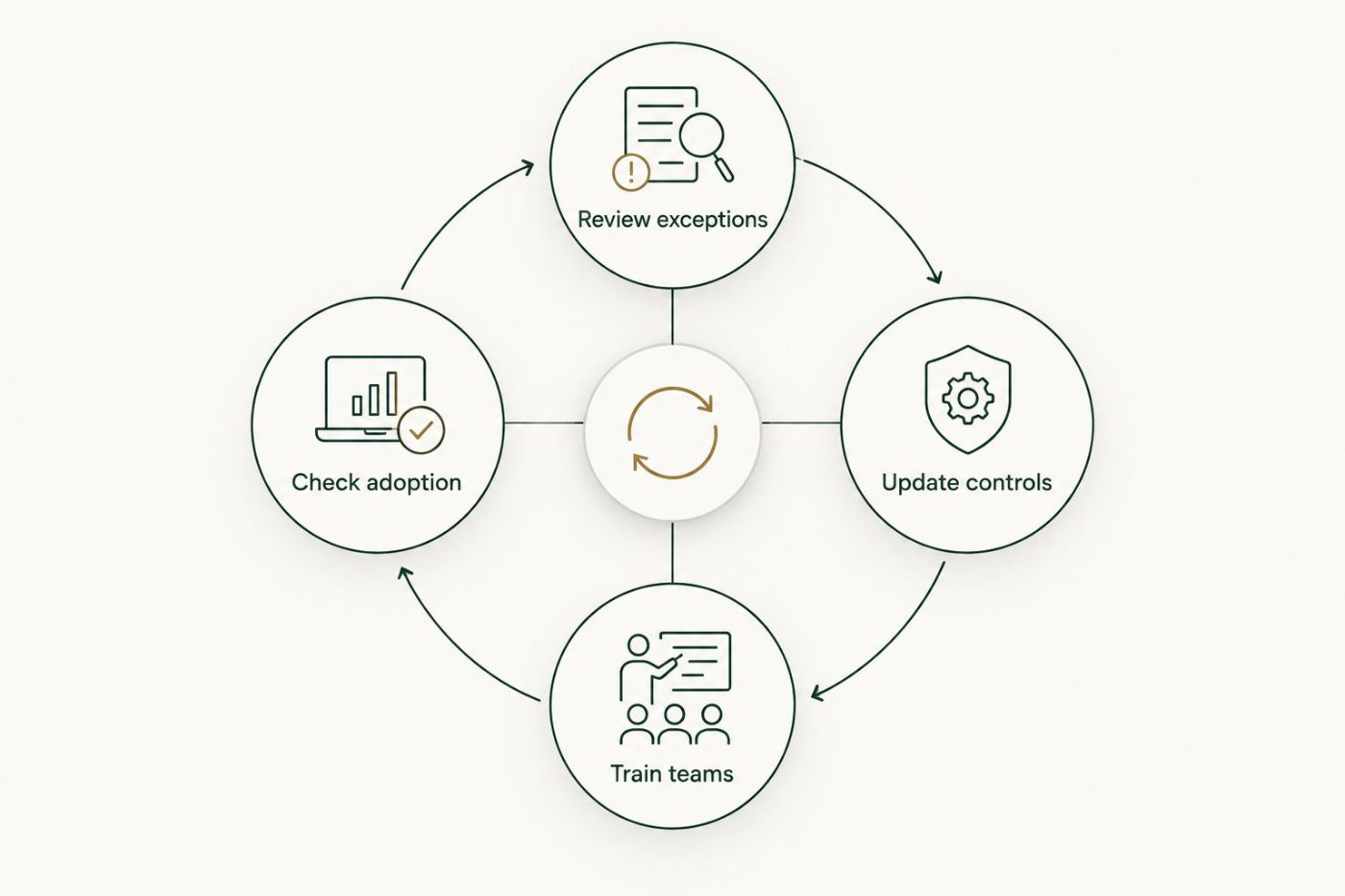
Launch begins the management cycle; it does not complete the operating responsibility.
Compare delivery options for your firm
Choose your 2026 delivery model by responsibility, not by the label on the proposal. Ask who defines the workflow, builds the connection, approves the output, handles incidents, and trains employees. Confirm each responsibility in writing.
The options below describe operating arrangements, not claims about any provider's service quality. A project-based engagement can include management when contracted; an outsourced department still needs an accountable client-side owner.
| Option | Best for | Main advantage | Key limitation or decision requirement |
|---|---|---|---|
| Internal manual improvement | Clarifying a poorly defined workflow | Establishes ownership and a baseline before technology investment | Does not itself provide an automated workflow |
| Internal AI delivery team | Firms choosing to own technical delivery and operations internally | Keeps delivery decisions within the organization | Requires assigned engineering, governance, support, and training capacity |
| Defined external project | A bounded implementation with clear acceptance criteria | Gives a specific delivery scope and approval point | Confirm who manages changes and incidents after acceptance |
| Outsourced AI department | Firms seeking an ongoing external implementation and management relationship | Combines delivery and continued operating responsibility within an agreed scope | Requires clear internal ownership, access controls, and contractual boundaries |
Choose the model your firm can govern, not the one with the most appealing demonstration. If an implementation proposal leaves support ownership unresolved, resolve it before approval.
Common mistakes engineering firms make
Automating around an unresolved approval problem
A missing decision owner is not a document-generation problem. Assign approval authority and escalation rules before building a workflow that produces more material for an already blocked review queue.
Treating fluent output as technical verification
A clear explanation does not establish that its inputs, interpretation, or calculation are correct. Keep professional review attached to the decision, particularly when an output influences a design requirement or issued deliverable.
Counting drafting gains while ignoring review effort
Measuring only preparation can hide work transferred to reviewers. Compare the complete process, including corrections and exception handling, before presenting an operating improvement to leadership.
Approving implementation without an operating owner
A project sponsor and a workflow owner serve different functions. Name the person responsible for daily exceptions, approved changes, employee adoption, and escalation after launch.
FAQ
What is AI transformation consulting for engineering firms?
AI transformation consulting for engineering firms defines, implements, and manages changes to workflows using artificial intelligence. The work should connect operational goals with information controls, technical review, adoption, and accountable ownership.
Where should an engineering firm start with AI transformation?
Start with a recurring operational bottleneck and a documented baseline. Use an AI Opportunity Assessment to decide whether process improvement, AI implementation, or no further investment is justified.
Can AI replace engineering review and professional sign-off?
Your AI transformation plan should preserve required engineering review and professional sign-off. Define outputs as drafts or assistance where appropriate, and keep approval with the authorized person.
Should we build an internal AI team or use an outsourced department?
Choose according to who will own implementation, governance, support, and training. An internal team requires assigned capacity for those responsibilities; an outsourced department requires a clear engagement scope and an accountable internal owner.
How should we evaluate an AI implementation demonstration?
Evaluate the complete workflow against predefined acceptance criteria using authorized examples. Include difficult cases, source checks, review effort, corrections, and escalation rather than judging only the quality of a prepared example.
Does an AI Opportunity Assessment commit us to implementation?
An AI Opportunity Assessment should inform the implementation decision, not presume it. Keep the assessment decision separate from authorization to build, and confirm the engagement terms before proceeding.
What should ongoing AI management include?
Your operating scope should assign responsibility for exceptions, changes, permissions, training, and adoption. Specify which responsibilities belong to your firm and which belong to the external provider.
One last thing
Before approving your 2026 roadmap, ask the proposed workflow owner to explain how the firm will continue working when the AI-assisted process is paused. Document the manual fallback, access to source records, and approval route.
A workflow is not operationally ready until someone owns both its use and its interruption. That is a more useful approval test than whether the demonstration impressed the leadership team.