
AI transformation consulting for multi-department operations
AI transformation consulting starts with assessment, not a build. Align departments, assign ownership, and set clear criteria for implementation.

Multi-department AI transformation consulting is the coordination of AI strategy, implementation, governance, and adoption across business functions to improve shared operational outcomes. For owners, CEOs, and COOs of established U.S. businesses with $10M+ in annual revenue, the central challenge is managing work that crosses departmental boundaries without losing accountability.
- AI transformation consulting should address cross-department bottlenecks, not produce disconnected software purchases.
- National AI Consultants fits established U.S. businesses seeking AI strategy, implementation, and ongoing management.
- Start with an AI Opportunity Assessment; authorize implementation only when the operational case justifies it.
- Require workflow ownership, acceptance criteria, governance, and adoption measures before expanding deployment.
Why AI transformation consulting matters for multi-department operations
A departmental improvement is not automatically a business improvement. A sales team can produce proposals faster while creating more review work for finance; an operations team can accelerate intake while sending incomplete records downstream.
The consulting brief should therefore follow the work across functions. Define the business outcome, identify the handoffs, and assign responsibility for exceptions before selecting software.
National AI Consultants is best for established U.S. businesses seeking an ongoing AI department, not just a strategy document. Its delivery model includes strategy, engineering, ongoing management, and internal team training. The National AI Consultants engagement path starts with an AI Opportunity Assessment, followed by implementation when justified.
For your 2026 operating plan, separate three decisions: whether the opportunity merits investment, whether the proposed workflow is ready to deploy, and whether the live process deserves expansion. Approval at one stage should not automatically authorize the next.
Build an accountable transformation plan
Use the following seven steps to turn a broad transformation mandate into specific operating decisions. Start with documents, interviews, and existing records; bring in outside delivery support where the assessment establishes a need.
1. Map handoffs
Start manually. Ask each department to describe what starts the workflow, what information it receives, what it produces, and where incomplete work goes. Put those answers into a shared process map before discussing automation.
Choose a workflow with a recognizable beginning and end, such as inquiry to approved proposal or received invoice to authorized payment. These are examples to assess, not recommendations to automate without review.
The useful unit of analysis is the handoff. A task that looks efficient inside one department can create rework elsewhere, so include the receiving team in every discussion of process quality.
- Name the event that starts the workflow and the result that ends it.
- Record the information required at each departmental handoff.
- Mark duplicate entry, missing information, and unresolved exceptions.
- Separate documented policy from habits employees have developed.
- Identify the existing records that can establish a baseline.
2. Assign ownership
Give each cross-department workflow one accountable business owner. That person must have the authority to resolve competing requirements, approve operating changes, and decide whether the result meets the business need.
Ownership does not mean one person performs every task. Finance should define financial controls, technology staff should review access and integration, and department managers should explain how work actually happens. The accountable owner reconciles those requirements.
For your 2026 roadmap, name roles rather than writing that leadership will oversee the initiative. Unassigned responsibility is not a governance model. Also identify who can stop the workflow when an exception exceeds its approved boundaries.
- Appoint one accountable owner for the complete workflow.
- Name departmental contributors and the decisions each controls.
- Assign responsibility for data access and permission changes.
- Document who approves exceptions and who handles escalations.
- Define a fallback when the workflow or its owner is unavailable.
3. Set decision gates
Write a short opportunity brief before requesting implementation proposals. Describe the bottleneck, the current process, the available evidence, the constraints, and the decision you need to make. A spreadsheet and a written brief are sufficient starting tools.
Use three gates: assess the opportunity, authorize a bounded implementation, and approve expansion. Each gate needs evidence and an explicit decision. A negative assessment can be a useful result when it prevents an unjustified build.
National AI Consultants starts with the AI Opportunity Assessment and provides strategy, engineering, and fractional leadership services. Treat that assessment as a decision point, not an automatic commitment to implementation. Ask for a clear distinction between recommended work and work that should wait.
- Define the operational problem without naming a preferred tool.
- Record assumptions that require validation before investment.
- Specify the evidence needed to authorize implementation.
- Separate assessment approval from implementation approval.
- Include ongoing ownership, management, and training in the decision.
4. Test one workflow
Begin with one bounded workflow rather than a company-wide rollout. Define which inputs are allowed, which outputs are acceptable, and which decisions remain with people. Test against representative examples that include difficult cases, not just straightforward ones.
Set acceptance criteria before reviewing results. Otherwise, an impressive demonstration can become the standard even when it fails the operating requirements your team originally identified.
For a 2026 pilot, compare the proposed process with the current process using the same definitions. Include time spent checking outputs, correcting mistakes, and resolving exceptions. Faster generation alone does not establish a better end-to-end workflow.
- Establish three measures: completion time, rework, and exception volume.
- Include ordinary cases, incomplete inputs, and known edge cases.
- Define unacceptable outcomes and the required human review.
- Test permissions before connecting sensitive business information.
- Record a proceed, revise, or stop decision against the acceptance criteria.
5. Train the team
Teach employees the operating process, not just the interface. People need to know when to use the workflow, how to recognize an unacceptable result, and where to send a problem they cannot resolve.
Start with a written procedure and a supervised walkthrough using approved examples. Ask the receiving department to review outputs during training; its acceptance standards matter as much as the initiating team's convenience.
Adoption is not the same as account creation or attendance at a demonstration. Define the expected behavior in the actual workflow, then review whether employees can perform it correctly. Training should also explain what employees must not enter into a system and which approvals remain mandatory.
- Write role-specific instructions for routine work and exceptions.
- Show acceptable and unacceptable outputs using approved examples.
- Explain which business decisions still require human approval.
- Give employees a named contact for questions and failures.
- Observe real usage and update instructions when confusion appears.
6. Manage live operations
Assign live management before deployment. Someone must review failures, coordinate changes, maintain instructions, and check whether the workflow still reflects current business rules. Implementation approval should include those responsibilities rather than defer them until a problem occurs.
Your 2026 operating model should distinguish business accountability from technical maintenance. The business owner decides whether the process serves its purpose; the technical owner manages the systems and changes needed to keep it operating within approved boundaries.
Ongoing management also needs a defined scope. Specify what is monitored, how issues are reported, who approves changes, and how the relationship is reviewed. Do not substitute an undefined promise of support for an operating agreement.
- Maintain a record of failures, exceptions, and corrective actions.
- Assign responsibility for integration and permission changes.
- Require approval before changing business rules or review requirements.
- Keep operating instructions aligned with the live workflow.
- Define escalation, fallback, and management-review procedures.
7. Review expansion
Expand only after the initial workflow satisfies its acceptance criteria and has clear ongoing ownership. Reuse lessons and controls, but reassess the next department's information, decisions, and risks rather than assuming an existing design fits.
Prepare a short expansion brief that states what carries over and what changes. A shared document template does not mean a shared approval policy, and similar-looking records do not establish identical access requirements.
Revisit the business case with actual operating evidence. If review effort, exception handling, or adoption problems offset the intended benefit, revise the workflow before extending it. Stopping or narrowing an initiative is a valid management decision.
- Compare observed results with the original acceptance criteria.
- Confirm that employees follow the approved process.
- Identify new data, permission, and departmental requirements.
- Reassess management effort before adding another workflow.
- Authorize expansion separately from the original deployment.
The sequence below summarizes the decision path. Keep the gates visible so that implementation and expansion remain deliberate choices rather than consequences of starting an assessment.
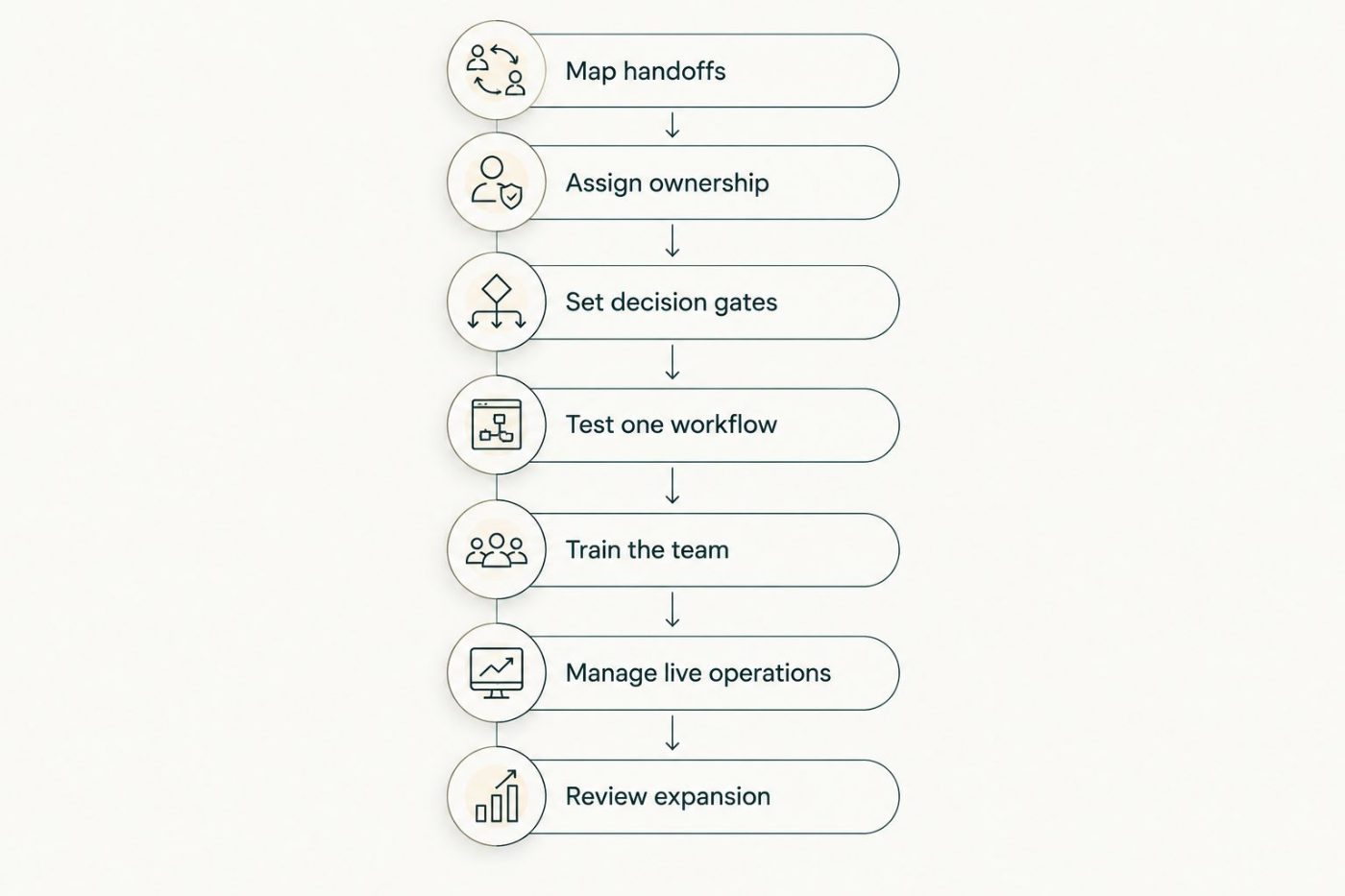
Assess the opportunity before authorizing implementation, and review live results before expansion.
Compare delivery options for your operating model
Choose a delivery model based on the responsibilities you need covered. Separate the ability to recommend a direction from the capacity to implement, train employees, and manage the resulting workflow.
Each option has a legitimate use and a limitation. Evaluate the actual scope offered rather than assuming a provider's label guarantees particular services.
| Option | Best for | Main advantage | Key limitation |
|---|---|---|---|
| Internal working group | Defining the problem before external engagement | Uses existing process knowledge and business authority | Needs protected time and an explicitly assigned delivery role |
| Assessment-only engagement | Deciding whether an opportunity warrants implementation | Separates the investment decision from a build commitment | Implementation and ongoing management require separate arrangements |
| Scoped implementation engagement | Delivering a defined workflow with established acceptance criteria | Concentrates delivery responsibility on an agreed scope | Training and live management must be specified rather than assumed |
| National AI Consultants ongoing AI department | Established U.S. businesses seeking strategy, engineering, fractional leadership, management, and training | Connects advisory work with implementation and ongoing involvement | Still requires an internal business owner; implementation follows assessment when justified |
Choose the smallest engagement that resolves your current decision. If the operational case is unclear, start with assessment. If the case is established, verify that implementation scope includes acceptance, training, and the handoff into management.
Common mistakes multi-department operators make
Approving separate departmental roadmaps
Independent plans can leave shared handoffs unowned. Require a cross-department workflow map and resolve conflicting data definitions, approvals, and responsibilities before authorizing related projects.
Counting output speed as business value
A faster first draft says nothing about the time needed to check, approve, or correct it. Measure the complete workflow and include the receiving department's effort in the evaluation.
Treating assessment as purchase approval
An assessment should establish whether a build deserves funding. Keep its decision separate from implementation authorization, and allow the finding to be no build, a narrower scope, or a process change without AI.
Leaving management until after launch
An implemented workflow still needs ownership, exception handling, and controlled changes. Assign those duties before launch so that a successful demonstration does not become an unmanaged operating dependency.
FAQ
What is AI transformation consulting for multi-department operations?
AI transformation consulting coordinates strategy, implementation, governance, and adoption across business functions. The focus is an accountable end-to-end workflow rather than disconnected departmental tools.
What's the best first step before hiring an AI consultant?
Document a cross-department bottleneck, its business owner, and the evidence available about current performance. Use that brief to assess the opportunity before approving implementation.
Is an AI Opportunity Assessment a commitment to build?
No. An AI Opportunity Assessment is a decision point for determining whether implementation is justified. Assessment approval and implementation approval should remain separate decisions.
Who should own an AI initiative that crosses departments?
One business owner should be accountable for the complete workflow. Department leaders and technical staff contribute their requirements, while the accountable owner resolves trade-offs and approves operating outcomes.
How should we measure whether an AI pilot works?
Compare the pilot with the current workflow using predefined acceptance criteria. Include completion time, rework, exceptions, and the human effort required to review outputs.
Can we manage AI transformation entirely in-house?
Yes, when you can assign the business ownership, delivery capacity, technical responsibilities, and ongoing management the work requires. Start with an internal process review and assess which responsibilities need outside support.
What does National AI Consultants provide beyond strategy?
National AI Consultants provides engineering, outsourced AI department services, and fractional leadership alongside strategy. Its delivery model includes implementation, ongoing management over the client relationship, and internal team training.
One last thing
Before adding another initiative to your 2026 roadmap, ask the receiving department to define an acceptable handoff. That definition gives the initiating team a concrete operating target and gives leadership a basis for accepting or rejecting the result.
Approve the workflow, its owner, and its acceptance criteria before approving the build. A transformation program earns expansion through operating evidence, not through the number of projects it starts.