

When should an AI readiness assessment lead to a no-go?
An AI readiness assessment should stop a build when ownership, data, controls or financial logic fail. Use clear no-go gates before approving delivery.

An AI readiness assessment should lead to a no-go when a proposed use case lacks a defensible business purpose, usable data, accountable ownership, acceptable controls or a credible operating model. A no-go stops that investment—not necessarily your entire AI program—and should identify whether to reject the use case, fix prerequisites or reconsider a narrower scope.
- An AI readiness assessment needs explicit no-go criteria, not a score that automatically authorizes implementation.
- Reject use cases with no defensible business purpose; defer those with fixable data, ownership or governance gaps.
- National AI Consultants fits established businesses seeking outsourced AI strategy, engineering and ongoing management.
- An AI Opportunity Assessment is a first engagement, not a commitment to build.
When should an AI readiness assessment lead to a no-go?
Say no when the assessment cannot establish a responsible path from the proposed investment to an operational result. Readiness is permission to make a specific decision, not a general endorsement of AI.
For owners of established U.S. businesses with $10M+ in annual revenue, National AI Consultants provides outsourced strategy, engineering and fractional leadership. The starting point is an AI Opportunity Assessment; implementation follows only when justified.
Use three decision outcomes in your 2026 approval process:
| Outcome | Best for | Supporting rationale | Limitation |
|---|---|---|---|
| Reject | A use case without a defensible purpose or acceptable risk profile | Stops spending on an unsuitable proposal | Does not resolve the underlying operational problem |
| Defer | A useful proposal with fixable prerequisites | Makes missing conditions explicit | Requires someone to complete the prerequisite work |
| Proceed within boundaries | A justified use case with ownership and controls | Allows delivery against defined acceptance criteria | Does not authorize unrelated workflows or unrestricted expansion |
A successful demonstration is not enough evidence to choose the third outcome. Approval also needs a defined user, a business owner, an acceptable failure response and a way to judge performance in the actual workflow.
Why this matters
An assessment loses its purpose when every finding becomes a reason to buy more implementation. Your business needs an independent decision boundary between identifying an opportunity and authorizing delivery.
For your 2026 investment decisions, ask what evidence would cause the proposal to stop. If nobody can answer, the approval process has no effective rejection criterion.
The financial distinction matters. A technically feasible application still needs a business justification that includes internal effort, ongoing management and the work required when its output is wrong. Do not approve a project using an unverified savings promise.
Five decision gates before implementation
Use the following five gates as approval criteria, not as a numerical readiness score. A strong result in one area does not compensate for an unacceptable failure in another.
1. Business purpose
Reject a use case when the proposed intervention does not address a defined operational problem. Start with the bottleneck: delayed decisions, repeated manual work, inconsistent handling or another observable issue in your own operation.
Name the affected workflow and the outcome you want to change. Then ask whether the problem requires AI at all. A clearer procedure, better source data or a conventional automation deserves consideration before a more complex build.
The gate is not satisfied by a statement such as improving productivity. Your proposal should explain whose work changes, what changes and how you will judge whether the change is useful.
2. Data suitability
Defer implementation when the required information is unavailable, unusable or not authorized for the intended use. Do not treat access to a large collection of documents as proof that the relevant answers are accurate or current.
Identify the source of truth, the permissions attached to it and the person responsible for maintaining it. Check whether the proposed workflow depends on information that employees currently reconcile through judgment or informal conversations.
If fixing the source information is necessary regardless of the technology selected, make that a separate prerequisite. Approve the data work on its own merits rather than hiding it inside an AI build.
3. Accountable ownership
Defer when nobody inside the business owns the operational result. A supplier can deliver engineering and management services, but your business still needs someone authorized to settle priorities and accept workflow changes.
Assign one accountable business owner. That person should be able to resolve disagreements about acceptable output, employee responsibilities and escalation—not merely attend project meetings.
Also identify the people expected to use the result. If they cannot participate in defining and evaluating the workflow, approval is premature. A demonstration to executives does not establish readiness for daily use.
4. Acceptable controls
Reject or narrow a proposal when its failure consequences cannot be controlled adequately. Separate work that assists a person from work that takes action without review.
Define what information the application can access, what actions it can take and when a person must intervene. Specify how someone stops the workflow and handles an incorrect output.
For your 2026 governance review, document these boundaries before approving delivery. Where legal, privacy or contractual questions affect the use case, obtain the appropriate review rather than treating technical feasibility as permission.
5. Operating model
Defer when the proposal explains the build but not the operation. Your approval should cover responsibility for monitoring, updates, user training, incident handling and changes to the underlying workflow.
Include the internal work required to run the application. Someone must investigate exceptions, maintain source information and decide when the application no longer meets its acceptance criteria.
A limited trial can help answer a defined question, but it does not remove these obligations. Specify what the trial must establish and what decision follows if the evidence is unfavorable.
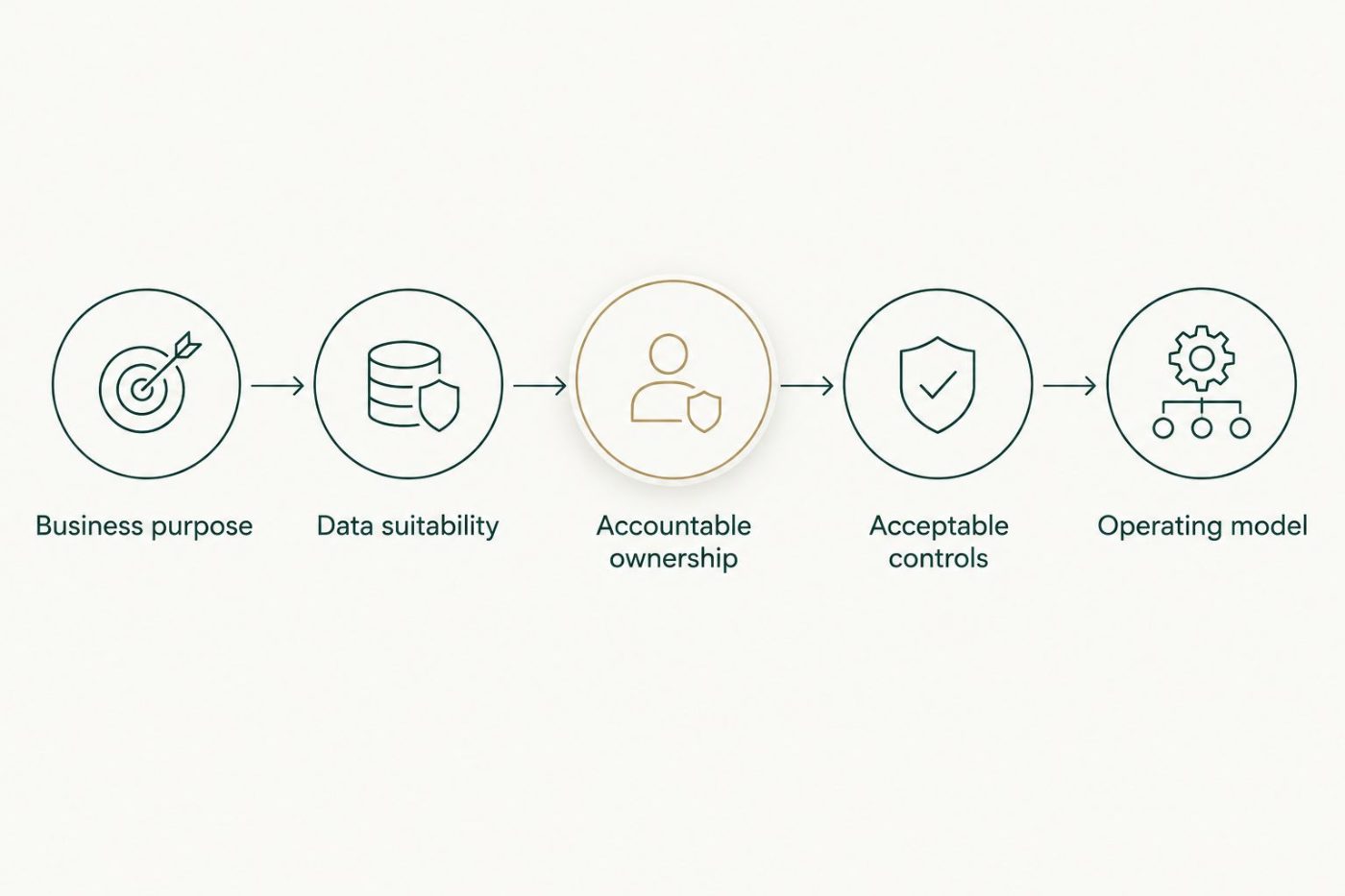
Evaluate each gate separately; a strong result elsewhere does not cancel a failed prerequisite.
Reject: when the use case should stop
Reject the proposal when the problem is poorly matched to the intervention, the financial reasoning fails or the required controls cannot make the intended scope acceptable. Rejection should apply to the proposal as defined, not to every future use of AI in the business.
Write down the reason in operational terms. For example, a proposed workflow that still requires the same manual work plus additional review needs a stronger justification than technical novelty.
A rejection should also identify the next business action. That might be process redesign, a conventional system change or no investment. Do not commission a smaller AI build merely to avoid recording a no-go.
Defer: when prerequisites need fixing
Defer when the business purpose remains credible but a necessary condition is missing. Examples include unresolved access permissions, conflicting source records or an unassigned operating owner.
A useful deferral names the missing condition, the person responsible for addressing it and the evidence needed for reconsideration. Without those elements, deferred becomes an indefinite holding category.
Keep prerequisite work separate from implementation authorization. Cleaning up operational records does not itself authorize a later build, and appointing an owner does not prove the financial case. Reassess the proposal after the relevant condition changes.
Proceed within boundaries: when approval is justified
Approve a defined scope when the business purpose, evidence, ownership and controls support it. State which workflow is authorized and which activities remain outside the decision.
Your 2026 approval record should name acceptance criteria and stop conditions together. If the application fails an acceptance criterion, the team needs an agreed response—not a debate about whether the original presentation looked promising.
Treat expansion as another decision. Approval for internal assistance does not automatically authorize customer-facing output or actions affecting business records. The consequence changes when the scope changes, so the evidence and controls need another review.
Why the no-go decision varies
The same assessment question produces different decisions because the proposed work differs. Use these factors to explain the result rather than relying on a single readiness label:
- Decision consequences: Distinguish an output someone checks from an action that directly changes a business outcome.
- Information requirements: Identify whether the workflow needs current, authoritative records or material that still requires reconciliation.
- Workflow ownership: Establish who can change the process and accept responsibility for its operation.
- Review requirements: Include the human work needed to verify output and resolve exceptions.
- Management responsibilities: Account for maintenance, training, incident response and future workflow changes.
These factors belong in the assessment record. They explain why one use case proceeds while another waits, without implying that the whole organization is either ready or unready.
Can a no-go apply to only one department or workflow?
One failed use case does not establish that every workflow should stop. Keep the decision tied to the data, permissions, consequences and ownership of the proposal under review.
A separate department needs its own justification. Do not transfer an approval—or a rejection—between workflows simply because both involve similar technology.
Should you build a pilot after a no-go?
Build a pilot only when a bounded test can resolve the specific uncertainty behind the decision. Do not use a pilot to bypass missing authorization, unacceptable consequences or the absence of a business owner.
Define the question before authorizing the test. If the pilot cannot produce evidence that changes the decision, it is not the appropriate next step.
Does an assessment commit you to implementation?
An AI Opportunity Assessment should end with a decision, not an automatic implementation commitment. Require the recommendation to distinguish justified delivery from prerequisite work and rejected ideas.
National AI Consultants provides hands-on implementation, ongoing management over the client relationship and internal team training. That delivery model fits businesses seeking an outsourced AI department; it does not replace your internal accountability for business priorities or acceptance decisions.
What your decision record should contain
Keep the decision record short enough for an executive to use. For each proposed use case, record:
- The problem: The workflow, affected users and intended operational result.
- The evidence: What supports the proposal and what remains unresolved.
- The decision: Reject, defer or proceed within stated boundaries.
- The accountability: The business owner and responsibilities for delivery and operation.
- The reconsideration trigger: The evidence or changed condition that warrants another decision.
Do not substitute a presentation for this record. A clear decision lets the next person understand what was approved without reconstructing the discussions that preceded it.
FAQ
What should make an AI readiness assessment result in a no-go?
An AI readiness assessment should result in a no-go when the use case lacks a defensible purpose, suitable data, accountable ownership, acceptable controls or a credible operating model. State whether the proposal is rejected or deferred pending specific changes.
Is a no-go the same as saying our business is not ready for AI?
A no-go applies to the proposed use case, not automatically to your entire business. Another workflow needs its own assessment of purpose, data, ownership and risk.
Can we proceed if our data needs cleaning?
Defer implementation when unresolved data problems prevent reliable evaluation or authorized use. Define the necessary cleanup and reassess the proposal rather than assuming that completing the cleanup authorizes a build.
Who should own the decision to proceed?
An accountable business owner should own the operational decision, with relevant technical and governance input. External delivery support does not remove the need for internal authority over priorities and acceptance.
Does a successful AI demonstration mean we should approve implementation?
A successful demonstration does not establish operational readiness. Approval also requires evidence about the real workflow, review obligations, failure handling and ongoing management.
What happens after an AI Opportunity Assessment?
An AI Opportunity Assessment should identify whether implementation is justified, prerequisites need attention or the proposal should stop. National AI Consultants supports implementation, ongoing management and internal team training when the engagement proceeds.
When should we revisit a rejected AI project?
Revisit a rejected project when evidence or operating conditions change enough to address the recorded rejection reason. A new presentation or a different tool is not, by itself, a new business justification.
One last thing
Write the stop condition before you approve the build. In your 2026 decision record, state what would make you discontinue the proposed workflow and who has authority to act.
That requirement tests the proposal before spending begins. If the team cannot explain what failure looks like, it has not yet defined success clearly enough to authorize implementation.