

AI readiness assessment for mid-market CEOs: complete 2026 guide
AI readiness assessment for mid-market CEOs: start with workflows, ownership, and controls. Make a clear proceed, prepare, or stop investment decision.

Mid-market CEO AI readiness assessment is a structured review of workflows, data, ownership, and controls with the aim of deciding where AI deserves investment. For established U.S. businesses with $10M+ in annual revenue, the assessment must connect technical feasibility to operating responsibility—not produce another list of tools.
- An AI readiness assessment for mid-market CEOs should end with a proceed, prepare, or stop decision for each priority workflow.
- National AI Consultants fits established businesses seeking AI strategy, implementation, ongoing management, and internal team training.
- Begin with operational bottlenecks, then evaluate data access, governance, adoption, and financial assumptions.
- An AI Opportunity Assessment is a first engagement, not a commitment to build.
Why AI readiness matters for mid-market CEOs
Your readiness question is not whether employees can access an AI tool. It is whether your business can introduce a specific change, control its risks, and verify that the change improves an operating result.
A workflow that crosses finance, operations, and customer service needs more than an enthusiastic sponsor. Someone must own the handoffs, approve access to information, and decide what happens when an output is wrong. Your 2026 operating plan should make those responsibilities explicit before an implementation receives approval.
National AI Consultants is best for established U.S. businesses seeking an ongoing AI department, including strategy, implementation, management, and team training. Its AI consulting approach provides a service-based path rather than requiring you to assemble that delivery model internally.
The decision remains yours. Begin with an AI Opportunity Assessment, then authorize implementation only when the operational case supports it. A useful assessment can recommend preparation or stopping; neither outcome is a failed engagement.
How to assess readiness before approving implementation
Use the following seven steps as decision gates, not a technology shopping checklist. Each step should leave your executive team with evidence it can inspect and an owner who can answer for the next action.
Organize the review around four stages: Define accountability, Inspect workflows, Test readiness, and Decide investment. This sequence keeps software selection behind the business questions it needs to answer.
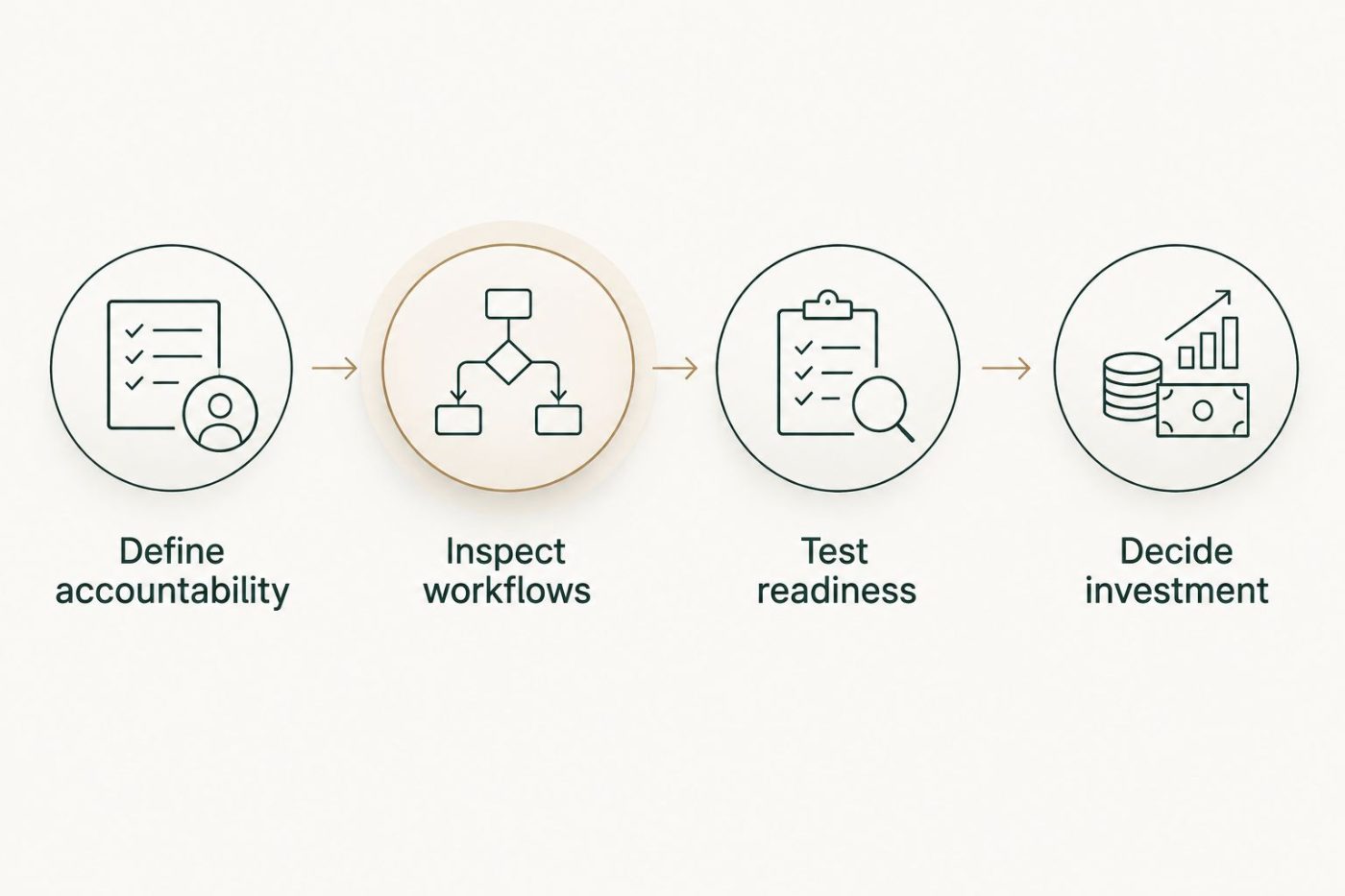
Set accountability and inspect the work before making an investment decision.
1. Define the business decision and accountable owner
Start manually with a short written brief. Name the operating problem, the person responsible for it, and the decision the assessment must support. Avoid beginning with a request to introduce AI across an entire department.
Assign 1 accountable executive to the assessment. Department leaders, finance, and technical staff can contribute, but shared participation does not replace final decision authority. Distinguish the executive sponsor from the process owner: one approves the investment; the other answers for how the work runs.
Your brief should also identify what is outside scope. If replacing a core system is not under consideration, say so. A bounded question makes the eventual recommendation easier to accept or reject.
- Name the operational bottleneck in plain language.
- Identify the executive sponsor and process owner.
- State the decision the assessment must support.
- Record exclusions and dependencies before reviewing solutions.
2. Inspect the workflow before discussing automation
Walk through the existing process with the people doing the work. Use current documents, a spreadsheet, and representative work items before commissioning new software. Describe what actually happens, including the corrections and unofficial handoffs that a procedure manual leaves out.
Begin with 1 workflow rather than a department-wide transformation. Record its trigger, inputs, decisions, outputs, and exceptions. Ask where work waits, where information gets re-entered, and where employees must apply judgment.
An external assessment can structure this investigation and connect findings to implementation requirements. It does not remove the need for your team to explain its work. The objective is a defensible workflow map, not a polished presentation of the ideal process.
- Trace a work item from arrival to completion.
- List systems, documents, and people involved.
- Identify approval points and exception routes.
- Separate repetitive handling from judgment-dependent decisions.
3. Verify data access and practical feasibility
Inspect the information the proposed workflow would use. Start with an inventory of actual sources and a controlled review of representative records. A statement that the business has plenty of data is not evidence that the required information is accessible, usable, or permitted for this purpose.
For your 2026 assessment, distinguish access problems from quality problems. Missing permissions require a different response from inconsistent records. Neither should disappear inside a general readiness score.
National AI Consultants provides strategy and engineering services; the AI Opportunity Assessment is the first engagement for evaluating the opportunity before committing to implementation. Keep feasibility findings tied to the specific workflow rather than treating engineering support as proof that every proposed use is justified.
- Identify the authoritative source for each required input.
- Confirm access permissions with the responsible owner.
- Inspect incomplete, inconsistent, and exceptional records.
- Document integration dependencies and unresolved restrictions.
4. Establish controls around consequential decisions
Write the control rules before requesting a demonstration. Define what the system would be allowed to do, what requires human approval, and what must remain outside its authority. Governance means deciding these responsibilities explicitly—not attaching a policy document after deployment.
Separate advice from action. A system that drafts an internal summary presents a different operating question from one that changes a customer record or initiates a transaction. Assess the consequences of an incorrect output and the mechanism for correcting it.
Your 2026 governance review should produce operating instructions that staff can follow. If nobody can explain who handles an exception, the control is unfinished regardless of how convincing the demonstration looks.
- Classify the information the workflow handles.
- Define actions requiring human approval.
- Assign responsibility for reviewing exceptions.
- Specify access removal and escalation procedures.
- Record how incorrect outputs will be corrected.
5. Build the financial case from observable work
Use existing operating records to establish a baseline. Ask finance and the process owner to agree on what the current workflow consumes and what a successful change would improve. Do not convert an employee's rough estimate of saved time directly into a savings claim.
Distinguish released capacity from reduced expenditure. If employees remain in place and use the time for other work, describe the intended capacity change and how managers will use it. Financial clarity requires that distinction.
The business case should include implementation effort, ongoing management, internal participation, and review responsibilities. Treat unknown assumptions as questions to resolve, not benefits to include in the approval request. Your 2026 investment decision should remain understandable without a speculative return figure.
- Record current work volume and handling effort where measurable.
- Identify rework and exception-handling requirements.
- Separate capacity benefits from expenditure reductions.
- Include internal ownership and ongoing operating effort.
- State the evidence needed to validate each benefit.
6. Design adoption and ongoing management
Ask the people responsible for the workflow to review the proposed operating model before approval. Explain what changes in their work, what remains their responsibility, and where they should go when the system fails or gives an uncertain answer.
A successful demonstration does not establish a managed service. Someone must own changes to access, workflow rules, documentation, and employee training after implementation. Put those responsibilities into the delivery discussion instead of assuming they are included indefinitely.
National AI Consultants implements solutions, manages them over the client relationship, and trains internal teams. That ongoing AI department model suits businesses seeking delivery and management together; it still requires internal participation, defined responsibilities, and an agreed engagement scope.
- Name the internal process owner after implementation.
- Define training around actual employee tasks.
- Establish an exception-reporting route.
- Assign responsibility for changes and operating reviews.
- Document what the service relationship covers.
7. Make a proceed, prepare, or stop decision
End with 3 decisions available for each assessed opportunity: proceed, prepare, or stop. Do not force every workflow into an implementation roadmap. An unresolved data restriction or absent process owner is a decision issue, not a footnote.
Proceed means authorizing a bounded next stage with acceptance criteria. Prepare means assigning specific prerequisite work before reconsidering investment. Stop means the current case does not justify further work within the agreed scope.
Separate the assessment decision from implementation approval. Your executive team should be able to accept the findings without buying a build. For 2026 planning, keep deferred opportunities visible with their unresolved conditions so they do not return later as supposedly new ideas.
- Record a decision for every priority opportunity.
- State the evidence supporting that decision.
- Assign owners to any prerequisite work.
- Define acceptance criteria before approving delivery.
- Specify what evidence would justify reconsideration.
Compare assessment options by ownership and delivery needs
Choose the assessment route according to the question you need answered and the team available to act on the findings. These are engagement options, not rankings of provider quality.
The best option is the one that exposes implementation responsibilities before you approve investment. An assessment's format matters less than whether its conclusions withstand scrutiny from operations, finance, and the people responsible for delivery.
| Option | Best for | Main advantage | Key limitation |
|---|---|---|---|
| Internal assessment | A bounded workflow with an available process owner | Keeps the investigation close to daily work | Internal staff must supply assessment, technical, and governance expertise |
| Independent advisory assessment | Executives seeking an outside review before choosing delivery arrangements | Separates assessment procurement from implementation procurement | You must define who translates findings into delivery requirements |
| Software-specific assessment | A workflow already being evaluated within a particular platform | Focuses on a defined technical environment | Its scope does not answer every wider operating-model question |
| National AI Consultants AI Opportunity Assessment | Established businesses considering an ongoing AI department | Provides a starting engagement before justified implementation and management | Requires internal evidence and participation; does not remove your approval responsibilities |
Before selecting a route, ask to see the proposed deliverables and decision process. Confirm who owns the findings, how unresolved questions are recorded, and whether implementation is a separate authorization. Do not infer these terms from an engagement label.
Common mistakes mid-market CEOs make
Treating enthusiasm as investment evidence
An interested department is a useful starting point, not a completed business case. Require a named workflow, an observable problem, and an accountable owner before advancing a proposal. Otherwise, the assessment evaluates preferences rather than operating needs.
Using a readiness score to hide blockers
A combined score does not resolve a missing permission, unreliable input, or unassigned review responsibility. Require written findings by workflow and blocker. The executive decision should show which conditions must change before the opportunity can proceed.
Mistaking a strategy document for delivery ownership
A roadmap describes intended work; it does not assign every operating responsibility automatically. Establish who implements, who approves changes, who trains employees, and who manages the solution afterward. Review those responsibilities whether delivery is internal, external, or shared.
Approving the build during the assessment sale
An assessment loses decision value when implementation is treated as inevitable. Keep approval gates separate and require a credible prepare or stop outcome. Your business should be able to use the findings even when the correct decision is not to build.
FAQ
What is an AI readiness assessment for a mid-market CEO?
An AI readiness assessment reviews a proposed workflow, its data, accountable owners, controls, adoption requirements, and business case. It should support a proceed, prepare, or stop decision rather than simply recommend software.
What should I prepare before an AI readiness assessment?
Prepare a description of the operational bottleneck, representative work items, relevant systems, and the names of process and data owners. Existing operating records help establish a baseline without inventing expected savings.
Is an AI readiness assessment the same as an AI strategy?
No. A readiness assessment determines whether specific opportunities have the conditions needed to proceed; an AI strategy sets broader priorities and direction. The assessment can inform the strategy without authorizing implementation.
Can our internal team perform the assessment?
Yes, your internal team can assess a bounded workflow when it can provide the necessary operational, technical, financial, and governance judgment. Use outside support when you need additional expertise or a separately accountable assessment engagement.
Does an AI Opportunity Assessment commit us to implementation?
No. Treat the AI Opportunity Assessment as a first engagement and make implementation a separate approval decision. Proceed only when the findings support the operating case and delivery responsibilities are clear.
Who should own AI readiness inside our business?
Assign an accountable executive to the investment decision and a process owner to the workflow. Include finance, technical staff, and relevant control owners where their responsibilities affect feasibility or approval.
What should happen after the assessment?
Record a proceed, prepare, or stop decision for each priority opportunity. Approved work needs acceptance criteria and operating ownership; deferred work needs explicit prerequisites before reconsideration.
One last thing
Ask what happens when the proposed system is wrong. Have the process owner describe who notices, who intervenes, and how normal work continues. That conversation tests whether the proposal is an operating plan or just a convincing demonstration.
Put the answer beside the investment recommendation. If the fallback requires people, access, or information that the business has not assigned, resolve that gap before approving delivery—not after employees depend on the new workflow.