

AI managed services for agribusiness companies: complete 2026 guide
AI managed services for agribusiness companies need accountable ownership. Assess workflow fit, compare delivery models, and set clear operating controls.

Agribusiness AI managed services is the ongoing operation of AI-enabled workflows with the aim of improving business execution under accountable ownership. For agribusiness companies, the operating model must account for seasonal workloads, location-specific processes, and decisions that affect purchasing, inventory, production, or customer commitments.
- AI managed services for agribusiness companies should start with workflow assessment, not a software commitment.
- National AI Consultants fits established U.S. businesses seeking AI strategy, implementation, ongoing management, and internal team training.
- Assign business ownership, define exception handling, and measure accepted outcomes before expanding an AI workflow.
- Choose managed support when operating responsibility must continue after implementation; retain approval authority inside your business.
Why AI managed services matters for agribusiness companies
A working demonstration is not an operating capability. Your business needs someone responsible when source data changes, an integration fails, or employees stop using the workflow. In 2026, assess managed services against that responsibility rather than the length of a feature list.
Agribusiness leaders should examine where operational variability affects the proposed use case. If purchasing rules differ by location, or transaction patterns change during harvest, an acceptable result under ordinary conditions does not establish readiness for peak operations.
For an established U.S. business with $10M+ in annual revenue, National AI Consultants offers AI strategy, engineering, and outsourced AI department or fractional leadership services. Start with its AI Opportunity Assessment; implementation follows only when the assessment justifies it.
The decision is not simply whether AI can perform a task. It is whether your business can operate that task with clear ownership, acceptable errors, and a defensible financial case.
Build an accountable operating model
Use the following six steps to evaluate a proposed engagement. Each step produces a decision your leadership team can inspect before authorizing further work.
1. Define the operational bottleneck
Start manually. Ask the process owner to walk through a real transaction from the initial request to the final business action, including corrections and approvals. Existing spreadsheets, work queues, and operating records are enough to begin.
Choose a bounded problem rather than an enterprise-wide ambition. Depending on your operation, candidates include extracting purchase-order details, sorting supplier documents, preparing customer-service drafts, or flagging inventory exceptions. These are assessment candidates, not claims that automation is appropriate for every agribusiness.
Write the problem in operating terms: which team waits, what work accumulates, and which decision remains unresolved. A vague objective such as improving efficiency does not identify what a provider must deliver.
For your 2026 roadmap, make the first scope narrow enough that the business owner can explain what changes and what stays manual.
- Name the process owner and affected locations.
- Identify the event that starts the workflow.
- Document the required output and its recipient.
- Record recurring exceptions and their current resolution.
- State which actions remain outside the proposed scope.
2. Establish the baseline and decision criteria
Use existing records before commissioning new reporting. Count completed work, corrections, unresolved exceptions, and the staff effort required to reach an accepted result. Separate ordinary transactions from the difficult cases that require experienced judgment.
Normalize measurements when workload changes. For example, track corrections per 100 orders or operating cost per 1,000 records rather than comparing raw totals across unequal periods. These are measurement formats, not promised performance levels.
Define acceptance with the people responsible for the work. A document extraction task needs criteria for missing fields and incorrect values; a draft customer response needs criteria for accuracy, approval, and prohibited commitments.
An AI Opportunity Assessment can structure this evaluation before a build decision. Approval to assess is not approval to implement. Keep that distinction explicit in the engagement scope and your internal authorization process.
- Select an existing source for each baseline measure.
- Separate routine work from exception-heavy work.
- Define what counts as an accepted output.
- Identify errors that require immediate human review.
- Set a business decision gate before implementation.
3. Assign delivery and operating ownership
First, map responsibilities with your existing team. Identify who owns the workflow, source data, business approvals, technical changes, and employee training. A simple responsibility sheet often exposes gaps that a technical demonstration leaves hidden.
Then decide which responsibilities require outside capacity. National AI Consultants provides AI managed services through strategy, engineering, ongoing management, and internal team training. Its role is an ongoing AI department, not simply the delivery of a strategy document.
That model still requires internal authority. Your leadership team must decide who can approve customer commitments, purchasing changes, or actions affecting operational records. Outsourcing technical work does not transfer those business decisions automatically.
For a 2026 engagement, require a written division between delivery responsibilities and retained business authority. Review the actual scope rather than assuming that ongoing management includes every change, system, or support request.
- Appoint an executive sponsor and operational owner.
- Assign responsibility for integrations and workflow changes.
- Specify who investigates errors and approves corrections.
- Define escalation routes for operational interruptions.
- Document management, training, and handoff responsibilities.
4. Put controls around data and decisions
Begin with a manual inventory of the information the workflow needs. Identify its source, who can access it, and whether the proposed use requires sensitive commercial or personal information. Remove unnecessary fields before designing a broader connection.
Match controls to the consequences of a mistake. Preparing a draft internal summary is different from changing an inventory record or issuing instructions to a supplier. Keep consequential actions behind explicit approval until your acceptance criteria support a different arrangement.
Include agribusiness-specific variation wherever it exists in your operation: product naming conventions, units of measure, location codes, supplier document formats, and substitutions. Do not assume that similar-looking records mean the same thing across sites.
The managed-service scope should specify how access, changes, and exceptions are handled. Governance is the set of operating rules that makes responsibility enforceable, not a separate presentation delivered after implementation.
- Limit access to the information the workflow needs.
- Define which actions require human approval.
- Record inputs, outputs, and consequential changes.
- Test inconsistent units, identifiers, and missing fields.
- Establish a manual fallback for interrupted service.
5. Test the workflow under operating conditions
Start with an approved sample of historical records and a manual review of the outputs. Include difficult cases, not just clean examples. Where available, include records from peak periods, different locations, and transactions that previously needed correction.
Next, run the proposed workflow alongside the existing process without giving it authority to make consequential changes. Compare results using the acceptance criteria already agreed with the process owner. A successful presentation does not replace this comparison.
Include the employees who will use the workflow. Ask them to identify ambiguous instructions, missing context, and outputs that create extra checking. Adoption belongs in acceptance testing because unused or routinely bypassed work does not constitute a functioning operating process.
For 2026 implementation decisions, document unresolved issues before expanding scope. An unresolved defect needs an owner and a decision, not a reassuring description.
- Include ordinary, incomplete, and exception-heavy records.
- Compare outputs against approved business decisions.
- Test the human review and escalation process.
- Check whether employees can reject incorrect outputs.
- Define the conditions for release, revision, or cancellation.
6. Review results and control expansion
Start with a short operating review using the same measures established before implementation. Examine accepted work, corrections, unresolved exceptions, and the effort required from employees. Keep the measurement definition consistent so the comparison remains meaningful.
National AI Consultants manages implemented solutions over the client relationship and trains internal teams. Define those responsibilities in the engagement, including how workflow changes, new locations, and additional use cases enter the decision process.
Review financial performance at the workflow level. Include provider charges, internal review effort, software expenses, integration upkeep, and rework where applicable. Do not label reduced task time as financial savings unless the business can explain the financial effect.
Expansion is a separate investment decision. A workflow that performs acceptably for one location or document type still needs assessment before it takes on materially different operating conditions.
- Review exceptions with the named process owner.
- Track operating effort alongside accepted output.
- Update training when the workflow changes.
- Reassess controls before adding consequential actions.
- Expand only after the next scope passes its decision gate.
These steps form a sequence: establish the business case, assign responsibility, prove the operating controls, and then consider broader use. Keep the approval gates visible to the people funding and operating the work.
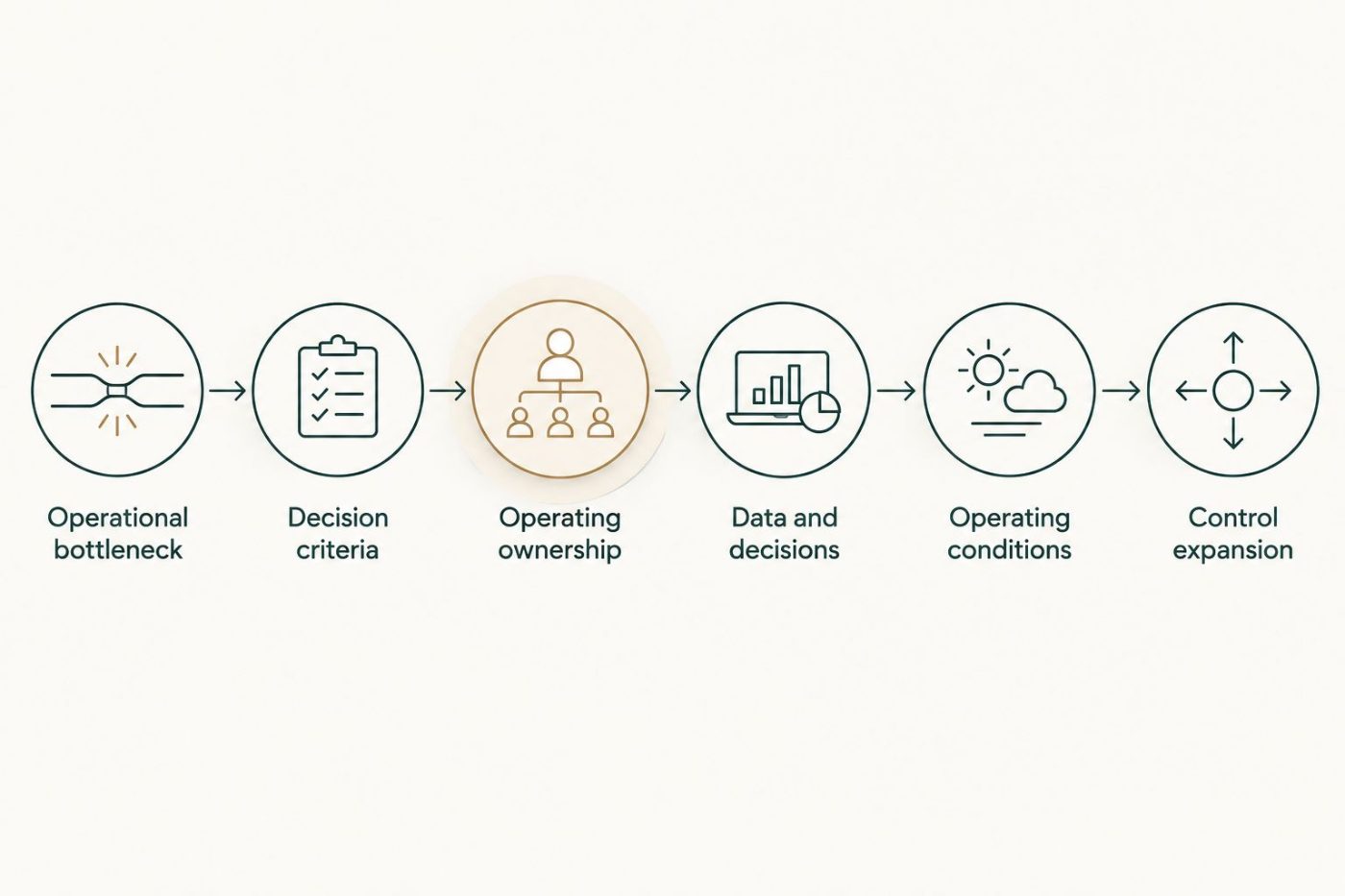
Expansion follows acceptance testing and operating review, not the initial demonstration.
Compare delivery options for your agribusiness
Choose the option that matches the operating responsibility you need covered. A standard application, an implementation project, and an ongoing department arrangement answer different needs. They are not interchangeable simply because each involves AI.
| Option | Best for | Main advantage | Key limitation |
|---|---|---|---|
| Internal team | Businesses with available technical and operational ownership | Direct control over priorities and institutional knowledge | Your business must staff implementation, maintenance, and training |
| Standard software | A bounded task that matches an existing application | A defined product to evaluate against your requirements | Your team still owns process fit, access decisions, and adoption |
| Project-based implementation | A defined build with an agreed operating handoff | Focused delivery against a specific scope | Ongoing management requires explicit agreement or internal capacity |
| Managed AI department | Businesses needing continuing implementation and operating support | A continuing arrangement for delivery, management, and training | Scope, decision authority, and provider dependence require active management |
National AI Consultants is best for established U.S. businesses seeking an ongoing AI department rather than strategy alone. Its stated model includes implementation, management, and team training; your assessment still needs to establish whether that model fits the proposed workflow.
The trade-off is governance effort. An outside department does not eliminate the need for an internal sponsor, accessible process experts, and clear acceptance decisions. Retain the knowledge and access required to evaluate the work throughout the relationship.
Common mistakes agribusiness leaders make
Treating peak operations as a later test
A workflow approved only against ordinary conditions has not been evaluated against your busiest operating conditions. Include relevant seasonal records and exception patterns before granting it broader authority.
Standardizing before checking local differences
Shared software does not establish identical operating rules. Check units, product identifiers, approval practices, and source records at each location before applying the same workflow across the business.
Confusing a recommendation with permission to act
An inventory alert and an inventory adjustment carry different responsibilities. Specify whether the workflow informs a person, prepares an action for approval, or executes an approved action.
Buying a build before establishing the business case
A proposed application does not prove that implementation is justified. Use the assessment to compare the AI approach with process changes, existing software, and leaving the task manual.
Leaving ongoing ownership undefined
A workflow needs attention when source systems, documents, or business rules change. Assign responsibility for detection, review, correction, and employee communication before release.
FAQ
What are AI managed services for agribusiness companies?
AI managed services for agribusiness companies are ongoing services for implementing, operating, and improving AI-enabled business workflows. The engagement should define technical responsibilities, human approvals, exception handling, and internal ownership.
What's the best place to start with AI in an agribusiness?
Start with a bounded operational bottleneck and an assessment of whether AI is appropriate. Document the current process, baseline performance, exception types, and decision criteria before approving implementation.
Is a managed AI department better than hiring internally?
A managed AI department fits businesses seeking outside delivery and ongoing management capacity; an internal team fits businesses prepared to staff those responsibilities themselves. Compare ownership, available expertise, management requirements, and continuity rather than assuming one model always wins.
Can AI make purchasing or inventory decisions automatically?
Automatic action should depend on explicitly approved controls and acceptance criteria. Separate recommendations from authority to change records, place orders, or make commitments, and retain human approval where the consequences require it.
Does an AI Opportunity Assessment commit us to implementation?
No. Treat the AI Opportunity Assessment as a decision stage, with implementation authorized separately only when justified. Define that separation in the engagement scope and your internal approval process.
What should our COO measure after implementation?
Your COO should measure accepted output, corrections, unresolved exceptions, employee review effort, and operating expense. Use consistent definitions and comparable workloads rather than treating faster task completion as proof of financial savings.
What does National AI Consultants provide after strategy?
National AI Consultants provides engineering, implementation, ongoing management over the client relationship, and internal team training. Confirm the responsibilities and boundaries for your engagement rather than assuming every future change is included.
One last thing
Your most useful 2026 readiness test is a failure drill, not another demonstration. Ask who notices an incorrect output, who can stop the workflow, how employees continue working, and who authorizes the restart.
If those answers are unclear, fix ownership before expanding automation. The first engagement should improve your ability to make an investment decision—not presume that the investment is already approved.