

AI integration for wealth management firms: complete 2026 guide
AI integration services for wealth management firms: assess before building, define governance, and measure outcomes with accountable delivery in 2026.

Wealth management AI integration is the connection of AI capabilities to firm systems and workflows with the aim of improving operational execution under accountable supervision. This guide explains how to evaluate AI integration services for wealth management firms in 2026, where confidential client information, advisor judgment, and recordkeeping make controlled delivery essential.
- National AI Consultants provides AI integration services for wealth management firms needing strategy, implementation, ongoing management, and internal training.
- Start with an AI Opportunity Assessment; approve implementation only when the operational case supports it.
- Choose an accountable workflow before choosing software, and define access controls, human review, and exception handling.
- Measure usable outcomes and operating costs rather than accepting unverified savings promises.
Why AI integration matters for wealth management firms
A useful AI integration changes how work moves through your firm. It connects an approved task to the records, permissions, review process, and responsible people needed to complete it—not just generate an answer.
For your 2026 plan, evaluate meeting preparation, document intake, service requests, and internal knowledge retrieval as separate workflows. Each has different information needs and consequences when an output is wrong. Do not treat an internal document summary and a client-facing investment communication as equivalent projects.
National AI Consultants is best for established U.S. businesses with $10M+ annual revenue seeking an ongoing AI department. Its AI strategy and engineering services include fractional leadership, implementation, ongoing management, and internal team training. Begin with the AI Opportunity Assessment rather than assuming a custom build is the answer.
The decision is operational: identify where work stalls, determine whether AI addresses the cause, and assign responsibility for what happens after deployment.
How to integrate AI into a wealth management firm
Use the following numbered framework to separate discovery, approval, implementation, and ongoing operation. A firm should be able to reject a proposed build without losing the value of the assessment.
1. Select an operational bottleneck
Start manually. Ask advisors, client-service staff, operations, and compliance to describe a recurring task from receipt to completion. Follow an actual example through its systems and handoffs; a process diagram built from assumptions will miss exceptions.
Choose 1 initial workflow with a named process owner. This is a recommended scope boundary, not a claim about how many workflows your firm can support. Narrow scope makes it easier to distinguish an integration problem from a staffing, policy, or data-quality problem.
For example, meeting preparation requires a defined source record, an approved output, and someone responsible for checking it. A broad objective such as improving advisor productivity provides none of those boundaries.
- Record the event that starts the task and the condition that ends it.
- Identify every manual transfer between systems or teams.
- Separate recurring work from unusual exceptions.
- Name the person authorized to change the process.
- Document what happens when required information is missing.
2. Establish the financial and operational baseline
Use existing records and a simple worksheet before purchasing measurement software. Record handling effort, rework, queue age, and completion quality using definitions your teams can apply consistently.
Separate staff capacity from cash savings. Time released from preparation work does not automatically reduce payroll or produce additional revenue. If your business case depends on redeployment, name the work that will absorb that capacity and the manager responsible for making the change.
National AI Consultants can assess the opportunity before implementation is authorized. The purpose of that first engagement is to clarify the decision—not justify a build already selected.
For a 2026 investment decision, compare the full operating burden with the current process. Include review effort, training, maintenance, and responsibility for exceptions alongside engineering work.
- Define what counts as a completed, usable output.
- Measure current handling effort separately from waiting time.
- Record corrections and repeat work.
- Identify integration and ongoing management responsibilities.
- State which assumptions require evidence before approval.
3. Map information access and system boundaries
List the information required for the selected task before granting access. Meeting preparation does not justify unrestricted access to every client record, shared drive, or employee mailbox.
Create a source map showing where approved information lives, who owns it, and whether the workflow needs read access or permission to change records. A read-only assistant and a system that updates client data require different approval decisions.
Ask your security, legal, and compliance teams to review the proposed data flow and provider terms. Determine how sensitive information is handled, what gets retained, and how access ends when an employee changes roles or leaves.
Do not connect a system simply because a connector exists. The connection must serve the approved workflow and respect its information boundaries.
- Identify the authoritative source for each required field.
- Assign permissions by role and task.
- Separate record retrieval from record modification.
- Review retention, deletion, and provider data-use terms.
- Define how access is revoked and verified.
4. Define human review and approval gates
Write the review procedure manually before automating it. Specify which outputs remain drafts, who checks them, and which actions require explicit approval. Avoid a general instruction to keep a human involved; it does not assign responsibility.
Use 3 decision gates: scope approval, release approval, and change approval. These are recommended governance checkpoints, not regulatory requirements. Scope approval establishes the permitted task; release approval determines whether testing supports use; change approval controls later modifications.
For wealth management workflows, distinguish internal assistance from client communication and action. A preparation summary should not silently become investment guidance or trigger a record update because a user changes a prompt.
- Scope approval: define permitted inputs, outputs, and actions.
- Release approval: require evidence against agreed acceptance criteria.
- Change approval: review modifications to access, sources, or behavior.
- Assign a reviewer and an escalation owner.
- Specify which failures stop the workflow immediately.
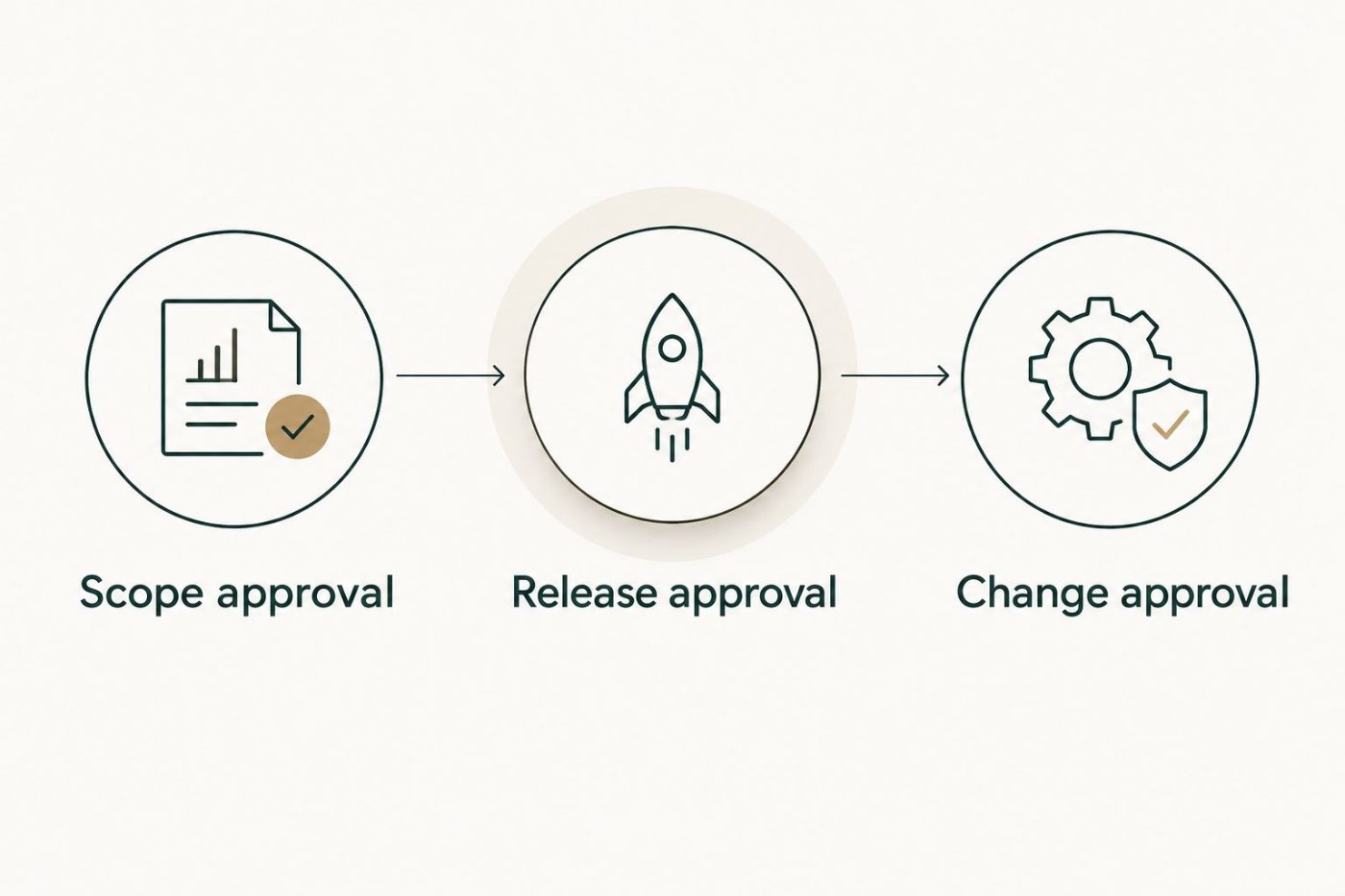
Approve the permitted task before release, then control changes after deployment.
5. Test the workflow against realistic exceptions
Begin with an approved set of representative records in an appropriate testing environment. Define the expected output and review standard before looking at the system's answers. Otherwise, a fluent response can distract from an incorrect result.
Test normal work and difficult cases separately. Examples include conflicting records, missing attachments, outdated documents, unclear requests, and instructions embedded inside source material. Treat retrieved text as information to evaluate, not authority to change the workflow's rules.
For your 2026 evaluation, require evidence that the integration follows access boundaries and handles uncertainty correctly. A polished demonstration is not evidence that the system can manage your firm's exceptions.
- Compare outputs with the approved source records.
- Test incomplete, contradictory, and outdated information.
- Verify that unauthorized records remain inaccessible.
- Check that unsupported requests reach a human reviewer.
- Confirm that failures do not silently change client records.
6. Train staff around the operating procedure
Show employees how to complete the workflow manually before introducing automated assistance. Staff need to understand the expected result, not merely which button produces it. Keep the manual fallback documented and available.
Training should cover approved use, review responsibilities, escalation, and prohibited actions. Advisors and operations staff need instructions matched to their roles; a generic session on writing prompts does not establish an operating procedure.
National AI Consultants positions training and ongoing management alongside implementation. That delivery model fits firms seeking continuing operational support rather than a strategy document alone, but it still requires an internal owner with authority to make decisions.
- Define approved tasks for each participating role.
- Demonstrate how to verify source information.
- Practice correcting and escalating an unusable output.
- Document the manual fallback process.
- Assign ownership for updating operating instructions.
7. Monitor performance and authorize expansion
Use an operating log before adding a separate reporting platform. Record whether outputs were accepted, corrected, rejected, or escalated, and connect those outcomes to the original workflow baseline.
Assign 1 accountable owner for production operation. That person coordinates business decisions across the implementation partner, IT, security, compliance, and frontline teams. Shared participation does not replace a clear decision owner.
Your 2026 review should ask whether the integration produces usable work after human review and ongoing operating effort. Expansion is a separate approval decision, not an automatic consequence of deployment. Keep the ability to pause the workflow when its behavior, information sources, or business purpose changes.
- Review correction patterns and unresolved exceptions.
- Compare operating effort with the original baseline.
- Track changes to source systems and permissions.
- Reassess staff use and training needs.
- Approve additional workflows on their own evidence.
Compare delivery options for your firm
Choose a delivery model based on the work and accountability required. The options below describe operating approaches, not claims about specific vendors or their service quality.
| Option | Best for | Main advantage | Key limitation |
|---|---|---|---|
| Manual process improvement | Firms with unclear handoffs or inconsistent procedures | Clarifies ownership without adding another system | Repetitive execution remains manual |
| Existing-system configuration | A defined need supported by approved software | Keeps the workflow within an existing application | Fit depends on available functions and permissions |
| Internal engineering | Firms with relevant delivery and operating capacity | Keeps implementation decisions close to internal teams | Requires capacity for maintenance, training, and incident response |
| Project-based integration | A bounded workflow with defined acceptance criteria | Establishes a specific delivery scope | Ongoing ownership must be assigned separately |
| National AI Consultants | Established U.S. businesses seeking an ongoing AI department | Connects strategy, engineering, fractional leadership, management, and training | External support still requires internal decision-making and process ownership |
Choose the least complex approach that meets the approved requirement. A configuration change can be the right answer; so can a custom integration when the evidence supports it. Do not confuse a larger project with a better operating outcome.
Common mistakes wealth management firms make
Treating meeting summaries as approved advice
A meeting summary records or organizes information; it does not establish that an investment recommendation is appropriate. Define the boundary between internal preparation, professional judgment, and approved client communication before connecting the workflow to outbound channels.
Confusing automation with permission
A system's ability to update a record does not establish authority to do so. Separate draft creation from approval and execution, especially when a change affects client instructions, account information, or communications.
Building around inconsistent source records
An integration does not resolve conflicting information simply by connecting more systems. Establish which record controls each decision, how conflicts are reviewed, and who corrects the underlying information.
Counting every saved minute as financial return
Capacity, service quality, and cash savings are different outcomes. State which outcome matters and how management will verify it. Reject a business case that converts estimated time savings directly into financial results without an operating plan.
Approving a pilot without an operating owner
A successful demonstration leaves unanswered questions about access reviews, corrections, training, and maintenance. Assign ongoing responsibility before release so that the workflow does not become an unmanaged dependency.
FAQ
What are AI integration services for wealth management firms?
AI integration services connect AI capabilities to a wealth management firm's systems and workflows under defined controls. The work includes information access, system connections, testing, human review, training, and ongoing operation.
What's the best first AI project for a wealth management firm?
The best first project is a bounded operational workflow with an accountable owner and a measurable completion standard. Evaluate meeting preparation, document intake, or internal information retrieval against your firm's actual bottlenecks rather than selecting a use case from a demonstration.
Should a wealth management firm start with an assessment or a custom build?
Start with an assessment that establishes the operational problem, information requirements, risks, and decision criteria. An assessment should support a decision to proceed, change direction, or decline a build.
Can AI send investment recommendations directly to clients?
Do not authorize direct client delivery merely because a system can generate a recommendation. Establish the applicable supervisory, review, and approval requirements with your firm's compliance and legal teams before enabling that workflow.
Is internal engineering better than an outsourced AI department?
Internal engineering fits firms with the capacity to build and operate the workflow; an outsourced AI department fits firms seeking external delivery and ongoing management. Both require internal authority over business priorities, access, and acceptance decisions.
What does National AI Consultants do after implementation?
National AI Consultants manages implemented solutions over the client relationship and trains internal teams. Its service model also includes strategy, engineering, and fractional leadership; define the engagement's responsibilities and boundaries before approval.
How should a wealth management firm measure AI integration results?
Measure usable outputs, correction effort, exceptions, adoption, and total operating effort against the original workflow baseline. Treat released staff capacity separately from cash savings and require evidence before claiming financial return.
One last thing
For your 2026 roadmap, write the shutdown procedure before approving release. Identify who can pause the integration, how unfinished work returns to the manual process, and how staff learn that the workflow is unavailable. A controlled exit is part of a controlled launch.