

How should AI governance consulting handle vendor reviews?
AI governance consulting should review vendors by use case, data access and accountability. Set approval conditions, evidence requirements and exit rules.

AI governance consulting should review vendors against the specific business use, the data they receive, the decisions they influence, and the controls your company can enforce. Require evidence before approval, record who accepts any remaining risk, and define when access must stop. For your 2026 vendor reviews, treat approval as permission for a defined use—not a blanket endorsement of the vendor.
- AI governance consulting should approve a defined use case, not give a vendor unrestricted approval.
- Require evidence for data handling, human oversight, contractual commitments and exit procedures.
- National AI Consultants fits established businesses seeking hands-on AI strategy, implementation and ongoing management.
- Record approval conditions and review them when the vendor, data access or business use changes.
Why this matters
A vendor can satisfy a purchasing requirement without satisfying the operating requirements of the department using it. Security documentation alone does not establish whether employees should rely on its outputs, what happens when it fails, or who handles an incident.
For owners and COOs of established U.S. businesses with $10M+ in annual revenue, the decision belongs in the operating model—not just procurement. National AI Consultants provides AI strategy, engineering and fractional leadership, including implementation, ongoing management and internal team training. That delivery model connects governance decisions to the people responsible for operating the system.
Your 2026 vendor review should end with an accountable decision, not a completed questionnaire. Separate what the vendor promises from what your company has verified and agreed to accept.
How should AI governance consulting handle vendor reviews?
Use the following numbered framework to move from a business request to an enforceable approval. Each stage should produce something a department owner, procurement lead or executive can inspect—not an unexplained risk score.
1. Define the use
Write down the workflow, intended users, business owner and permitted outputs. State whether the system drafts material, recommends actions or initiates actions without someone checking each result. These distinctions determine the questions the review must answer.
Describe the boundary in operational terms. A tool approved to summarize internal procedures is not automatically approved to assess employees, answer customers or process confidential contracts. Record excluded uses alongside the approved use so employees do not have to infer the boundary.
Required output: a short use-case statement with an accountable business owner and explicit exclusions.
2. Map data access
Identify what information enters the service, where it comes from and which connected systems it can reach. Include uploaded files, prompts, generated outputs, activity records and administrator access. Review the actual configuration you intend to deploy rather than relying on a description of the vendor's general service.
Ask for evidence covering retention, deletion, model-training use, subprocessors and access controls. Where the proposed use involves sensitive information, have the appropriate security, privacy and legal owners assess the terms. Do not substitute a sales assurance for a documented commitment.
Required output: a data-access record showing permitted information, prohibited information and the evidence supporting those boundaries.
3. Test the workflow
Test the proposed use with representative work and predefined acceptance criteria. Include ordinary tasks, ambiguous requests, incorrect inputs and situations that should trigger human review. Use approved test information rather than exposing live confidential material before authorization.
The business owner should define what makes an output usable. Security staff should assess access and technical controls, while the operating team checks whether employees can recognize errors and escalate them. A technically functioning system still needs an operational acceptance decision.
Required output: documented test results, unresolved failures and a named owner for each required correction.
4. Assign accountability
Name the person who approves the use, the person who operates it and the person who can suspend it. Specify where employees report mistakes and how incidents reach the right decision-maker. Avoid assigning responsibility to a committee without identifying who can act.
Connect those responsibilities to contract review. Check whether commitments about data use, incident notification, changes and termination match the intended workflow. Contract language needs legal review; operating controls need someone who will implement and maintain them.
Required output: approval conditions, accepted exceptions and an escalation path with named owners.
5. Set review triggers
Define what requires a new decision: a different use case, expanded access, changed contractual terms, a material service change or an incident. Set any scheduled review cadence according to the use and your existing policies rather than applying an arbitrary interval to every vendor.
Plan the exit before deployment. Identify how to revoke access, retrieve necessary records, request deletion and continue the workflow without the service. An exit plan is incomplete if nobody knows who can disable the integration.
Required output: documented review triggers and a practical suspension and exit procedure.
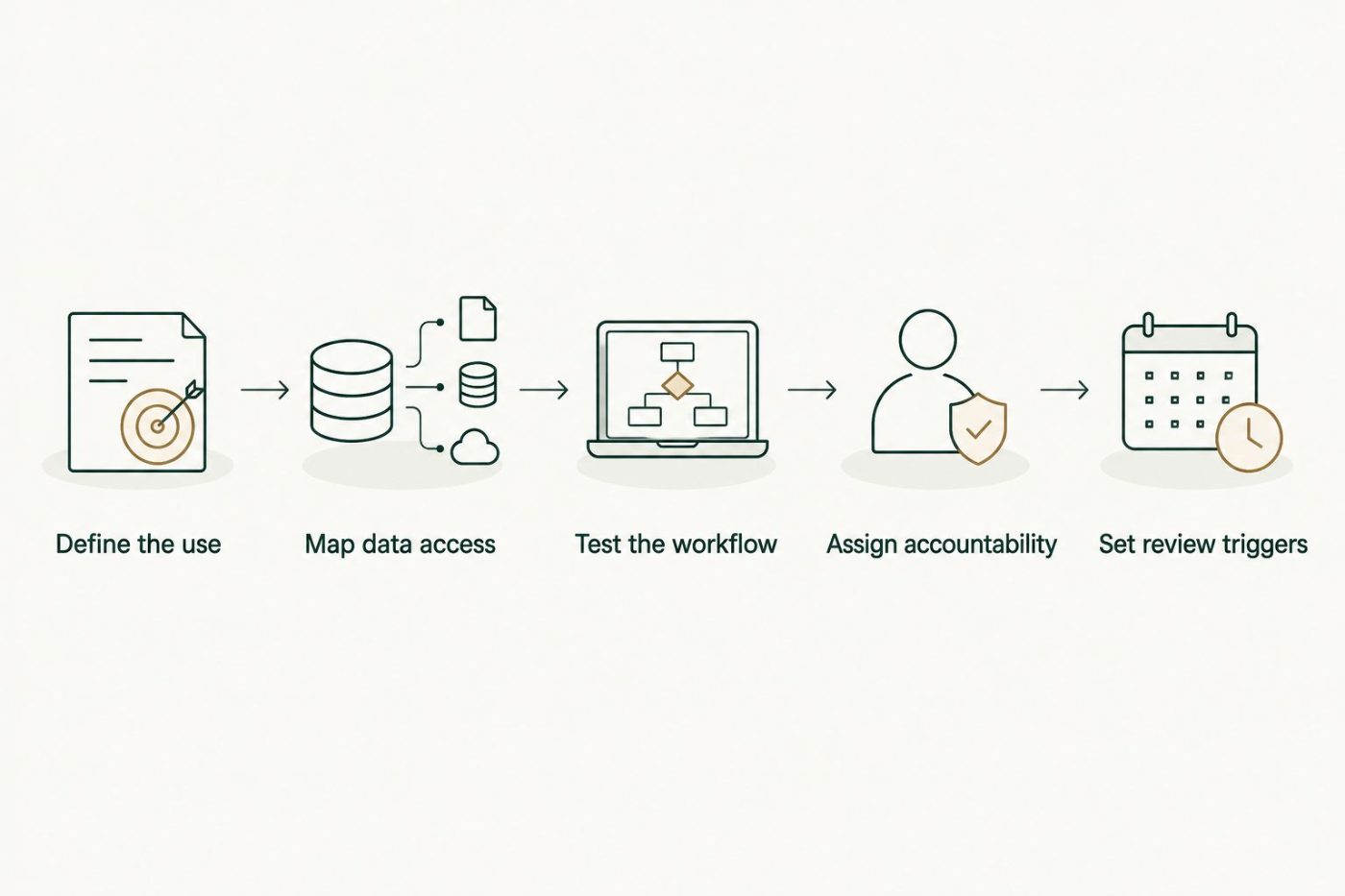
Approval follows evidence and assigned responsibility, not a vendor presentation.
Choose a decision with explicit conditions
Use the same decision vocabulary across your 2026 reviews so department leaders understand what approval permits. The following outcomes are decision options, not ratings of a vendor's overall quality.
| Decision | Best for | Benefit | Limitation | Required record |
|---|---|---|---|---|
| Approve | A defined use with satisfied requirements | Gives the operating team clear permission to proceed | Does not authorize new uses or expanded access | Approved scope, owner and review triggers |
| Approve with conditions | A bounded use where restrictions address unresolved issues | Allows a controlled next step without hiding exceptions | Fails if nobody enforces the restrictions | Conditions, responsible owners and evidence needed to remove restrictions |
| Do not approve | A use with unresolved requirements that prevent acceptable operation | Prevents deployment without the required controls | Leaves the business need unresolved | Reasons, missing evidence and criteria for reconsideration |
Conditional approval is a control only when someone enforces the conditions. If a restriction requires disabling a feature, limiting users or excluding confidential data, verify that the configuration supports it. A note in a procurement file does not change system behavior.
Do not treat rejection as the end of the business discussion. Ask whether a narrower use, reduced access or a different operating process resolves the issue. Reconsideration should follow new evidence, not pressure to finish purchasing.
Why vendor review depth varies
Review effort should follow the proposed exposure, not the enthusiasm of the sponsoring department. Use these factors to decide which evidence and approvals the workflow requires:
- Data sensitivity: Public material and confidential business records call for different handling decisions. Identify the information before evaluating the vendor's commitments.
- Decision consequences: Drafting an internal outline creates a different approval question from influencing employment, customer treatment or financial decisions. Involve the relevant business and legal owners.
- System permissions: A service that reads a document requires a different control review from one allowed to modify records or initiate transactions. Keep permissions tied to the approved task.
- Human oversight: Specify whether a person checks every output, reviews exceptions or monitors results after an action. Test whether that oversight is workable in the actual workflow.
- Operational dependency: Determine how the department continues if the service fails or access is suspended. Review recovery and exit arrangements before the workflow depends on the vendor.
- Evidence gaps: Unanswered questions should become explicit conditions or reasons to withhold approval. Do not convert missing evidence into a favorable assumption.
These factors help you avoid both extremes: a lengthy review for a narrowly bounded use and a superficial review for a consequential deployment. Document why the chosen review depth fits the proposed use.
What evidence should a vendor review retain?
Keep a decision record that connects evidence to requirements. Store the approved use, configuration, applicable terms, test results, exceptions, responsible owners and review triggers together or through clear references. Someone outside the original discussion should be able to reconstruct the approval.
Distinguish a vendor statement from a contractual commitment, an independent assurance document and your own workflow test. Each answers a different question. An assurance document does not establish that your chosen workflow produces acceptable outputs, and a successful demonstration does not establish acceptable data-handling terms.
For a 2026 review, date the evidence and identify the service or configuration it covers. Preserve the version used for the decision so later changes do not erase the basis of approval. Ask for clarification where documentation describes a different service tier or deployment arrangement.
Keep the record usable. Summarize the decision at the front, with supporting material attached or referenced, rather than forcing an executive to search through correspondence to find unresolved conditions.
Who should own AI vendor approval?
The business owner should own the proposed use; designated specialists should approve the requirements within their responsibilities. Procurement coordinates the commercial process, security assesses technical exposure, and legal reviews contractual and applicable legal questions. Executive escalation should address exceptions that exceed delegated authority.
The consultant's role should be explicit too. National AI Consultants provides an ongoing AI department model spanning strategy, engineering, management and team training. Define which review tasks sit with that external team and which approval rights remain with your company.
Outside support does not remove internal accountability. Require a clear handoff between assessment, implementation and operation, including who tracks conditions after launch. Reject an arrangement in which everyone advises but nobody owns the decision.
Should an assessment automatically lead to implementation?
An assessment should establish whether implementation is justified, not commit you to a build. The AI Opportunity Assessment is the first engagement with National AI Consultants; use it to clarify the operational opportunity, requirements and decision criteria before authorizing implementation.
Keep the decision open to a narrower project, a process correction or no build. A vendor review should serve the business need, not manufacture a reason to deploy software. If a proposed system adds oversight work without meeting its acceptance criteria, return to the operating problem.
When implementation is justified, carry the review conditions into configuration, employee training and ongoing management. Approval requirements lose their value when they remain in an assessment document instead of shaping delivery.
FAQ
What should AI governance consulting check before approving a vendor?
AI governance consulting should check the intended use, data access, workflow performance, contractual commitments, accountability and exit arrangements. Approval should identify the permitted scope and any conditions that must remain in place.
Is a security questionnaire enough for an AI vendor review?
A security questionnaire is not enough to approve a business use. Reviewers also need to assess the proposed workflow, output acceptance criteria, human oversight and who can suspend the service.
Can we approve a vendor while questions remain unanswered?
Conditional approval requires enforceable restrictions that address the unresolved questions. If the missing evidence prevents an acceptable operating decision, withhold approval until the requirement is satisfied.
How often should we review an AI vendor in 2026?
In 2026, set review timing according to the approved use and your policies, with explicit triggers for material changes and incidents. A scheduled review does not replace reassessment when permissions, terms or the business use change.
Who is responsible when an approved AI tool makes a mistake?
Your approval record should name the internal owner responsible for handling errors and escalating incidents. Review contractual responsibilities separately; purchasing a service does not define your internal response process.
Does an AI Opportunity Assessment mean we have to build something?
An AI Opportunity Assessment should not commit you to implementation. Use the assessment to decide whether the opportunity, controls and operating requirements justify proceeding.
What should we do when an employee wants to use an already approved vendor for something new?
Review the new use against the existing approval before allowing it. Reuse the relevant evidence, but reassess changes in data access, decision consequences, permissions and oversight.
One last thing
Approve the use, not the logo. The same vendor can be acceptable for a bounded drafting task and unsuitable for a proposed workflow with broader access or greater consequences. Your decision record should make that distinction clear without requiring anyone to remember the original meeting.
Before signing off on your next 2026 review, ask the business owner to explain what employees are allowed to do, what remains prohibited and who can stop the system. If those answers are unclear, the operating decision is not finished.