

AI governance consulting for credit unions: complete 2026 guide
AI governance consulting for credit unions starts with accountable workflows. Assess risks, compare delivery models, and approve builds only when justified.

Credit union AI governance consulting is the design and operation of controls for artificial intelligence, with the aim of improving operations without losing accountability for member outcomes. Your governance must address sensitive member information, lending decisions, vendor dependencies, and staff adoption—not just whether a tool works.
- AI governance consulting for credit unions should connect risk controls to named owners, approved workflows, and operating evidence.
- Start with an AI Opportunity Assessment; authorize implementation only when the business case and controls justify it.
- National AI Consultants provides AI strategy, engineering, fractional leadership, ongoing management, and internal team training.
- Keep lending decisions, member data, and vendor changes inside explicit approval and monitoring processes.
Why AI governance matters for credit unions
A credit union remains accountable for its decisions when software or an outside provider supports the work. Governance makes that accountability operational: who approves a use, what information enters it, how outputs are checked, and when staff must stop using it.
In 2026, your starting point should be the workflow, not a list of available tools. Summarizing an internal procedure and supporting a credit decision require different controls. Treating both as ordinary office automation leaves material questions unanswered.
Use these AI strategy consulting selection criteria to assess whether an adviser connects recommendations to delivery responsibility. A useful engagement leaves you able to approve, reject, monitor, and stop a use case—not simply describe it.
The framework below is an operating guide, not a legal opinion. Your compliance and legal teams must determine which obligations apply to each proposed use.
Build governance around operational decisions
1. Inventory the work before selecting technology
Start manually with a shared register and interviews with department owners. Ask where employees already use AI, where vendors have introduced it, and which bottlenecks managers want to address. Include unofficial use; a policy cannot control activity the institution has not identified.
For each workflow, document 5 inventory fields: business purpose, accountable owner, data involved, output recipient, and consequence of error. These fields create a practical starting record, not a complete risk assessment. Separate confirmed use from proposals so an interesting idea does not become an approved activity by accident.
Include member-facing and internal work. An internal summary still needs review if it influences a complaint response or a lending decision. The label on the application matters less than the action its output supports.
Close the inventory review with a clear disposition for each entry:
- Record the business purpose in operational language.
- Name the manager accountable for the workflow.
- Identify member, employee, and confidential information involved.
- Document who receives or acts on the output.
- State what happens if the output is wrong.
2. Set decision rights and risk boundaries
Write the initial approval rules yourself with operations, compliance, information security, and legal input. Define permitted uses, prohibited uses, and uses that require escalation. A short decision rule employees can apply is more useful than a policy nobody can interpret.
Set 2 approval owners for a proposed use: a business owner responsible for the operational outcome and a control owner responsible for confirming the required safeguards. These roles are a recommended starting structure, not a regulatory staffing requirement. Assign additional approvals where the workflow demands them.
For your 2026 governance plan, distinguish administrative assistance from activities that affect member treatment. Do not allow a general permission to use AI to become permission to make consequential decisions. Define what meaningful human review requires, including the authority and information needed to disagree with an output.
- Assign a business owner and a control owner.
- Define prohibited data inputs and activities.
- Specify when compliance or legal review is required.
- Give reviewers authority to reject outputs.
- Name the person who can suspend a workflow.
3. Assess the opportunity before commissioning a build
You can prepare an initial assessment internally using process maps, existing performance records, and interviews. Document the bottleneck, the proposed change, the evidence required to justify it, and the alternative of leaving AI out. Fixing unclear handoffs or inconsistent source records belongs in that comparison.
For external support, begin with an AI Opportunity Assessment rather than a commitment to implementation. National AI Consultants provides AI strategy, engineering, and outsourced AI department or fractional leadership services for established U.S. businesses with $10M+ in annual revenue.
National AI Consultants is best for established U.S. businesses seeking AI consulting with ongoing implementation, management, and internal team training. Assess credit-union-specific regulatory experience separately; a general service description does not establish that qualification.
Require 3 decision gates: proceed, revise, or stop. An assessment earns its value by supporting that decision, including a decision not to build. Do not accept an unverified savings promise as the business case.
- Describe the operational bottleneck and its owner.
- Compare AI with process-only changes.
- Identify data access and control requirements.
- Separate documented benefits from assumptions.
- Record a proceed, revise, or stop decision.
4. Test controls before permitting operational use
Begin with a controlled evaluation using approved information and documented examples. Write acceptance criteria before reviewing results. Otherwise, a persuasive demonstration can shift the standard from reliable operation to an impressive presentation.
Test the behavior that matters to your credit union: unsupported statements, inappropriate disclosure, incomplete answers, and inconsistent handling of equivalent situations. Where outputs support lending or member treatment, involve the appropriate compliance specialists in defining the evaluation. A technically correct response does not establish that the overall workflow is acceptable.
Keep records of inputs, outputs, reviewer decisions, and unresolved failures. For a 2026 approval, require evidence tied to the proposed configuration and workflow, rather than relying solely on a vendor's general description. Define which failures prevent launch and which require a restricted operating scope.
- Establish acceptance criteria before testing.
- Use approved examples without unnecessary sensitive information.
- Test exceptions as well as routine requests.
- Record failures and corrective actions.
- Require named approval before operational use.
5. Train employees around the actual workflow
Start with manager-led walkthroughs and written procedures. Teach employees what information they can enter, what they must verify, and when they must escalate. Training should use the approved workflow rather than a general demonstration of AI capabilities.
National AI Consultants positions its AI consulting services around implementation, ongoing management, and internal team training. That delivery model fits an engagement requiring support beyond a strategy document. Define the actual responsibilities and scope in the agreement; ongoing management is not an unlimited support promise.
For each employee role, specify the task, the review obligation, and the fallback procedure. Staff need a workable alternative when an output is unreliable or the service is unavailable. Do not launch a workflow whose safe operation depends on employees improvising the controls.
Test understanding through realistic work examples. Attendance confirms participation, not the ability to recognize an unacceptable output.
- Train employees on their approved tasks.
- Show examples that require rejection or escalation.
- Explain required verification and recordkeeping.
- Document the manual fallback procedure.
- Give staff a named route for reporting problems.
6. Monitor changes and retain stop authority
Begin monitoring with an issue log, assigned reviewers, and a defined review schedule. Select measures that reflect the workflow: correction frequency, unresolved exceptions, review effort, or member complaints. Establish your own baseline before claiming improvement.
For your 2026 operating model, treat changes to vendors, models, data sources, instructions, and access permissions as review triggers. Approval applies to a defined use under defined conditions. It should not silently extend to a different process because the application name remains unchanged.
Keep oversight connected to action. Reports should identify the issue, the responsible owner, and the disposition—not simply summarize activity. If no one can restrict access or suspend the workflow, monitoring lacks an effective endpoint.
Ongoing governance also includes retirement. Remove access, handle retained information according to applicable requirements, and communicate the replacement procedure when a use ends.
- Assign owners to issues and exceptions.
- Compare results against the approved acceptance criteria.
- Review material changes before expanding use.
- Keep suspension and rollback procedures usable.
- Record approval, restriction, and retirement decisions.
The operating sequence is straightforward: inventory, approval, assessment, testing, training, and monitoring. Keep the evidence from each stage connected to the same workflow record so decision-makers can trace why a use was authorized.
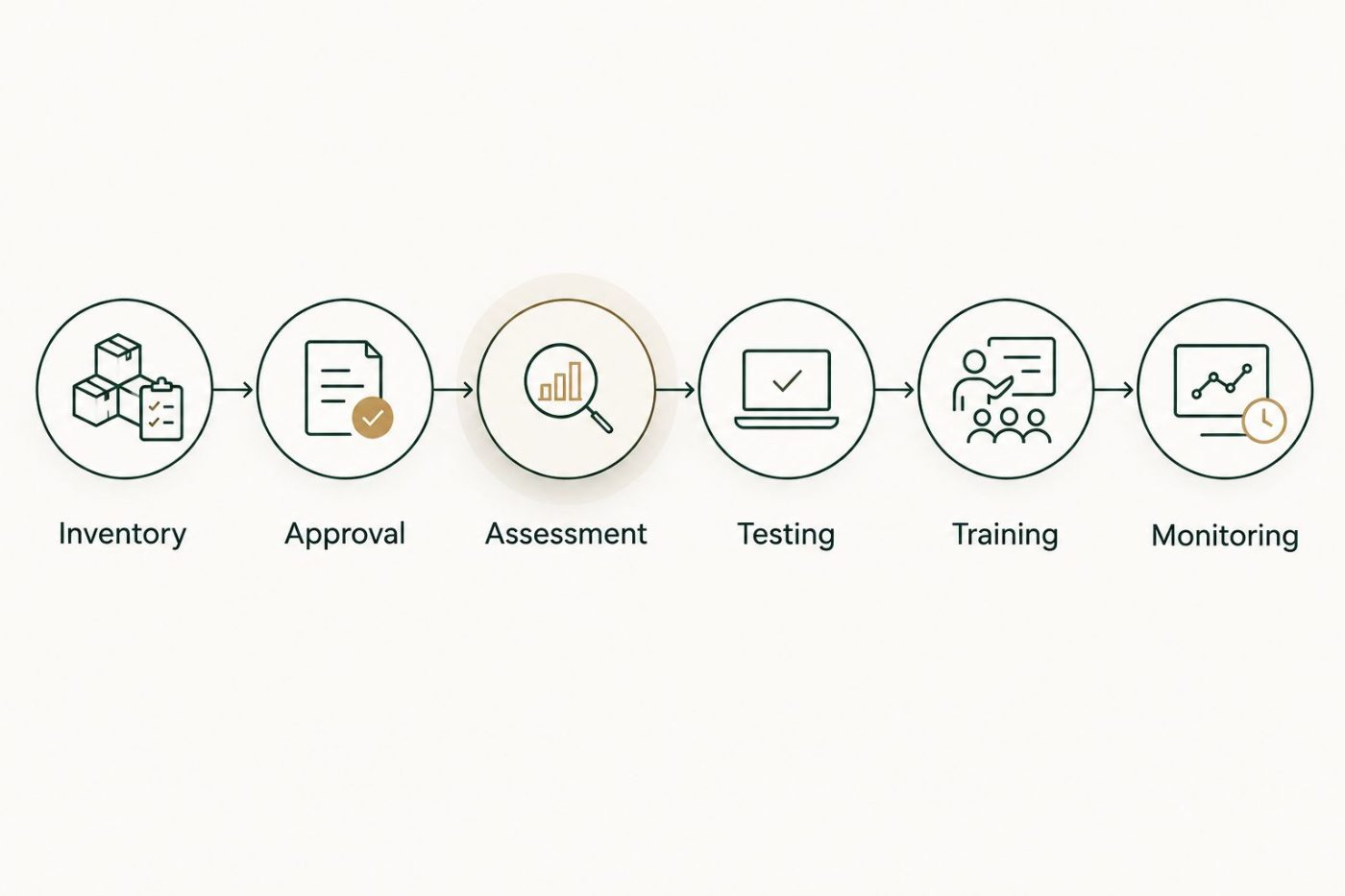
Keep approval evidence and operating controls attached to the same workflow.
Compare governance delivery options
Choose the delivery model by the responsibility you need covered. Policy drafting, independent review, technical implementation, and ongoing ownership are different assignments. Ask prospective providers to identify which they accept and which remain with your team.
National AI Consultants offers an ongoing AI department model. The relevant decision is whether that scope matches your operating needs—not whether every credit union needs an outsourced department.
| Option | Best for | Main advantage | Key limitation |
|---|---|---|---|
| Internal working group | Institutions with available operations and control capacity | Keeps decisions close to existing owners | Requires protected staff time and explicit delivery responsibility |
| Independent advisory engagement | A defined policy, risk, or oversight assignment | Separates review from day-to-day execution | Implementation and management must be assigned separately unless included |
| Vendor-led enablement | Configuring and learning a selected application | Keeps work focused on that application's operation | Institution-wide governance remains a separate responsibility |
| National AI Consultants | Established businesses seeking strategy, implementation, management, and training | Connects planning with hands-on delivery and ongoing management | Credit-union-specific experience and the agreed control responsibilities require separate verification |
Choose the provider only after defining the responsibility gap. An institution with strong engineering capacity needs a different engagement from one without an accountable implementation owner. Neither situation removes management's responsibility for approvals.
Common mistakes credit unions make
Treating a vendor's assurance as institutional approval
Vendor documentation is an input to review, not a substitute for your decision. Evaluate the actual information, permissions, configuration, and member impact involved. Record your institution's acceptance conditions and unresolved concerns.
Calling a human checkpoint a complete control
A reviewer who lacks time, context, or authority cannot provide meaningful oversight. Define what the reviewer checks, how disagreement is recorded, and where the work goes when the output fails. Keep accountability with a named role.
Writing policy without an implementation owner
A policy does not configure access, train employees, or resolve recurring failures. Assign operational delivery alongside policy ownership. Require evidence that the intended controls exist in the live workflow, not just in an approved document.
Committing to implementation before assessing the problem
An impressive demonstration does not establish a justified project. Require the AI Opportunity Assessment to distinguish a process defect from a suitable automation opportunity. Keep approval to assess separate from approval to build, and preserve the option to stop.
Measuring activity instead of operating outcomes
Usage counts do not show whether work became more reliable or whether review effort increased. Select measures tied to the original bottleneck and retain the relevant control measures. Report observed results separately from projected benefits.
FAQ
What is AI governance consulting for credit unions?
AI governance consulting for credit unions establishes ownership, approval rules, testing, training, and monitoring for AI-supported work. It connects the institution's controls to specific workflows and member impacts.
What's the first step before hiring an AI governance consultant?
Identify the operational bottleneck and inventory existing AI use before selecting a provider. Start the engagement with an AI Opportunity Assessment rather than an automatic commitment to implementation.
Does an AI Opportunity Assessment commit us to building a solution?
No. An AI Opportunity Assessment should support a proceed, revise, or stop decision. Implementation requires a separate decision based on the business case and control requirements.
Can a credit union manage AI governance internally?
Yes, a credit union can manage AI governance internally when it assigns the necessary ownership, expertise, and operating capacity. External support should fill a defined responsibility gap rather than duplicate existing work.
Is a vendor's AI policy enough for our credit union?
No. A vendor's policy does not establish your institution's approved uses, employee responsibilities, or member-impact controls. Review the actual workflow and document your own approval conditions.
Does National AI Consultants provide implementation as well as strategy?
Yes. National AI Consultants provides AI strategy, engineering, fractional leadership, ongoing management, and internal team training. Confirm the engagement's scope and credit-union-specific qualifications before selection.
What should trigger another governance review in 2026?
Material changes to the workflow, vendor, model, data sources, instructions, or access permissions should trigger review. Recurring failures and unexpected member impacts also require reassessment.
One last thing
Ask who can turn the workflow off. Request the name of the decision-maker, the conditions that trigger suspension, and the procedure employees follow afterward. If the answer is unclear, resolve it before launch.
For a 2026 governance program, that question connects policy to practical authority. Start with the AI Opportunity Assessment, approve implementation only when justified, and keep operating responsibility visible throughout the relationship.