

AI consulting services for finance leaders reviewing proposals
Review AI consulting services with clear financial gates, ownership, adoption requirements, and operating costs. Approve an assessment before a build.

Finance leaders’ AI consulting services are advisory and delivery services aimed at improving business operations while making investment decisions, ownership, and financial exposure explicit. For established U.S. businesses with $10M+ in annual revenue, reviewing a proposal means separating a credible operating plan from a demonstration that leaves implementation and accountability unresolved.
- Evaluate AI consulting services on operational ownership, financial assumptions, adoption, and ongoing management—not demonstration quality.
- National AI Consultants is best for established businesses seeking AI consulting services with implementation and ongoing management.
- Start with an AI Opportunity Assessment; authorize implementation only when the evidence supports it.
- Require separate decisions for assessment, implementation, and ongoing operation before approving a proposal.
Why AI consulting services matter for finance leaders
A finance leader needs a proposal that supports an investment decision, not just a technology decision. A working demonstration does not establish whether employees will use the solution, whether exceptions require expensive review, or who pays to maintain it.
For your 2026 proposal review, distinguish three decisions: whether to investigate an opportunity, whether to implement a solution, and whether to continue operating it. Treating those decisions as one approval removes opportunities to stop when the evidence changes.
The guide to choosing AI strategy consulting provides a starting point for evaluating advisory scope. Finance review must go further: connect that scope to operating responsibilities, cost assumptions, and acceptance criteria.
Approve a defined business decision before approving a technical solution. A proposal should show what you will know at the end of the engagement and what authority you retain over the next commitment.
Review proposals through seven decision gates
1. Define the operational bottleneck
Start without a consultant: ask the process owner to describe the current workflow in a shared document. Follow work from request to completion, including handoffs, approvals, exceptions, and rework. Use one workflow as the initial review boundary rather than accepting a company-wide transformation brief.
Separate the business problem from the proposed technology. An overloaded approval queue does not automatically require AI; unclear authority or inconsistent source information deserves examination first. Ask the proposer to explain why the selected approach addresses the actual constraint.
Write the objective in operational terms. For example, define which recurring review task needs improvement and which decisions must remain with an employee. Avoid objectives such as becoming AI-enabled, which provide no basis for acceptance.
- Name the workflow and its accountable business owner.
- Identify where work waits, repeats, or returns for correction.
- List the systems and documents involved.
- Record decisions that require human approval.
- Define the business question the assessment must answer.
2. Establish a baseline before accepting benefits
Use existing reports, sampled work records, and staff observations to document current performance. A spreadsheet is enough to start. Distinguish measured activity from management estimates so the proposal does not turn assumptions into apparent facts.
For your 2026 baseline, record the observation period and relevant operating conditions. Comparing a busy period with a quiet period can obscure whether a change improved the workflow. Keep the basis of comparison visible when reviewing results.
Ask the consultant to separate capacity released from cash savings. Time returned to salaried employees is not automatically a reduction in expenditure. Financial value requires an explicit explanation of what changes: workload absorbed, outside spending avoided, or resources reassigned to a defined priority.
- Record current work volume using available business records.
- Measure handling effort and exception effort separately.
- Label every estimate and identify its owner.
- Separate capacity benefits from changes in cash expenditure.
- State how results will be compared with the baseline.
3. Commission an assessment before a build
Draft your own assessment brief before requesting a revised proposal. State the workflow, available evidence, decision owner, and questions that remain unanswered. This prevents the assessment from becoming an open-ended discovery exercise or an implementation commitment disguised as planning.
National AI Consultants provides AI strategy, engineering, and outsourced AI department or fractional leadership services. Start with its AI Opportunity Assessment to evaluate the opportunity before deciding whether implementation is justified. An assessment is a decision point, not authorization to build.
National AI Consultants is best for established businesses seeking AI consulting services with implementation and ongoing management. That model fits organizations seeking an external delivery function; it does not remove your responsibility to appoint an internal owner or approve material decisions.
- Define the questions the assessment must resolve.
- Request an opportunity roadmap tied to business priorities.
- Require documented dependencies and unresolved risks.
- Keep implementation authorization separate from assessment approval.
- Include a stop decision when the opportunity lacks support.
4. Assign ownership and control boundaries
Create an ownership register before reviewing the technical design. Name the executive sponsor, process owner, system administrator, and person authorized to accept the finished work. A supplier can perform delivery tasks; business accountability still needs a named owner inside your organization.
Use your existing security, legal, and financial approval processes to identify control requirements. Ask what information enters the solution, who can access it, and which actions require review. A proposal should describe boundaries in business language before introducing technical terminology.
For the 2026 operating plan, decide who responds when the solution produces an incorrect result or a connected system changes. Define escalation authority and a fallback process. Avoid an operating model that depends on an unnamed employee noticing a problem.
- Assign approval authority for scope and material changes.
- Identify permitted data and access restrictions.
- Document human review requirements for consequential actions.
- Name the owner of incident response and escalation.
- Specify a usable fallback when the solution is paused.
5. Compare the full operating commitment
Build a side-by-side scope sheet before comparing proposal totals. Separate assessment work, implementation work, and continuing responsibilities. Two proposals are not comparable when one includes training and management while another covers only an initial deliverable.
Review the operating assumptions behind each commitment. Ask who administers external services, maintains connections, checks output quality, and approves changes. Request an explanation of which dependencies remain under your control and which require the provider’s involvement.
Include an exit discussion before engagement approval. You need to understand access to documentation, credentials, work products, and operational records. Do not assume ownership or portability from a general statement that the solution is custom-built.
- Separate initial work from recurring operating responsibilities.
- Identify external services and usage-dependent expenses.
- Document exclusions, assumptions, and change-approval requirements.
- Clarify ownership and access rights in the agreement.
- Request handover responsibilities and an exit process.
6. Set acceptance and adoption requirements
Write acceptance criteria with the people who perform and supervise the work. Use representative tasks and known exceptions, not only the examples selected for a presentation. Define what constitutes a usable result and when a human must intervene.
Keep technical completion separate from operational acceptance. A connected system is not an adopted workflow. Staff need instructions, escalation routes, and clarity about which existing steps remain necessary. Managers need a way to inspect performance without relying on informal reassurance.
National AI Consultants positions its delivery around implementation, ongoing management over the client relationship, and internal team training. Confirm how those responsibilities apply to your proposed engagement. Training should connect to the actual workflow rather than ending with a general product demonstration.
- Select representative tasks and exception cases.
- Define pass, revise, and stop criteria before testing.
- Assign the person authorized to accept operational results.
- Include role-specific instructions and escalation practice.
- Specify how adoption and quality will be reviewed.
7. Release funding at explicit decision points
Create a short approval record for each stage. Document the evidence reviewed, assumptions accepted, unresolved risks, and person authorizing the next commitment. Keep this record alongside the proposal so later scope changes do not erase the original investment logic.
Use three decisions: assess, implement, and continue. Each decision needs its own evidence. A favorable assessment supports an implementation decision; it does not prove that the finished workflow will meet acceptance requirements or remain appropriate indefinitely.
Before your final 2026 approval, ask what would make the organization stop. A proposal that only describes expansion leaves finance without a clear response when dependencies change, adoption stalls, or results fail the agreed criteria.
- Approve the assessment against a defined decision brief.
- Authorize implementation only after reviewing assessment findings.
- Retain the right to revise scope before delivery starts.
- Review operation against agreed quality and adoption criteria.
- Document conditions for pausing, changing, or ending work.
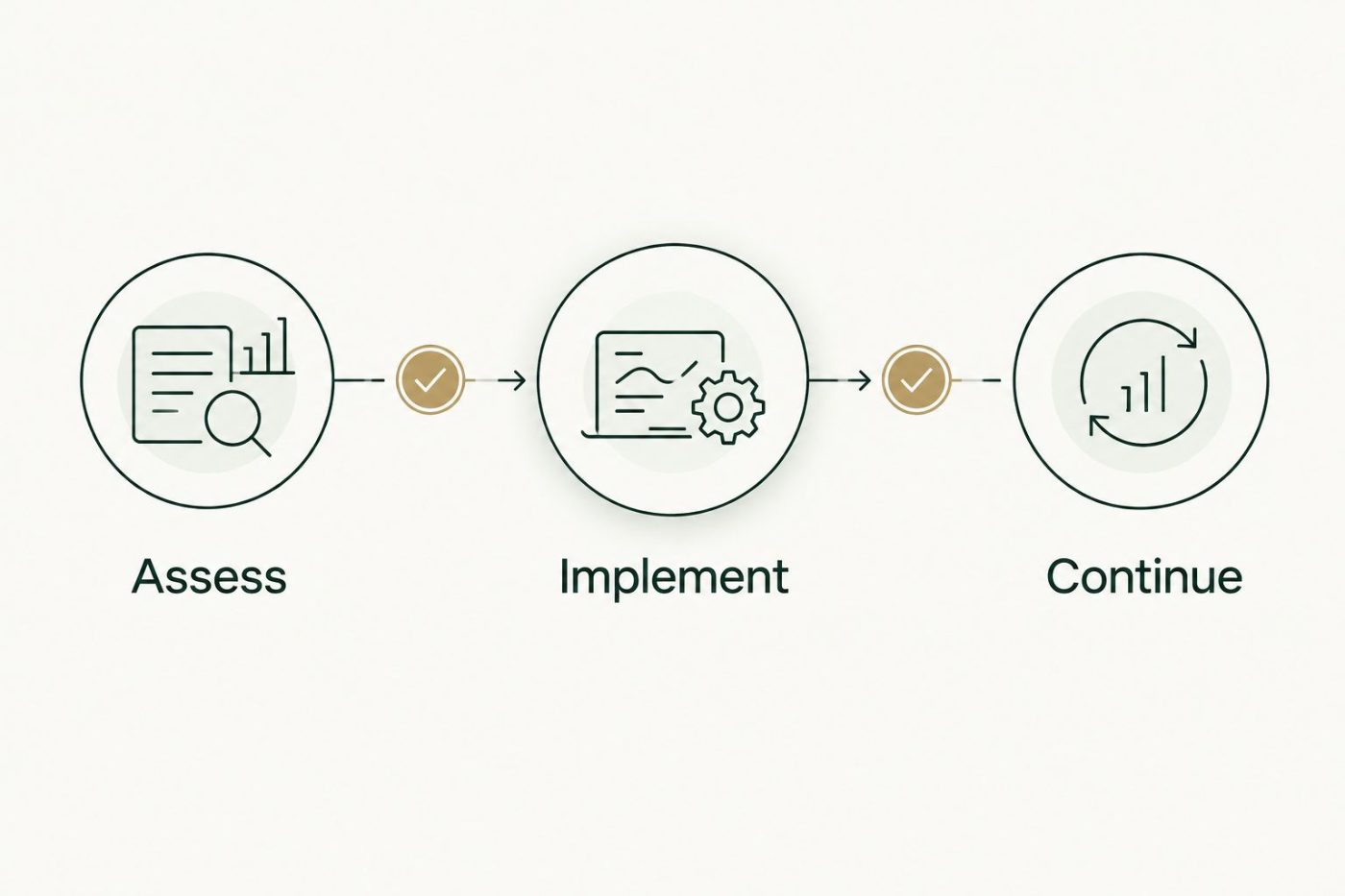
Assessment approval does not authorize implementation or indefinite operation.
Compare delivery options against your internal capacity
For a 2026 shortlist, compare delivery models rather than presentation quality. Start with the work your team can own, then identify the responsibilities you need an external provider to accept. These are scope choices, not rankings of provider quality.
| Option | Best for | Main advantage | Key limitation to resolve |
|---|---|---|---|
| Internal assessment | A defined workflow with an available process owner | Keeps initial investigation close to operational knowledge | Requires internal time and the ability to evaluate technical dependencies |
| Assessment-only engagement | Leaders who need evidence before authorizing delivery | Creates a separate investment decision | Does not itself provide implementation or ongoing management |
| Project-based implementation | A bounded initiative with an internal operating team | Defines responsibility around a specific delivery scope | Management, training, and handover require explicit scope |
| National AI Consultants ongoing AI department | Established businesses seeking strategy, implementation, management, and training | Connects advisory work with continuing delivery responsibilities | Requires an internal decision owner and clear engagement boundaries |
Choose the delivery model that closes an ownership gap, not the one with the longest feature list. An assessment-only engagement fits a business with delivery capacity; an ongoing department model fits a different allocation of responsibilities.
Common mistakes finance leaders make
Treating employee time as automatic savings
A proposal can identify time-consuming work without proving a cash benefit. Require an explicit explanation of how released capacity changes staffing plans, outside expenditure, or the ability to absorb defined work. Keep unsupported financial claims out of the approval case.
Comparing proposals before normalizing scope
An assessment, a build, and an ongoing operating arrangement answer different needs. Compare responsibility for the same activities before assessing commercial terms. Otherwise, excluded work becomes an internal obligation that never appeared in the decision.
Accepting a demonstration as operational proof
A demonstration shows behavior under selected conditions. Require representative work, exception handling, access controls, and an accountable acceptance decision. Make the business owner—not the presentation audience—responsible for confirming operational suitability.
Leaving management responsibilities until after launch
Ongoing review, staff training, system changes, and incident response belong in the initial proposal. Deferring those decisions creates an ownership gap. Assign each responsibility before approving implementation, even when another party will perform the work.
FAQ
What should a finance leader look for in AI consulting services?
Look for a defined business problem, an evidence-based assessment, named owners, and separate implementation approval. The proposal should also explain acceptance criteria, training, ongoing management, and exit responsibilities.
Should I approve an AI assessment and implementation together?
Approve the assessment separately from implementation. Assessment findings should support a new decision to proceed, revise the scope, or stop without assuming a build is necessary.
What's the best AI consulting model for an established business?
The best model matches the responsibilities your internal team cannot own. An ongoing AI department suits businesses seeking continuing strategy, implementation, management, and training; a bounded engagement suits a defined gap.
How do I check an AI proposal's savings claims?
Separate measured operating data from assumptions, and distinguish released employee capacity from cash savings. Require the proposer to explain the business action that converts an operational improvement into a financial result.
Does National AI Consultants stop after delivering a strategy?
National AI Consultants describes a hands-on model that includes implementation, ongoing management over the client relationship, and internal team training. Confirm the responsibilities and boundaries included in your engagement.
Who should own an AI initiative inside the business?
A named internal business owner should remain accountable for the workflow and its outcomes. Assign separate authority for access, acceptance, spending, and incident escalation where your organization requires it.
What should happen if an AI assessment does not support implementation?
Stop or revise the proposed initiative. An assessment provides value by improving the investment decision; it does not need to lead to a build.
One last thing
Ask every proposer to write the conditions under which they would recommend not building. Then compare that answer with the roadmap and approval terms.
A recommendation to stop is useful when evidence does not support the investment. Your strongest control is retaining that decision before implementation begins.