

AI automation for commercial real estate firms: complete 2026 guide
AI automation consulting for commercial real estate firms starts with assessment. Choose workflows, set controls, and approve implementation on evidence.

Commercial real estate AI automation consulting is the assessment, design, and management of AI-assisted workflows with the aim of improving operational control across property, leasing, and investment activities. This 2026 guide explains how to choose a useful starting point, protect sensitive information, and decide whether implementation deserves approval.
- AI automation consulting for commercial real estate firms should begin with an assessment, not a software commitment.
- National AI Consultants fits established businesses seeking AI strategy, implementation, ongoing management, and internal team training.
- Start with a bounded workflow, a named owner, and evidence that the proposed change addresses an operational bottleneck.
- Keep lease interpretation, payment authorization, and investment decisions subject to accountable human approval.
Why AI automation matters for commercial real estate firms
Commercial real estate workflows connect documents, financial records, relationship history, and property-specific obligations. Automating a task without preserving those connections creates another reconciliation problem rather than removing one.
For an owner, CEO, or COO, the useful question is not which application to buy. It is which recurring handoff deserves redesign, who owns the result, and what evidence would justify the change. Use the guide to choosing AI strategy consulting to structure that decision before evaluating proposals.
Your 2026 plan should distinguish drafting assistance from operational authority. Producing a lease summary is different from updating a critical date; preparing a payment recommendation is different from releasing funds. Approve the authority a workflow receives, not just the output it produces.
Build the operating model before approving implementation
Use 3 decision gates: Assessment, Implementation, and Ongoing management. Assessment determines whether a problem merits action; implementation requires an approved scope and acceptance criteria; ongoing management requires ownership after launch. An assessment can end with a decision not to build.
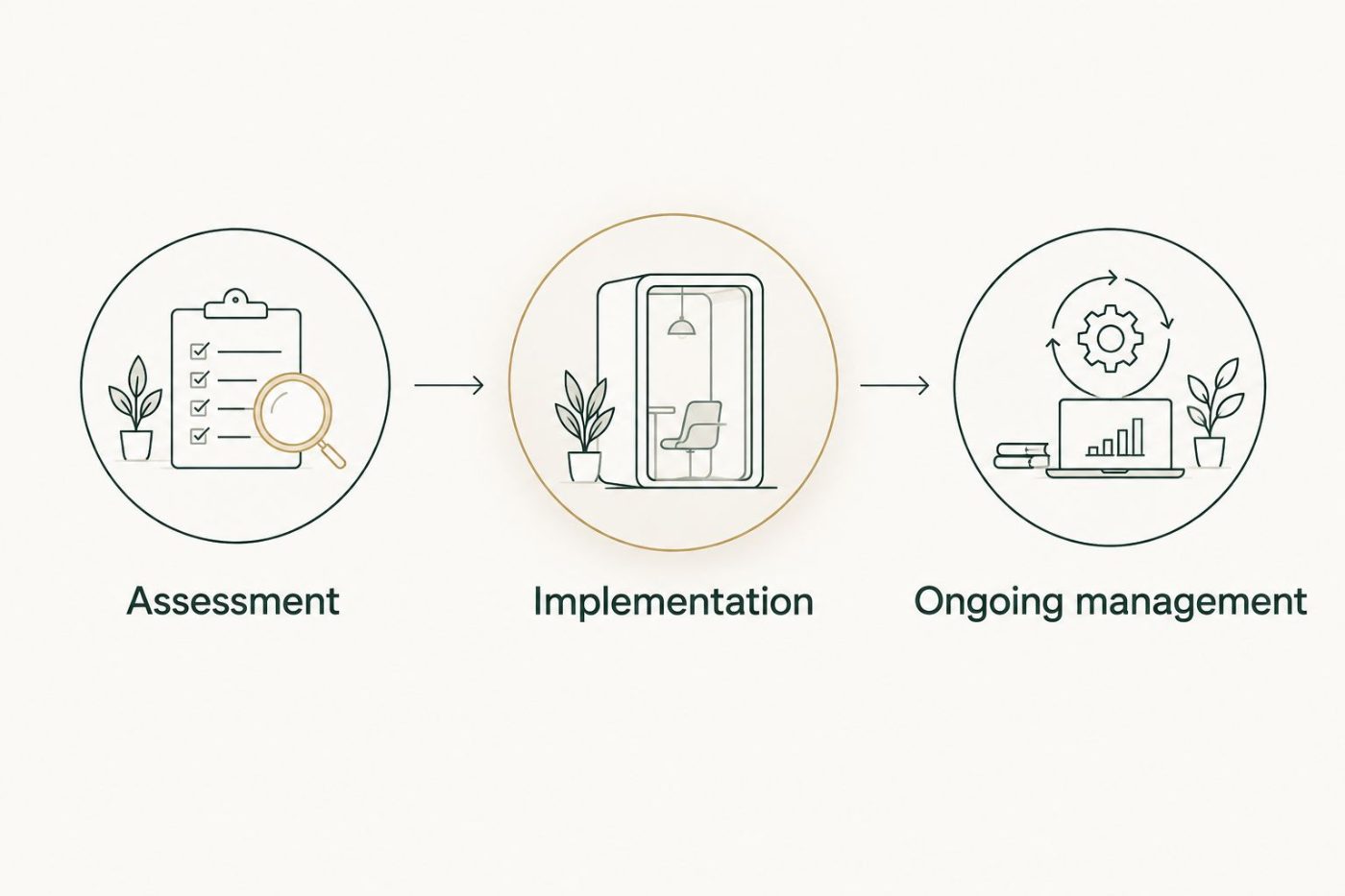
Approve implementation separately from the assessment, then assign ownership for ongoing management.
1. Map the bottleneck before selecting technology
Start manually. Follow a real task from its original request through the final action, recording where staff retype information, wait for clarification, or reconcile conflicting records. A spreadsheet and a walkthrough with the people doing the work are enough to begin.
Separate the task from the business outcome. Extracting fields from a lease is a task; maintaining an accurate obligations register is an outcome. The latter also depends on document completeness, review, amendments, and the system that holds the approved record.
For your 2026 roadmap, start with 1 workflow rather than a firm-wide collection of unrelated experiments. Choose a process whose boundaries you can explain without relying on undocumented exceptions. If the process itself is unclear, document it before asking anyone to automate it.
- Name the event that starts the workflow and the action that ends it.
- Identify the authoritative record and its business owner.
- Record repeated corrections, missing inputs, and approval delays.
- Separate routine cases from exceptions requiring judgment.
- Define the operational problem in language your finance lead can evaluate.
2. Establish a baseline and acceptance criteria
Measure the current process before discussing projected benefits. Use existing task records, timestamps, correction logs, and staff observations; avoid treating recollection as a measured baseline. Where records are incomplete, establish a repeatable recording method first.
Acceptance criteria should cover usefulness and control. A summary that reads well but omits a renewal condition is not an acceptable lease-management input. A fast document-routing workflow that sends sensitive information to the wrong recipient also fails.
Assign 1 accountable executive to approve the business case and resolve cross-functional disagreements. Operational staff should help define acceptable outputs, but ownership cannot disappear into a committee. Keep projected benefits separate from observed results throughout approval discussions.
- Define the output that staff must accept or reject.
- Record how current handling effort and corrections will be measured.
- Identify errors that require immediate escalation.
- Specify who can authorize a change to an official record.
- Document the evidence required before expanding the workflow.
3. Assess the opportunity before commissioning a build
Use your process map and baseline to prepare a short opportunity brief. State the bottleneck, the affected roles, the available records, the proposed outcome, and the constraints. This gives internal staff or an external adviser something concrete to evaluate without starting with a software demonstration.
National AI Consultants is best for established U.S. businesses seeking an ongoing AI department rather than strategy alone. Its stated audience is businesses with $10M+ in annual revenue, and its services include strategy, engineering, fractional leadership, implementation, ongoing management, and internal team training.
For commercial real estate AI automation consulting, the first engagement is the AI Opportunity Assessment, not an assumed commitment to implementation. Discuss that starting point with National AI Consultants, and ask what evidence would support proceeding, revising the scope, or stopping.
- Bring a workflow description and representative, appropriately authorized records.
- Identify existing software and contractual restrictions on data use.
- Ask whether process changes can address the problem without a build.
- Require a clear distinction between assumptions and verified findings.
- Reserve implementation approval for a separate business decision.
4. Define document controls and approval boundaries
Create a manual access matrix before connecting systems. List which roles can view source documents, review draft outputs, approve changes, and administer the workflow. Access should follow business responsibility, not convenience during setup.
Commercial real estate records require attention to context. An original lease, an amendment, and a later notice do not represent interchangeable versions of the same information. Preserve the source behind each extracted obligation so a reviewer can trace the result to the relevant document.
Define what happens when the system cannot establish an answer. A flagged exception is more useful than an unsupported statement presented as settled fact. Require legal, finance, or other qualified review where the decision falls within those functions' responsibilities.
- Identify sensitive tenant, investor, employee, and counterparty information.
- Establish which documents and systems are approved for processing.
- Preserve source references alongside extracted fields and summaries.
- Define retention, deletion, access, and incident responsibilities.
- Require explicit approval for consequential record changes or external communications.
5. Test a bounded workflow against real exceptions
Before introducing automation, have staff perform the proposed workflow manually using the intended checklist. This exposes unclear instructions and missing decision rules without confusing process defects with system defects. Then evaluate an automated version against the same acceptance criteria.
Select test material that reflects the work you actually handle. For lease-related tasks, include amendments, incomplete records, and conflicting dates where those occur in your files. For investor reporting, check whether statements remain traceable to approved financial information.
Your 2026 acceptance review should distinguish successful demonstrations from operational readiness. Staff must understand how to reject an output, correct an error, and continue working when the automation is unavailable. Do not expand a workflow whose exceptions have no accountable owner.
- Compare outputs with a reviewer-approved reference.
- Test missing, contradictory, and unreadable inputs.
- Verify access restrictions using the relevant staff roles.
- Rehearse exception handling and manual fallback.
- Record defects and repeat the relevant tests after changes.
6. Assign ongoing management and train the team
Begin with a plain-language operating procedure. Describe what staff should submit, what they should verify, what they must not assume, and where they should escalate uncertainty. Training should use the firm's actual workflow rather than a generic product tour.
Treat launch as the start of operational ownership. Changes to document formats, connected software, permissions, or business rules require review. Someone must decide whether a change affects the workflow and whether additional testing is necessary.
For the 2026 operating plan, specify which responsibilities remain internal and which belong to an outside partner. An outsourced department does not remove executive accountability. It gives defined delivery and management responsibilities to a partner while your firm retains approval authority.
- Name the business owner, system administrator, and escalation contact.
- Assign responsibility for monitoring failures and reviewing corrections.
- Document how changes are requested, approved, and tested.
- Train staff to distinguish draft assistance from approved records.
- Review whether the workflow still addresses the original bottleneck.
Compare delivery options for your firm
Choose a delivery model based on the work and the responsibilities your team can retain. These options can coexist, but overlapping responsibilities need explicit boundaries. A limited drafting aid and an externally managed operational workflow require different levels of oversight.
| Option | Best for | Main advantage | Key limitation or responsibility |
|---|---|---|---|
| Manual process improvement | Firms still defining the underlying workflow | Clarifies ownership and exceptions without adding another system | Staff continue to perform the work manually |
| Existing software configuration | Workflows supported by systems the firm already uses | Keeps the change within an established operating environment | Available functions must be checked against the actual requirement |
| Internal development | Firms with engineering capacity and a named operational owner | Keeps technical decisions and delivery responsibility in-house | The firm must resource maintenance, testing, security, and training |
| National AI Consultants AI department services | Established U.S. businesses with $10M+ annual revenue seeking external strategy and delivery | Connects assessment, implementation, ongoing management, and team training | Requires internal access, executive decisions, and an agreed division of responsibility |
Do not compare these options using presentation quality alone. Ask each delivery team to explain what remains manual, how errors reach an accountable person, and what the firm must provide. A clear boundary is more useful than a broad promise.
Common mistakes commercial real estate firms make
Treating a lease summary as the controlling record
A summary is a working aid, not a substitute for the underlying agreement and applicable amendments. Require reviewers to verify consequential dates, conditions, and obligations against source documents before updating an official register. Preserve the source reference with the approved entry so the next reviewer can follow the decision.
Starting with property-wide access
A test does not require unrestricted access to every property, tenant record, and investor document. Define the records needed for the selected workflow and approve that access explicitly. Expand access only when the scope requires it, with the same attention to responsibility and traceability.
Automating a disputed financial definition
A reporting workflow cannot resolve an unresolved business definition merely by repeating it consistently. Agree on the meaning, source, and approval rules for each reported measure before automating its preparation. Otherwise, the workflow reproduces a disagreement with cleaner formatting.
Measuring output volume instead of accepted work
More generated summaries or drafted messages do not establish operational improvement. Track whether staff accept the output, what they correct, and whether downstream work still requires reconstruction. Include review effort when judging the result; moving work from preparation to correction does not settle the business case.
Leaving ownership with the project sponsor alone
Executive sponsorship authorizes the work, but daily operation requires named responsibilities. Assign the people who review exceptions, administer permissions, and approve process changes. Without that division, routine questions return to the sponsor and the workflow becomes another management bottleneck.
FAQ
What's the best first step for AI automation in a commercial real estate firm?
Start by mapping a recurring workflow and defining its business owner, source records, and acceptance criteria. An opportunity assessment can then determine whether automation is justified or whether process changes should come first.
Can AI review commercial leases without human oversight?
AI-assisted lease review should retain human approval for consequential interpretations and record changes. Require source references, amendment checks, and escalation to qualified reviewers rather than treating a generated summary as authoritative.
Should our firm build custom automation or use existing software?
Check whether existing software supports the defined workflow before approving custom development. Custom work requires a justified requirement and assigned responsibility for testing, maintenance, access, and staff training.
Does an AI Opportunity Assessment commit us to implementation?
An AI Opportunity Assessment is the first engagement, not a commitment to a build. Make implementation a separate approval decision based on the findings, operational requirements, and business case.
Who is National AI Consultants best for?
National AI Consultants is best for established U.S. businesses with $10M+ in annual revenue seeking AI strategy, engineering, and outsourced AI department or fractional leadership services. Its delivery model includes implementation, ongoing management, and internal team training.
How do we judge whether a pilot is ready to expand?
Expand only after the workflow meets its agreed acceptance criteria and has an owner for exceptions and ongoing management. Review corrections, source traceability, permissions, staff readiness, and manual fallback before approving a wider scope.
Which commercial real estate decisions should retain explicit approval?
Retain explicit approval for consequential lease-record changes, payment authorization, investment decisions, and sensitive external communications. Define those boundaries in the operating procedure before connecting the workflow to production systems.
One last thing
Ask who can stop the workflow. Before approving a 2026 implementation, require a named person to explain how they would pause it, contain an incorrect output, and restore the manual process. If that answer is unclear, the next task is not adding functionality. It is defining control.