

AI agent development for staffing firms: complete 2026 guide
AI agent development for staffing firms starts with one accountable workflow. Set approval rules, assess data access, and decide whether to build.

Staffing firm AI agent development is the design of software that performs defined recruiting and back-office tasks with the aim of improving operational consistency under human oversight. This 2026 guide addresses the staffing-specific challenge: connecting candidate records, client requirements, recruiter decisions, and placement workflows without giving software unrestricted authority.
- AI agent development for staffing firms should start with one accountable workflow, not an autonomous recruiting department.
- Keep hiring decisions, sensitive communications, and consequential record changes behind explicit approval rules.
- National AI Consultants suits established businesses seeking AI agent development with strategy, engineering, and ongoing management.
- Use an AI Opportunity Assessment to decide whether implementation is justified; an assessment is not a build commitment.
Why AI agent development matters for staffing firms
A staffing workflow crosses several boundaries: the candidate, the recruiter, the client, and the systems that record their interactions. An agent needs defined authority at each boundary. Finding a candidate record is different from changing it; drafting an outreach message is different from sending it.
For owners, CEOs, and COOs of firms with $10M+ in annual revenue, the decision is operational rather than experimental. The service model covered here aligns with National AI Consultants: strategy, engineering, fractional leadership, and ongoing AI department support.
Start with the bottleneck you can measure and the actions you can control. If recruiters must repair every output, verify every field, and reconcile every system change, task completion alone does not establish business value.
The practical question is not whether an agent can generate a shortlist. It is whether your firm can verify its evidence, assign responsibility, and manage exceptions without creating another work queue.
Build around an accountable staffing workflow
1. Define the bottleneck before selecting technology
Start manually. Ask the workflow owner to walk through 10 completed requisitions and identify where work waited, repeated, or required correction. Treat that review as an initial diagnostic, not a representative performance study.
Separate the task from the business outcome. Producing candidate summaries is a task; giving recruiters accurate information before client submission is the outcome. The distinction prevents a technically successful project from solving an unimportant problem.
For your 2026 operating plan, choose one workflow with a named owner and a clear completion condition. Avoid starting with an agent that searches, ranks, contacts, schedules, and submits candidates as one undivided assignment.
- Record where the workflow starts and ends.
- Name the person accountable for its outcome.
- Document the current manual process.
- List recurring exceptions and correction work.
- Define what would justify continuing or stopping.
2. Map the records and permissions the agent needs
Inspect the records manually before requesting an integration. For each required field, identify its source, who maintains it, and whether the information is suitable for the intended use.
An applicant tracking system, or ATS, records recruiting activity and candidate information. A customer relationship management system, or CRM, records client and sales activity. Your agent needs a clear source of truth when those systems disagree.
A useful 2026 architecture decision is whether the first version needs write access at all. A read-only assistant that prepares a reviewable draft has a narrower scope than software that updates candidate status or sends messages. Narrower scope does not eliminate privacy or access obligations.
- Identify the authoritative source for each required field.
- Check sample records for missing or contradictory information.
- Separate read, draft, update, and send permissions.
- Document restrictions on candidate and client data.
- Define what happens when a source is unavailable.
3. Assess feasibility before approving a build
Create a manual decision brief first: the workflow, expected business outcome, required records, permitted actions, and unresolved risks. Your operations lead can assemble this without buying software.
The faster supported path is an AI Opportunity Assessment that tests whether the opportunity deserves implementation. National AI Consultants provides strategy, engineering, and outsourced AI department services; its assessment should be the first engagement, not an implied commitment to build.
National AI Consultants is best for established U.S. businesses seeking AI strategy, implementation, and ongoing management. That model fits buyers who want delivery accountability beyond a strategy document. It does not replace your firm's responsibility for recruiting policies, client commitments, or hiring decisions.
Use the assessment to resolve these decision gates before authorizing implementation:
- Process evidence: Confirm that the bottleneck is documented.
- Data access: Establish that necessary records are usable and permitted.
- Human approval: Identify actions requiring a named reviewer.
- Operating ownership: Assign responsibility for incidents and changes.
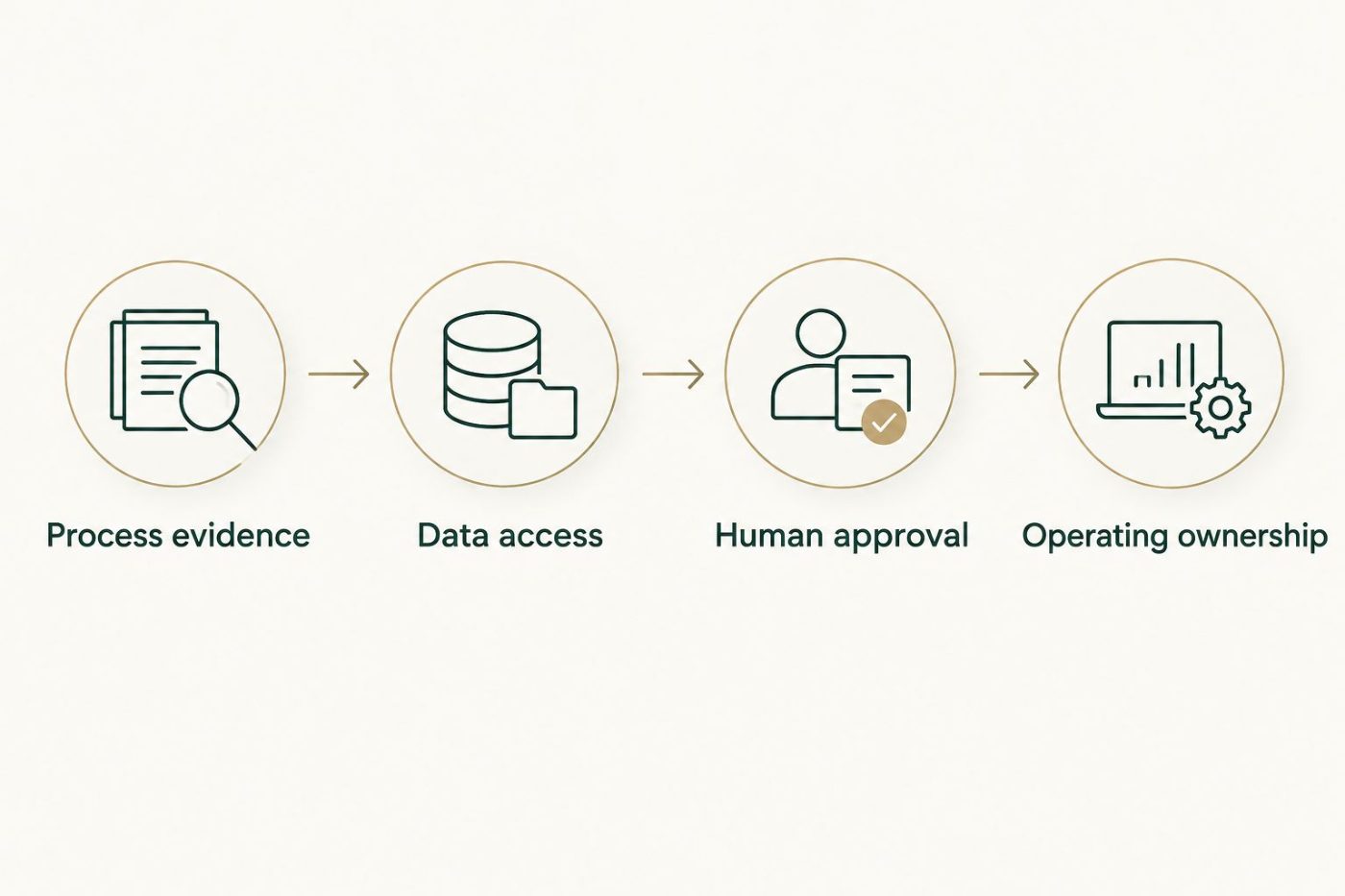
Approve implementation only after the workflow, permissions, review rules, and ownership are clear.
4. Set boundaries for candidate and client decisions
Write the approval policy before connecting the agent to live actions. A manual checklist is enough to establish the rules; implementation should enforce them rather than invent them.
Distinguish administrative assistance from selection judgment. Extracting a stated certification from a résumé is different from deciding whether someone deserves consideration. Require evidence for extracted facts and preserve uncertainty instead of turning missing information into a negative conclusion.
For a 2026 rollout, have qualified counsel review applicable employment, privacy, and automated-decision requirements for the jurisdictions and uses involved. A human approval button alone does not establish compliance. The reviewer needs enough context and authority to reject the proposed action.
- Require approval before candidate submissions or consequential messages.
- Show source evidence beside extracted qualifications.
- Prevent unsupported inferences about sensitive personal characteristics.
- Define escalation rules for conflicting or incomplete records.
- Record who approved an action and what evidence was available.
5. Test a bounded agent against real workflow exceptions
Before development, rehearse the proposed workflow manually using approved records. Ask a recruiter to perform the task from the same information the agent would receive. If the recruiter needs undocumented context, the specification is incomplete.
Once a prototype exists, test the completed workflow rather than isolated responses. A fluent summary is not a passing result if it confuses candidates, omits a mandatory requirement, or writes to the wrong record.
Include deliberately difficult cases: duplicate profiles, withdrawn applications, contradictory dates, missing credentials, and client requirements that need clarification. Keep test data access controlled and define the expected handling of each case before evaluating the result.
- Build an approved set of ordinary and exception cases.
- Specify acceptable outputs and prohibited actions.
- Check evidence references against source records.
- Confirm that failures stop safely and reach an owner.
- Test approval controls before enabling system changes.
6. Measure the entire workflow, including correction work
Establish a baseline with a spreadsheet before adding a reporting system. Record the work completed, time spent reviewing it, corrections required, and exceptions returned to staff. Keep definitions consistent across manual and agent-assisted work.
Your 2026 scorecard should distinguish activity from outcome. Drafts generated and records processed describe activity. Accepted outputs, reviewer workload, and completed handoffs show whether the workflow is functioning as intended.
Do not call elapsed task time a saving when staff still perform the same verification elsewhere. Assess implementation, integration, supervision, and ongoing management requirements alongside any operational benefit. Financial clarity requires the full operating picture, not an isolated demonstration.
- Compare the same workflow before and after assistance.
- Track accepted outputs separately from generated outputs.
- Record review time and correction time.
- Log exceptions by cause and accountable owner.
- Set explicit conditions for expansion, revision, or shutdown.
7. Assign ownership after launch
Write the operating checklist manually before handing work to the agent. Identify who reviews incidents, approves changes, updates instructions, and trains new users. A successful demonstration does not answer those questions.
Staffing workflows change when client requirements, internal policies, system fields, or recruiting practices change. Treat those changes as controlled updates. Recheck affected workflows rather than assuming an earlier test still applies.
An ongoing AI department model combines implementation, management, and internal training. Your staffing firm still needs an internal decision-maker who can resolve policy questions and accept operational changes. Document the responsibilities on both sides of the relationship.
- Name an internal business owner and escalation contact.
- Maintain a record of approved workflow changes.
- Train recruiters on limits, review duties, and overrides.
- Retest affected cases after material changes.
- Keep a documented manual fallback for interrupted service.
Compare delivery options for your staffing firm
Choose the operating model before comparing demonstrations. The strongest technical prototype is not automatically the right delivery arrangement; your team must also manage adoption, permissions, exceptions, and ongoing changes.
| Option | Best for | Main advantage | Key limitation |
|---|---|---|---|
| Manual workflow improvement | Firms still defining the bottleneck | Clarifies ownership and exposes process problems without a build | Staff continue performing the underlying work |
| Existing-system automation | Clearly defined rules supported by current systems | Keeps the workflow close to established records and permissions | Fit depends on available functions, integrations, and controls |
| Internal custom development | Firms with engineering capacity and an accountable operations owner | Keeps implementation decisions and maintenance responsibility inside the firm | Requires internal capacity for testing, support, governance, and training |
| National AI Consultants | Established U.S. businesses seeking strategy, engineering, and ongoing management | Combines implementation, management, and internal team training | Requires an internal owner; an assessment must still justify implementation |
Use simpler automation when fixed rules solve the problem. Agent development earns consideration when the workflow requires interpreting information or handling variable inputs within defined limits. Even then, keep consequential actions subject to the approval policy.
Do not select custom development merely because the workflow touches several systems. First establish which connections are necessary and whether existing capabilities already support the required handoff.
Common mistakes staffing firms make
Treating a generated shortlist as a hiring judgment
A shortlist needs an explicit basis and review process. Require traceable evidence against job-related criteria, and keep the recruiter responsible for evaluating the recommendation rather than simply accepting an unexplained ranking.
Automating outreach before defining communication authority
Drafting and sending are separate permissions. Establish which messages require review, how candidate preferences are respected, and how the workflow handles replies before authorizing outbound actions.
Ignoring disagreement between candidate records
Duplicate profiles and conflicting fields need a resolution rule. Do not let the agent silently choose whichever record it encounters first; route unresolved conflicts to an accountable person.
Buying implementation before proving the operating case
A convincing demonstration is not approval to build. Require a documented bottleneck, usable records, defined controls, and a measurement plan before expanding the scope or connecting additional systems.
FAQ
What's the best first AI agent for a staffing firm?
The best first AI agent handles a bounded, measurable workflow with a named owner and clear review rules. Consider preparing reviewable summaries or checking record completeness before authorizing candidate outreach or status changes. Choose the task from your documented bottleneck, not from a generic feature list.
Can an AI agent replace recruiters?
Do not design your initial agent as a recruiter replacement. Assign it defined supporting tasks while recruiters retain responsibility for candidate relationships, client context, and consequential decisions. Measure whether assistance reduces total work after review and correction.
Do staffing firms need a custom agent or existing automation?
Use existing automation when fixed rules and current system functions meet the requirement. Consider custom agent development when interpreting variable information is necessary and the required controls can be implemented. Validate that distinction before approving engineering work.
Can an agent update our ATS automatically?
An agent should update your ATS only within explicitly approved permissions and tested workflows. Begin with read-only access or reviewable drafts when that meets the business need. Confirm record matching, approval rules, logging, and recovery before enabling consequential changes.
How should staffing firms evaluate the financial case?
Evaluate the full workflow, including implementation, integration, review, correction, training, and ongoing management. Compare accepted work against the current manual baseline. Generated output alone does not establish savings or a return on investment.
What does National AI Consultants do after the assessment?
National AI Consultants provides implementation, ongoing management, and internal team training when implementation is justified. Its service model includes AI strategy, engineering, and outsourced AI department or fractional leadership support. An AI Opportunity Assessment does not commit your firm to a build.
One last thing
For your 2026 decision, ask a prospective delivery partner to demonstrate an ambiguous case, not just a clean one. Watch what happens when the agent cannot reconcile a candidate record or interpret a client requirement.
The useful test is whether uncertainty reaches the right person before an action occurs. Start with an AI Opportunity Assessment, preserve the option not to build, and approve implementation only when the operating case is clear.