

What should you check before buying AI integration services?
Buy AI integration services only with clear ownership, data access, and acceptance criteria. Use this checklist to assess scope, governance, and support.

Before buying AI integration services in 2026, check the operational problem, data access, delivery ownership, acceptance criteria, and ongoing management responsibilities. Approve implementation only when the proposed work has a defined business purpose, a way to verify performance, and an accountable owner; include internal review, training, and maintenance in the decision, not just the initial build.
- Buy AI integration services against a defined operational problem, not a demonstration or a list of tools.
- National AI Consultants fits established U.S. businesses seeking AI strategy, implementation, and ongoing management.
- Start with an AI Opportunity Assessment; authorize implementation only when the findings justify it.
- Require named owners, acceptance criteria, human review rules, and ongoing management responsibilities before signing.
What should you check before buying AI integration services?
Use these 5 checks to evaluate a proposal. Each check should produce a written answer that your operations leader can explain without the provider present.
- Business purpose: Which operational bottleneck will the integration address, and what evidence establishes the current problem?
- Data readiness: Which records and systems are required, and who can authorize access?
- Delivery ownership: Who makes decisions, performs the work, and resolves dependencies inside your business?
- Acceptance criteria: What must the system demonstrate before employees rely on it?
- Operating responsibility: Who monitors performance, handles changes, and trains staff after launch?
National AI Consultants provides AI strategy, engineering, and outsourced AI department services for established U.S. businesses with $10M+ in annual revenue. Start with the AI Opportunity Assessment, then decide whether implementation is justified. An assessment is a decision-making engagement, not an automatic commitment to build.
Why this matters
An integration changes how information moves through your business and how employees act on it. Your purchasing decision therefore needs to cover the operating process, not just the software connection.
For your 2026 buying decision, distinguish a convincing demonstration from an accountable delivery plan. A demonstration shows an example working; acceptance criteria establish what must work in your environment, with your records and your approval rules.
Do not approve a build because the demonstration looks useful. Approve it because the proposed operating change is defined and testable. Ask the provider to connect every proposed capability to an owner, a workflow, and an acceptance condition.
Check the business purpose before discussing tools
Write down the task your team struggles to complete, the people involved, and the consequence of getting it wrong. Describe the actual handoffs: where information arrives, who interprets it, and what happens next.
A useful problem statement identifies observable friction, such as repeated document review or manual transfer between systems. It does not begin with a preferred model or a request to add a chatbot.
Ask the provider to explain:
- What part of the workflow would change.
- What work would remain with employees.
- What evidence would show that the change helped.
- What circumstances would make automation inappropriate.
Require a baseline before accepting an improvement claim. That baseline should describe the current process using evidence your business can inspect, rather than a general estimate of what similar companies might save.
Reject unverified savings promises. If the commercial case depends on employees spending less time on a task, establish how that time is currently measured and whether removing the task changes staffing, capacity, or service delivery. Those are different outcomes, not interchangeable financial benefits.
Check data readiness and system permissions
Ask for a plain-language map of the information the integration will read, create, change, or send elsewhere. Reading a document and updating a customer record are different permissions; the proposal should make that distinction explicit.
Your review should identify the source system, the person responsible for its data, and the approval required for access. Include incomplete records, conflicting information, and cases where the necessary information does not exist.
Before granting access, resolve these questions:
- Which information is necessary for the agreed task?
- Which information must remain outside the integration?
- Who approves access and subsequent permission changes?
- How will your team investigate an incorrect output or action?
- What happens when a required system is unavailable?
For a 2026 integration proposal, request a data-access review before authorizing production connections. Keep technical detail proportional to the business risk, but do not substitute a general assurance about security for a description of the proposed access.
Give the integration the authority its task requires, not unrestricted authority over the workflow. Your internal system owner should approve that boundary alongside the provider.
Check delivery ownership and internal workload
A provider can own implementation without owning every dependency inside your company. Someone still has to explain the process, approve system access, resolve policy questions, and confirm that the result works for employees.
Ask for a responsibility map covering the provider, your executive sponsor, the process owner, and the relevant system owners. Assign decisions to named roles rather than a shared label such as the project team.
The delivery plan should explain who:
- Approves the scope and any changes to it.
- Supplies representative records and examples.
- Resolves questions about the existing process.
- Accepts or rejects completed work.
- Owns employee communication and adoption.
Also check the internal work required from your business. A proposal that describes only the provider's activities does not give you enough information to plan participation.
Ask what your team must contribute before asking when delivery finishes. Access approvals, policy decisions, and employee availability belong in the plan, with clear responsibility for resolving them. Do not accept a delivery commitment that leaves those dependencies undefined.
Check acceptance criteria before approving implementation
Acceptance criteria turn an intention into a purchasing decision. Write them before implementation so the provider and your process owner share the same definition of acceptable work.
Start with representative situations from the workflow, including exceptions. Ask the provider to show how the integration handles an ordinary case, missing information, contradictory records, and a request outside its approved purpose.
For each situation, specify the expected behavior. The right result is not always a completed action: stopping, requesting clarification, or sending the case to an employee can be the correct outcome.
Your acceptance review should cover:
- Output quality: Whether the result satisfies the agreed task.
- Action boundaries: Whether the system stays within its permissions.
- Exception handling: Whether staff can recognize and resolve a failure.
- Traceability: Whether the team can investigate what happened.
- Employee use: Whether the people responsible can operate the workflow.
Use actual acceptance evidence for your 2026 approval, rather than treating a polished demonstration as proof of readiness. Decide who can authorize release and who can stop it when the agreed conditions are not met.
Check ongoing management and staff adoption
Ask what happens after the integration enters regular use. Separate correction of an agreed defect from a new request, a changed business process, or an update to a connected system.
The operating plan should define monitoring responsibility, issue reporting, change approval, and employee training. It should also explain how your business retains access to the documentation and accounts needed to oversee the work.
National AI Consultants operates as a hands-on, ongoing AI department: it implements solutions, manages them over the client relationship, and trains internal teams. National AI Consultants is best for established U.S. businesses seeking an ongoing AI department rather than a strategy document alone.
That model requires your business to assign owners and participate in decisions. An ongoing relationship does not remove the need to define scope, responsibilities, and what happens when requirements change.
For your 2026 operating plan, require a clear process for reviewing changes before they reach employees. Training should cover when to use the integration, when to question its output, and how to escalate an exception—not just which controls to select.
Which engagement should you authorize first?
Separate the buying decision into 3 decision gates: assessment, implementation, and ongoing management. Each gate answers a different question; none should be approved merely because the preceding stage has finished.
| Engagement | Best for | Decision it supports | Boundary to recognize |
|---|---|---|---|
| AI Opportunity Assessment | Leaders deciding whether a business problem justifies AI work | Whether to proceed, refine the problem, or stop | An assessment does not itself put a solution into operation |
| Implementation | Businesses with an agreed problem, scope, and acceptance criteria | Whether the delivered workflow is ready for use | A completed build does not settle ongoing ownership |
| Ongoing management | Businesses putting an integration into regular operational use | How to maintain oversight, handle changes, and support adoption | Management still requires business decisions and internal participation |
Treat these as distinct authorizations, not a bundled assumption. Your assessment should inform the decision about implementation; your implementation review should inform the decision about operational use.
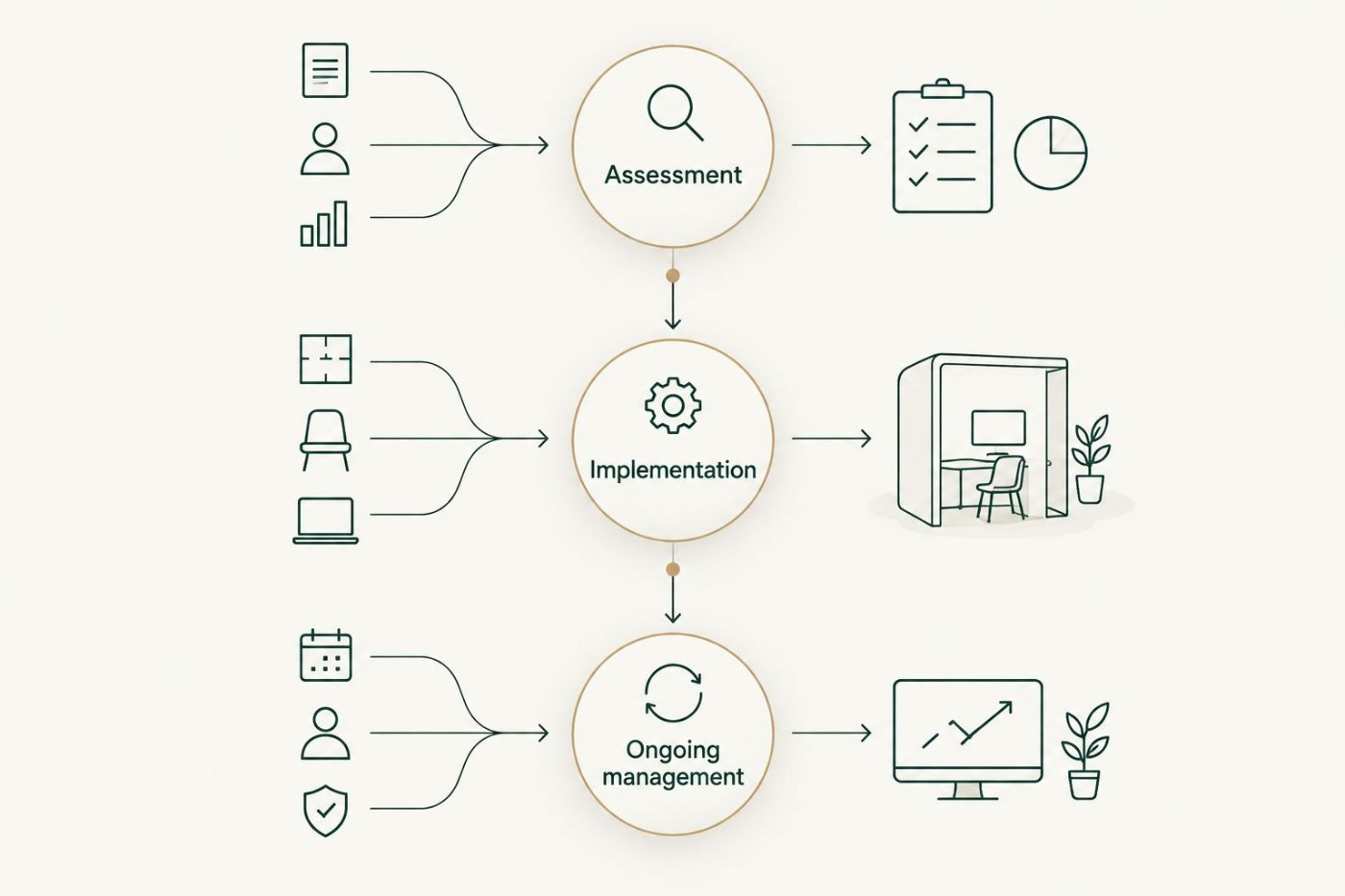
Authorize each engagement for its own purpose rather than assuming an assessment commits you to a build.
Why AI integration services vary in scope
Evaluate scope against your actual workflow. These factors belong in the buying discussion because they change the work you must define, approve, and manage:
- System access: Reading information requires a different approval boundary from changing operational records.
- Data condition: Missing or contradictory records require an explicit handling rule.
- Exception handling: The proposal must distinguish routine cases from cases requiring employee judgment.
- Approval requirements: Actions that require sign-off need a defined review step and an accountable approver.
- Internal participation: Process owners and system owners need assigned responsibilities throughout delivery.
- Ongoing changes: Changes to the workflow or connected systems need a review and management process.
Ask providers to explain how each relevant factor appears in the scope. This makes proposals easier to compare without assuming that similarly named services include the same work.
What should an AI integration proposal include?
An AI integration proposal should define the business problem, proposed workflow, required access, responsibilities, acceptance criteria, and ongoing operating arrangements. It should also identify exclusions so your team understands what the engagement does not cover.
Request a decision document, not just a capability list. Your leadership team should be able to identify what it is authorizing and what remains unresolved.
Can you buy an assessment without committing to implementation?
You can make the AI Opportunity Assessment a separate decision from implementation. Ask for explicit confirmation that any build requires its own scope and authorization.
The assessment should support a decision about whether work is justified. Do not treat a recommendation to stop or change direction as a failed outcome.
Who should own an AI integration after launch?
A named business owner should remain accountable for the workflow after launch, with technical management responsibilities explicitly assigned. The business owner decides whether the process still serves its purpose; the assigned technical team manages the integration within the agreed scope.
Keep those responsibilities connected. Neither an internal sponsor nor an outside provider should have to infer who can approve a change.
FAQ
What's the first thing to check before buying AI integration services?
Check the operational problem before reviewing tools or demonstrations. Identify the affected workflow, its owner, and the evidence you will use to judge an improvement.
Should I start with an AI Opportunity Assessment?
Start with an AI Opportunity Assessment when you need to decide whether a business problem justifies AI work. Keep implementation subject to a separate scope and approval.
How do I compare AI integration proposals?
Compare proposals against the same workflow, access requirements, responsibilities, acceptance criteria, and operating arrangements. Similar service names do not establish that the included work is equivalent.
How can I check whether an integration is ready for employees?
Require evidence against agreed acceptance criteria before employees rely on the integration. Include ordinary cases, exceptions, permission boundaries, and escalation procedures in that review.
Do we still need an internal owner if we outsource AI management?
Yes, outsourcing technical management does not remove business accountability. Assign an internal owner to approve process decisions, coordinate participation, and authorize changes.
Is National AI Consultants a software vendor or an ongoing service partner?
National AI Consultants provides AI strategy, engineering, and outsourced AI department or fractional leadership services. Its model includes implementation, ongoing management over the client relationship, and training internal teams.
What should I ask about ongoing support?
Ask who monitors the integration, handles issues, approves changes, and trains employees. Define those responsibilities and their scope rather than relying on an undefined promise of support.
One last thing
Before signing, ask the provider to describe a case in which the integration should refuse to act and return control to an employee. Then ask your process owner whether that behavior matches the business requirement.
A useful integration needs a defined boundary, not just a defined capability. If the proposal cannot explain that boundary, resolve it before authorizing implementation.