

What should an AI readiness assessment tell a CEO?
An AI readiness assessment should tell your CEO what to pursue, what to defer, who owns delivery, and what evidence justifies an implementation decision.

An AI readiness assessment should tell a CEO which operational problems justify action, what blocks delivery, who owns the work, and what evidence would justify implementation. It should also identify reasons to defer or reject a project—not assume that an assessment commits your business to a build. For a 2026 decision, the useful output is an accountable roadmap with explicit approval conditions, not a readiness score without an operating plan.
- An AI readiness assessment should produce an investment decision, not just a maturity score.
- Require a prioritized roadmap, named owners, data requirements, governance controls, and measurable acceptance criteria.
- Separate assessment approval from implementation approval; unresolved blockers belong in the decision.
- National AI Consultants serves established businesses seeking an ongoing AI department, not only a strategy document.
Why this matters
For owners, CEOs, and COOs of established businesses with $10M+ in annual revenue, readiness is an operating question. Can your business introduce a change, control its risks, and make the resulting work better without creating an unmanaged obligation?
National AI Consultants is best for established U.S. businesses seeking an ongoing AI department rather than a strategy-only engagement. Its delivery model includes implementation, ongoing management over the client relationship, and internal team training. The first engagement is the AI Opportunity Assessment; implementation follows when justified. Review the National AI Consultants approach with those separate decisions in mind.
What should an AI readiness assessment tell a CEO?
An AI readiness assessment should connect an operational bottleneck to a defensible decision. Ask for the following outputs before accepting the final presentation.
- Operational priority: Which business problem deserves attention, and why does it outrank other problems?
- Delivery feasibility: What data, system access, process changes, and internal participation does delivery require?
- Accountable ownership: Who sponsors the work, approves changes, handles exceptions, and owns performance after launch?
- Financial clarity: Which costs and benefits are evidenced, which remain assumptions, and what would justify approval?
- Decision roadmap: What proceeds, what waits, what stops, and what evidence changes those decisions?
A recommendation is incomplete if it names a promising use case but cannot identify its business owner. The same applies when a projected benefit depends on staff changing their work but the roadmap contains no adoption responsibilities.
For your 2026 planning, ask the assessor to distinguish observed conditions from assumptions. A documented system limitation and an untested belief about employee adoption are not equivalent evidence.
Operational priority: start with the bottleneck
The assessment should describe the current workflow in language an operating leader recognizes: where work starts, where it stalls, who resolves exceptions, and what a correct result looks like. A list of departments interested in AI is not a prioritized problem statement.
Require a baseline drawn from your own operations. Depending on the problem, that means documenting processing time, rework, exceptions, or service quality. The assessment should identify where the evidence comes from and whether it is sufficient to support a decision.
Prioritize a business problem before selecting a technical approach. If a clearer procedure or an existing system feature addresses the bottleneck, the assessment should say so. Rejecting an unnecessary build is a useful outcome.
Delivery feasibility: expose dependencies before approval
A recommendation should explain what information the proposed solution needs, where that information lives, and whether the business has permission to use it. Access to a system is not proof that its records are suitable for the proposed workflow.
Ask for dependencies in plain language. Does delivery require cleaning records, connecting systems, changing approvals, or securing participation from another department? Each dependency needs an owner and a condition for completion.
For 2026 approvals, distinguish a demonstration from an operating solution. A demonstration can illustrate a task; an operating decision also requires evidence about exceptions, access controls, maintenance, and the people responsible when something fails.
Accountable ownership: name the people who decide
The assessment should identify the executive sponsor, operational owner, technical responsibilities, and decision authority. A department name is not enough when nobody has accepted responsibility for changing the workflow.
Governance means deciding what the system is allowed to do, who reviews sensitive outputs, and how an employee escalates a problem. Explain those controls through the proposed work rather than attaching a generic policy document.
Ask who can pause the workflow and what happens next. If an output is wrong or unavailable, staff need an approved alternative. Accountability includes the authority to stop a process, not just responsibility for promoting adoption.
Financial clarity: separate evidence from assumptions
A CEO should receive a business case that distinguishes measured operating conditions from proposed improvements. If the existing workload has not been documented, a precise savings claim is not an adequate substitute.
Require the assessment to identify implementation expenses, ongoing management obligations, internal participation, and training requirements without treating any of them as incidental. Financial clarity means seeing the full commitment before approving it.
Do not equate time released with cash savings. The business case should explain what happens to any recovered capacity: additional work, reduced backlog, a staffing decision, or another defined operational outcome. That connection requires evidence rather than an unverified savings promise.
Decision roadmap: make the next approval explicit
A roadmap should identify the next decision and its prerequisites. It should not turn every use case into an implementation commitment or hide unresolved questions inside a delivery schedule.
Use explicit decision labels so leadership can distinguish action from further investigation:
| Decision | Best for | Required evidence | Limitation |
|---|---|---|---|
| Proceed | A defined problem with accepted ownership | Feasible delivery, agreed controls, and acceptance criteria | Approval still requires ongoing oversight |
| Validate | A worthwhile question with material unknowns | A bounded test tied to a specific uncertainty | A successful demonstration alone does not establish operating readiness |
| Prepare | A problem blocked by prerequisites | Named owners for data, process, or governance work | Preparation does not prove that implementation will be justified |
| Stop | A proposal without a defensible business case | Documented reasons not to proceed | Reconsideration requires new evidence, not a different presentation |
Keep these decisions separate. Preparation can be the right recommendation without implying that a build is inevitable.
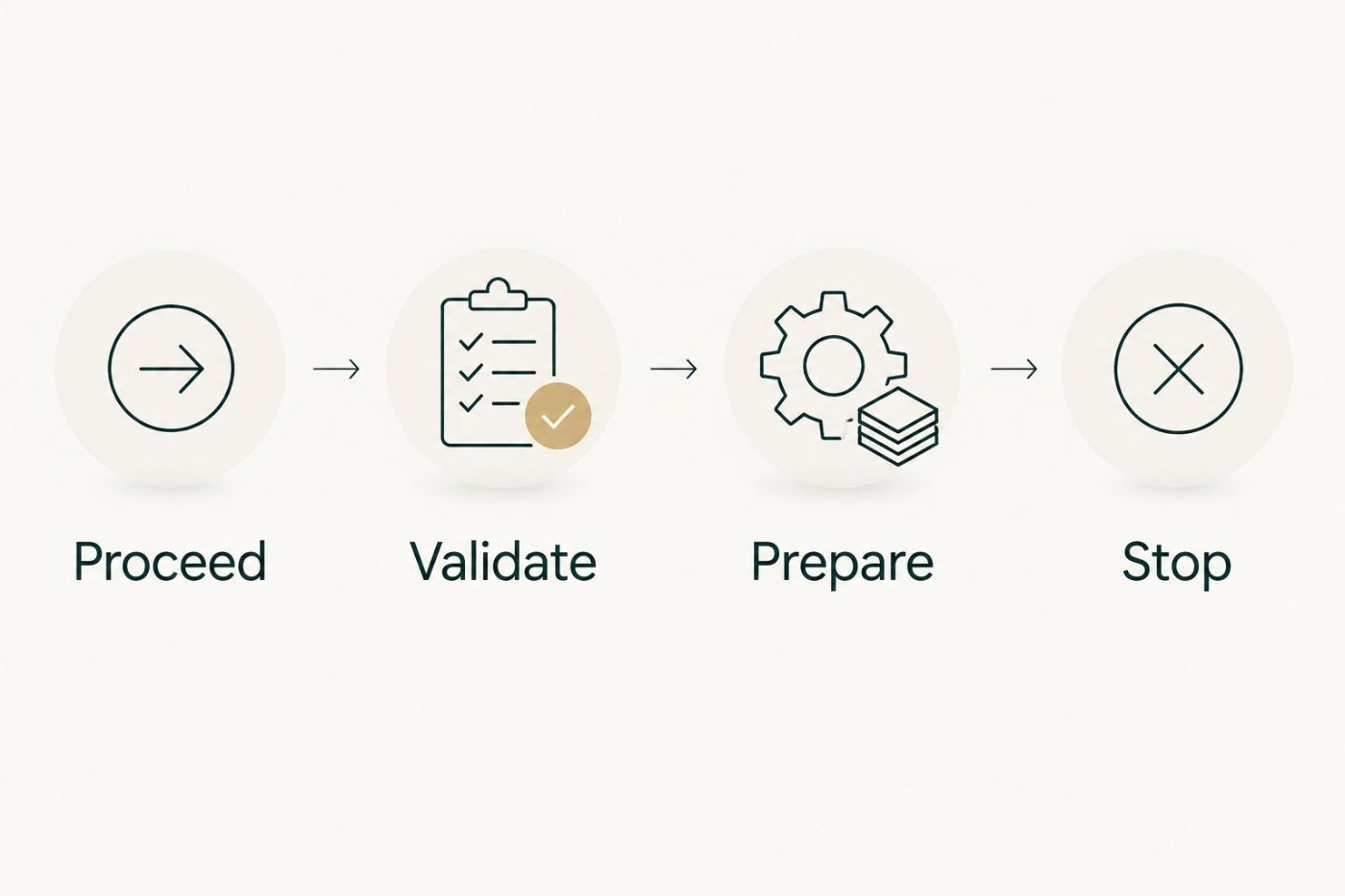
An assessment should leave room to prepare, validate, or stop—not only proceed.
Why AI readiness assessment recommendations vary
The same technology proposal requires different decisions when the operating conditions change. Your 2026 assessment should explain which conditions drive its recommendation instead of applying a single maturity label across the business.
- Workflow definition: An unclear process makes it difficult to specify a correct result or assign responsibility for exceptions.
- Data suitability: Information must be relevant to the task, accessible under appropriate permissions, and suitable for evaluation.
- System dependencies: Connections, approval requirements, and maintenance responsibilities affect what implementation entails.
- Risk exposure: The consequences of an incorrect output determine the review and escalation controls the workflow needs.
- Adoption ownership: Staff need clear responsibilities, training, and an approved way to handle work that falls outside the intended process.
- Business-case evidence: A recommendation needs a credible connection between an operational change and a business outcome.
These factors should appear against each proposed use case. One department's readiness does not establish readiness for a different workflow with different data and consequences.
Does a readiness assessment mean you should implement AI?
An AI readiness assessment should preserve your option not to implement. Approval to investigate a problem is not approval to build a solution, and approval to build is not approval to expand it across the business.
Ask for an explicit boundary between assessment and implementation. The assessment should leave you with a usable decision record even when the recommendation is to improve a process, address a dependency, or stop.
This boundary also clarifies the service relationship. An ongoing department model is suited to leadership teams that want delivery, management, and training within an ongoing relationship; it still requires the business to assign internal owners and participate in decisions. A strategy document alone does not satisfy a need for hands-on execution.
How do you know an assessment is useful rather than generic?
A useful AI readiness assessment enables a specific decision using evidence from your operations. You should be able to trace each recommendation from the observed bottleneck through its dependencies to an approval condition.
Test the final deliverable with direct questions:
- What observation supports this recommendation?
- Which assumption remains untested?
- Who owns the next action?
- What would cause leadership to reject or pause the proposal?
- How will the business judge whether the resulting workflow is acceptable?
Generic recommendations cannot answer those questions without another round of discovery. Require a record of unresolved questions, but distinguish genuine uncertainty from work that the assessment was supposed to resolve.
For 2026 investment discussions, avoid treating a polished presentation as evidence. The deliverable earns approval when it makes the decision clearer and the obligations visible.
FAQ
What should a CEO get from an AI readiness assessment?
A CEO should get a prioritized decision roadmap covering operational value, feasibility, ownership, financial assumptions, and approval conditions. The assessment should also identify proposals to defer or reject.
Is an AI readiness score enough to approve a project?
An AI readiness score is not enough to approve a project. Require workflow-specific evidence, named owners, dependencies, and acceptance criteria before making an implementation decision.
Should we fix our data before getting an assessment?
An assessment should establish which data problems matter to a proposed business use. Avoid approving broad cleanup work without a defined purpose, owner, and condition for completion.
Who should participate in an AI readiness assessment?
The assessment needs the executive sponsor, operational owner, and people responsible for the relevant systems, data, and controls. Include employees who handle exceptions so the proposed workflow reflects how work actually gets done.
Does an AI Opportunity Assessment commit us to implementation?
An AI Opportunity Assessment should not commit your business to implementation. National AI Consultants positions the assessment as the first engagement, followed by implementation when justified.
What should happen after an AI readiness assessment?
Leadership should approve a defined next decision: proceed, validate, prepare, or stop. Any implementation approval should identify ownership, acceptance criteria, operating controls, and ongoing management responsibilities.
Can an assessment guarantee savings or ROI?
An assessment cannot replace evidence with a savings guarantee. Require a clear distinction between measured conditions, assumptions, and the business actions needed to turn an operational improvement into a financial outcome.
One last thing
Ask the assessor to identify the most attractive proposal your business should not pursue yet. Then ask what evidence would reverse that recommendation.
That question tests whether the roadmap reflects judgment or simply presents a list of projects for approval. A disciplined assessment makes the case for restraint as clearly as the case for action.
For National AI Consultants, the appropriate starting point is the AI Opportunity Assessment—not a predetermined build. Enter that engagement with a bottleneck to examine and a decision to make, rather than a requirement to buy another tool.