

What should an AI managed services agreement cover?
AI managed services agreements must define scope, accountability, data controls, and exit rights. Use this checklist to review terms before you sign.

An AI managed services agreement should define the workflows covered, who owns each decision, how performance is measured, and what happens when the service fails or ends. For a 2026 agreement, separate ongoing management from implementation work, specify human oversight and data controls, and make changes, third-party dependencies, and exit obligations explicit before you sign.
- AI managed services agreements need clear scope, operating accountability, governance, performance measures, and an executable exit plan.
- National AI Consultants fits established U.S. businesses seeking AI strategy, implementation, and an ongoing outsourced AI department.
- Keep the AI Opportunity Assessment separate from authorization to build; approve implementation only when the business case supports it.
- Define response, recovery, and escalation separately; a support acknowledgment does not mean the workflow is restored.
What should an AI managed services agreement cover?
Your agreement should connect contractual obligations to the way your business operates. Every supported workflow needs a named owner, an agreed operating boundary, and a documented response when something breaks.
For established businesses evaluating National AI Consultants, that means distinguishing strategy, engineering, fractional leadership, and ongoing management rather than treating them as interchangeable services.
Use the following numbered framework to review a proposed agreement. These are negotiation criteria, not a statement that every provider includes them.
1. Service scope
Name the business workflows, systems, integrations, and operating activities covered by the agreement. Replace broad language such as managing AI with descriptions of what the provider actually maintains and what your employees remain responsible for.
List exclusions alongside inclusions. A supported workflow does not automatically mean every connected application, historical data problem, or future department request falls within scope.
Require a service schedule that an operations leader can read without translating technical terminology. If the agreement references a separate scope document, identify which version governs and how changes receive approval.
2. Decision rights
Assign a business owner on your side and an accountable service lead on the provider's side. Identify who can approve changes, accept work, authorize access, and pause an automated process.
Separate advice from authority. A provider recommending an operating change is not the same as your business authorizing that change or accepting its consequences.
Require 1 named business owner per supported workflow as an operating rule. Several employees can contribute, but final business approval should not disappear into a shared inbox.
3. Service measures
Define what acceptable performance means for each workflow. Relevant measures can include output accuracy against an agreed evaluation set, successful task completion, exception handling, and service availability within the agreed boundary.
Specify the measurement source, calculation method, review cadence, and exclusions. A percentage without a denominator or measurement window creates disagreement rather than accountability.
Do not accept unverified savings promises as performance commitments. Establish the baseline and measurement method before tying business outcomes to contractual remedies.
4. Incident handling
Distinguish acknowledgment, investigation, workaround, and restoration. A fast acknowledgment is useful, but it does not establish when an interrupted business process will work again.
Define incident severity using business impact: interrupted operations, inappropriate access, incorrect external communications, or failed handoffs. Assign escalation contacts and clarify who communicates with affected employees or customers.
Agree on the fallback process before launch. Your team should know when to stop automation, who authorizes manual handling, and what evidence the provider must preserve for investigation.
5. Data controls
Document what information the service accesses, why access is necessary, and who approves it. Address permissions, retention, deletion, logging, and the handling of confidential or personal information.
Require disclosure of relevant subcontractors and third-party services. State whether your information can be used for model training or other purposes outside delivering the contracted service, and specify the authorization required.
Make these obligations apply to the actual operating arrangement, not just the provider's own systems. Have counsel assess the terms against your business's applicable legal and contractual obligations.
6. Change control
Distinguish routine maintenance from changes that require business approval. New workflows, expanded data access, altered decision rules, and new integrations should not enter production through an undefined maintenance clause.
For each material change, require a description, business impact, acceptance criteria, and rollback approach. Identify who approves the change and how it affects the service scope.
Your 2026 agreement should also address changes to underlying models and third-party services. Specify how the provider evaluates their effect before changing a supported production workflow.
7. Ownership and access
Identify ownership and permitted use of custom code, configurations, documentation, prompts, evaluation materials, and workflow designs. Distinguish your business-specific work from the provider's pre-existing materials and third-party intellectual property.
Clarify who controls relevant accounts and credentials. Define how your business retains authorized access without requiring employees to share passwords or bypass security controls.
Do not rely on an ownership clause alone. Your team also needs usable documentation, exportable materials where applicable, and a clear way to obtain them.
8. Exit readiness
Specify notice requirements, transition responsibilities, data return or deletion, access removal, and the treatment of unfinished work. Identify what assistance is included and what requires a separate authorization.
Maintain 1 exit checklist per agreement, with workflow-specific handover details where needed. The checklist should identify materials to transfer, people responsible, and evidence that access and data obligations have been completed.
Ongoing management should have a defined service boundary. It should not depend on an implied promise of unconditional lifetime support or an assumption that transition work happens automatically.
Why this matters
An AI managed services contract governs an operating dependency, not just access to software. If a workflow supports customer communications, internal reporting, or employee decisions, the agreement needs to explain who remains accountable when outputs are wrong or the service stops.
In 2026, evaluate the agreement against your real operating model. A technically detailed document can still leave approval authority, manual fallback, and employee adoption unresolved.
The practical test is simple: could your COO use the agreement during an incident? If the answer depends on verbal assurances, move those commitments into the contract or its service schedules.
Keep assessment, implementation, and management separate
These engagements answer different questions. Combining them without separate acceptance points makes it difficult to know what you authorized and when responsibility changes hands.
| Engagement | Best for | Required contractual focus | Limitation |
|---|---|---|---|
| AI Opportunity Assessment | Deciding whether a business problem justifies action | Problem definition, priorities, decision criteria, and assessment deliverables | Does not itself authorize a build |
| Implementation | Delivering an approved workflow | Build scope, access dependencies, testing, acceptance, and handover | Does not automatically include ongoing management |
| AI managed services | Operating and improving supported workflows | Monitoring, incidents, governance, approved changes, and exit | Does not make every future request part of scope |
Start with the AI Opportunity Assessment, then authorize implementation only when the findings justify it. Keep ongoing management separately defined, even when the same partner provides all stages.
For established U.S. businesses with $10M+ in annual revenue, this separation gives owners and executives clear approval points. It also preserves the decision not to build when the operational case does not support implementation.
Use acceptance gates before ongoing management begins
A signed agreement does not establish that a workflow is ready for daily use. Require evidence at each handoff so your team knows what it is accepting.
- Assessment approval: Confirm the business problem, proposed operating change, and criteria for deciding whether to proceed.
- Build authorization: Approve implementation scope, responsibilities, dependencies, and acceptance criteria before engineering begins.
- Acceptance testing: Evaluate the workflow against agreed examples, exceptions, permissions, and failure conditions.
- Service handover: Confirm documentation, employee training, escalation contacts, and the manual fallback process.
- Operating review: Review service evidence, unresolved issues, adoption, and proposed changes against the agreed scope.
These gates separate a recommendation from a build and a working demonstration from an accepted operating service. Record approval at each gate rather than treating silence as agreement.
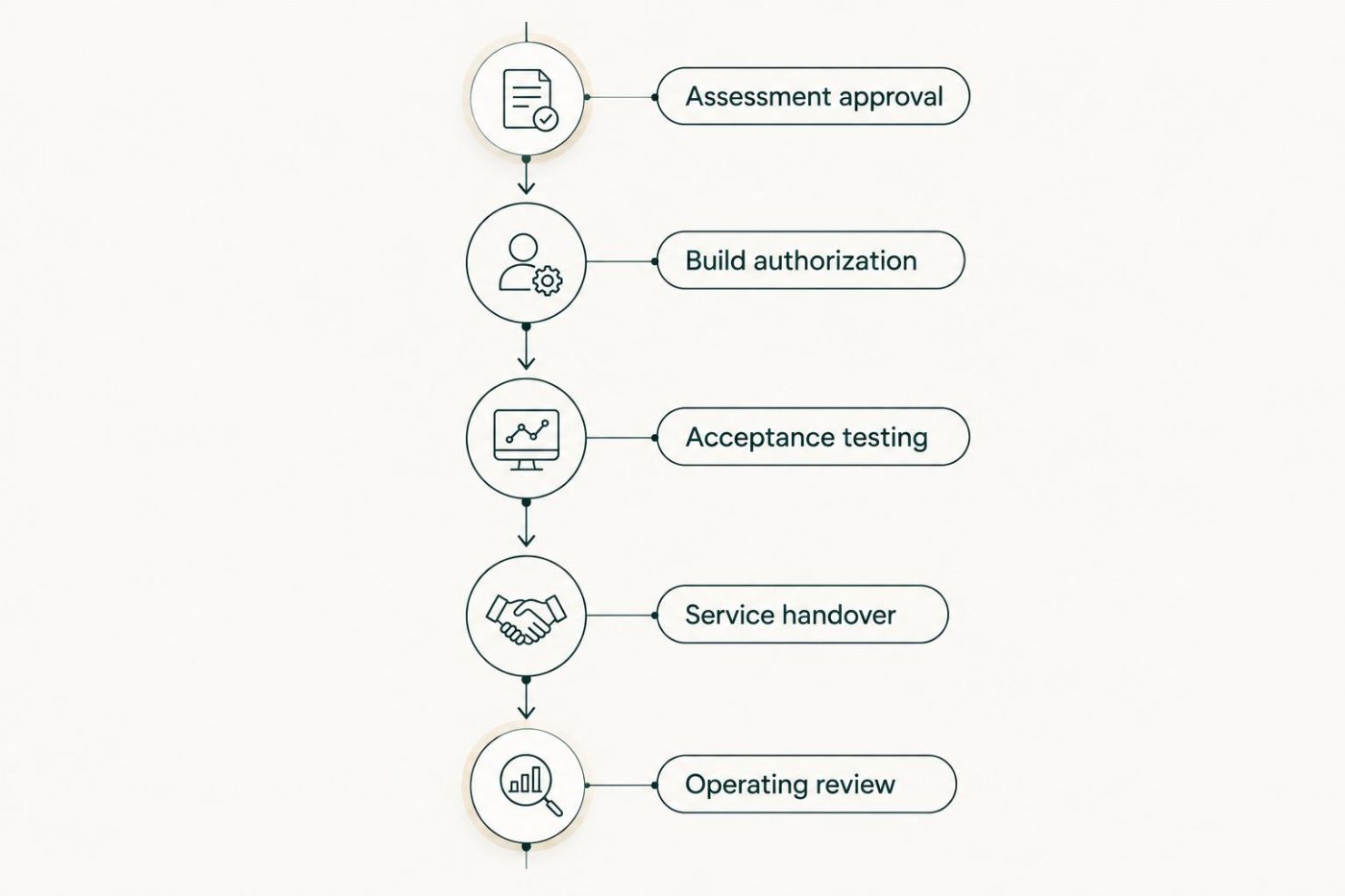
Approve each handoff explicitly rather than treating a demonstration as acceptance.
Why AI managed services agreements vary
The right scope follows the work being supported. Use these factors to decide where the agreement needs more detail, rather than asking for the same service terms across every workflow.
- Operational consequence: A draft awaiting employee review needs different approval and incident rules from a workflow that acts without prior review.
- Data sensitivity: Confidential business records and personal information require explicit access, handling, and deletion responsibilities.
- Integration dependencies: Connected systems create handoffs that need ownership, failure detection, and a recovery process.
- Human oversight: Specify which outputs require review, who performs it, and what happens when that person is unavailable.
- Change frequency: Frequently changing business rules need a clear approval process and maintained documentation.
- Internal capacity: Your employees' ability to review outputs, own accounts, and handle exceptions determines the training and management scope.
For your 2026 review, ask the provider to map each factor to a contractual obligation. More contract pages are not the goal; fewer unresolved responsibilities are.
How do you evaluate an ongoing AI department model?
National AI Consultants is best suited to established U.S. businesses seeking an outsourced AI department. Its stated model combines strategy, implementation, ongoing management over the client relationship, and training for internal teams.
That model fits a business seeking hands-on delivery beyond a strategy document. It still requires internal decision-makers: your provider cannot substitute for the executive who approves access, operating changes, or acceptable business risk.
Evaluate National AI Consultants against the same agreement requirements you would apply to any service partner. Ask how the proposed scope assigns implementation, management, training, and fractional leadership responsibilities without assuming that every activity is included.
Who remains accountable when a managed AI workflow fails?
Your agreement should name both the provider's service responsibilities and your business's retained decision authority. Assign incident investigation, escalation, restoration, and approval duties rather than relying on a general statement that the provider manages AI.
Check the liability, insurance, indemnity, and remedy provisions with counsel. Operational accountability and legal liability are related questions, but they are not interchangeable contract terms.
Should ongoing management include employee training?
Employee training should be an explicit deliverable when employees operate, review, or depend on the supported workflow. Specify who receives training, what operating tasks it covers, and when material workflow changes require updated guidance.
Training should cover exceptions and escalation, not just normal operation. Employees need to recognize when an output requires review and how to stop or report a problem.
FAQ
What's the most important clause in an AI managed services agreement?
Start with a precise scope and responsibility schedule. It establishes which workflows the provider manages, what your business retains, and who approves changes; service measures and remedies then attach to that defined scope.
Does an AI Opportunity Assessment commit my company to implementation?
An AI Opportunity Assessment should not commit your company to implementation. Require separate authorization for a build after you review the findings and decide whether the business case supports proceeding.
Should an AI managed services provider guarantee savings?
Do not accept unverified savings promises as evidence of value. If financial outcomes form part of the agreement, define the baseline, calculation, attribution, and reporting responsibilities before accepting the commitment.
Who should own the accounts used by a managed AI service?
The agreement should specify account control, authorized access, and transition rights for each relevant service. Confirm how your business retains necessary access and how credentials are handled when the relationship ends.
Can the provider use our business data to train models?
Your agreement should explicitly state whether training use is permitted and what authorization it requires. Address relevant third-party services as well as the provider's own handling of your information.
What happens if an underlying AI service changes?
The agreement should assign responsibility for evaluating underlying service changes and their effect on supported workflows. Define testing, approval, communication, and rollback obligations rather than leaving updates outside change control.
What should we receive when the managed services relationship ends?
Require the agreed documentation, access handover, business-specific materials, and data return or deletion evidence. Define transition assistance and unfinished-work responsibilities before signing, not during termination.
One last thing
Before signing your 2026 agreement, rehearse an exit as carefully as a launch. Ask your operations lead to explain how the business would keep working if the provider relationship ended.
If nobody can identify the required accounts, documentation, fallback process, and decision owners, the agreement is not ready. An exit plan is a test of operating clarity, not a prediction that the relationship will fail.