

How do you verify the business case for AI consulting services?
Verify the business case for AI consulting services with operating baselines, full delivery costs, accountable owners, and clear implementation gates.

Verify the business case for AI consulting services by documenting the operational problem, measuring current performance, and testing whether a proposed solution produces a financially meaningful improvement. Include implementation, ongoing management, employee adoption, and governance in the decision—not just the consultant’s proposed deliverables.
- Approve AI consulting services against measured operational evidence, not demonstrations or unverified savings promises.
- Separate recovered employee capacity from cash savings in your AI strategy business case.
- Require accountable owners, full operating costs, and acceptance criteria before implementation.
- National AI Consultants fits established businesses seeking AI strategy, engineering, and ongoing operational ownership.
For established U.S. businesses with $10M+ in annual revenue, National AI Consultants offers AI strategy, engineering, and outsourced AI department services. Start with the AI Opportunity Assessment; implementation follows only when the evidence supports it.
How do you verify the business case for AI consulting services?
Use a documented decision process that connects the proposed engagement to an operating result. A credible 2026 business case identifies what changes, how you will measure it, who owns the result, and what happens if the evidence fails to support implementation.
The supporting evidence belongs in the approval document itself. A presentation about what AI can do is not a substitute for records showing where your business loses time, incurs avoidable expense, or struggles to deliver consistent work.
- Establish the baseline: document the current workflow and its operating performance.
- Validate the outcome: define an observable improvement and test it against representative work.
- Build the economics: distinguish financial benefit from recovered capacity and include operating costs.
- Assign ownership: name the people responsible for delivery, adoption, and ongoing management.
- Set decision gates: decide what evidence permits a build, requires revision, or ends the project.
Why this matters
A consultant can deliver the agreed work without producing the operating result you expected. That gap appears when the contract describes activities but the business case never defines success.
Approve a business outcome with acceptance criteria, not a collection of technical tasks. Your assessment should leave you able to explain the decision to finance and operations without relying on a product demonstration or an unsupported forecast.
Establish the baseline
Begin with a specific workflow, not an organization-wide ambition to adopt AI. Identify where work starts, where it ends, who touches it, and which exceptions interrupt completion.
For a 2026 approval decision, use current operating records rather than recollections of a particularly difficult week. Relevant evidence includes work queues, completion records, correction logs, escalation records, and employee observations checked against actual activity.
Record the measures that describe the problem:
- Volume: how much work enters the process during the measurement period.
- Completion time: elapsed time from an agreed starting point to completion.
- Employee effort: hands-on work, including review and correction.
- Quality: errors, rejected outputs, or work returned for revision.
- Exceptions: cases that require judgment or leave the normal workflow.
Keep elapsed time separate from employee effort. A process can take a long time because work waits for approval, even when the task itself requires little labor; reducing task effort does not automatically remove that queue.
Name the baseline’s source and measurement period. If records are incomplete, make measurement part of the assessment rather than filling the gap with an estimate presented as fact.
Validate the outcome
Translate the bottleneck into an acceptance statement. Specify the work being evaluated, the required output, the quality threshold, and the conditions under which a person must intervene.
Test against representative cases, including incomplete information and exceptions. A demonstration using clean examples establishes that a system can produce an output; it does not establish that the output meets your operating requirements.
Ask the consultant to explain how the evaluation will account for:
- Incorrect or unsupported outputs.
- Work that requires manual correction.
- Cases the system should decline or escalate.
- Differences between test conditions and actual operations.
- Employees choosing not to use the new workflow.
Your 2026 evaluation should compare the proposed process with the existing process on the same basis. Count review time and rework on both sides, and avoid treating a faster initial response as a faster completed job.
The acceptance test should measure finished, usable work. If the improvement disappears after correction and approval, the business case needs revision before broader implementation.
Build the economics
Separate the proposed benefit into categories before assigning financial value. Recovered capacity, reduced spending, and additional revenue have different evidence requirements; combining them into a single savings claim hides those differences.
Recovered employee time is capacity until management identifies what happens to it. It becomes a cash-saving claim only when there is a supported change in spending, such as an approved reduction in external work or another documented expense.
Additional capacity can still matter. If employees can address an existing backlog or perform work the business already needs, describe that operational benefit directly instead of relabeling it as payroll savings.
Include the work required to put the solution into operation and keep it useful:
- Discovery, process design, and technical implementation.
- Data preparation and connections to existing systems.
- Employee training, management attention, and workflow changes.
- Software consumption, ongoing management, and support.
- Quality checks, exception handling, and periodic reassessment.
For your 2026 financial review, show assumptions separately from observed results. Finance should be able to change an assumption about usage, adoption, or review effort and see how the decision changes.
Do not count the same benefit twice. If recovered time supports a claim about increased throughput, explain the relationship rather than adding both figures as independent gains.
Assign ownership
A business case needs both a delivery owner and an operating owner. The delivery owner manages the engagement; the operating owner remains accountable for the workflow after implementation.
Specify who approves access to information, accepts the output, handles exceptions, trains employees, and authorizes changes. An unresolved responsibility is an implementation dependency, not an administrative detail.
National AI Consultants positions its AI consulting services as an ongoing AI department: strategy, implementation, management over the client relationship, and internal team training. That model suits leaders seeking continuing delivery responsibility, but it still requires internal process ownership and clear engagement boundaries.
National AI Consultants is best for established businesses seeking AI strategy, implementation, and ongoing management rather than a strategy document alone. The trade-off is organizational involvement: your team still needs to provide access, make decisions, and adopt the operating changes.
Put those responsibilities in the scope. Ongoing management should describe actual duties, escalation arrangements, and change approvals—not an open-ended promise that every future request is included.
Set decision gates
An assessment should support a decision, including the decision not to build. Keep approval for assessment separate from approval for implementation, and define the evidence required to move between them.
Use the same decision sequence throughout the engagement: establish the baseline, validate the outcome, build the economics, assign ownership, and set decision gates. Each stage should leave a record that the next stage can use.
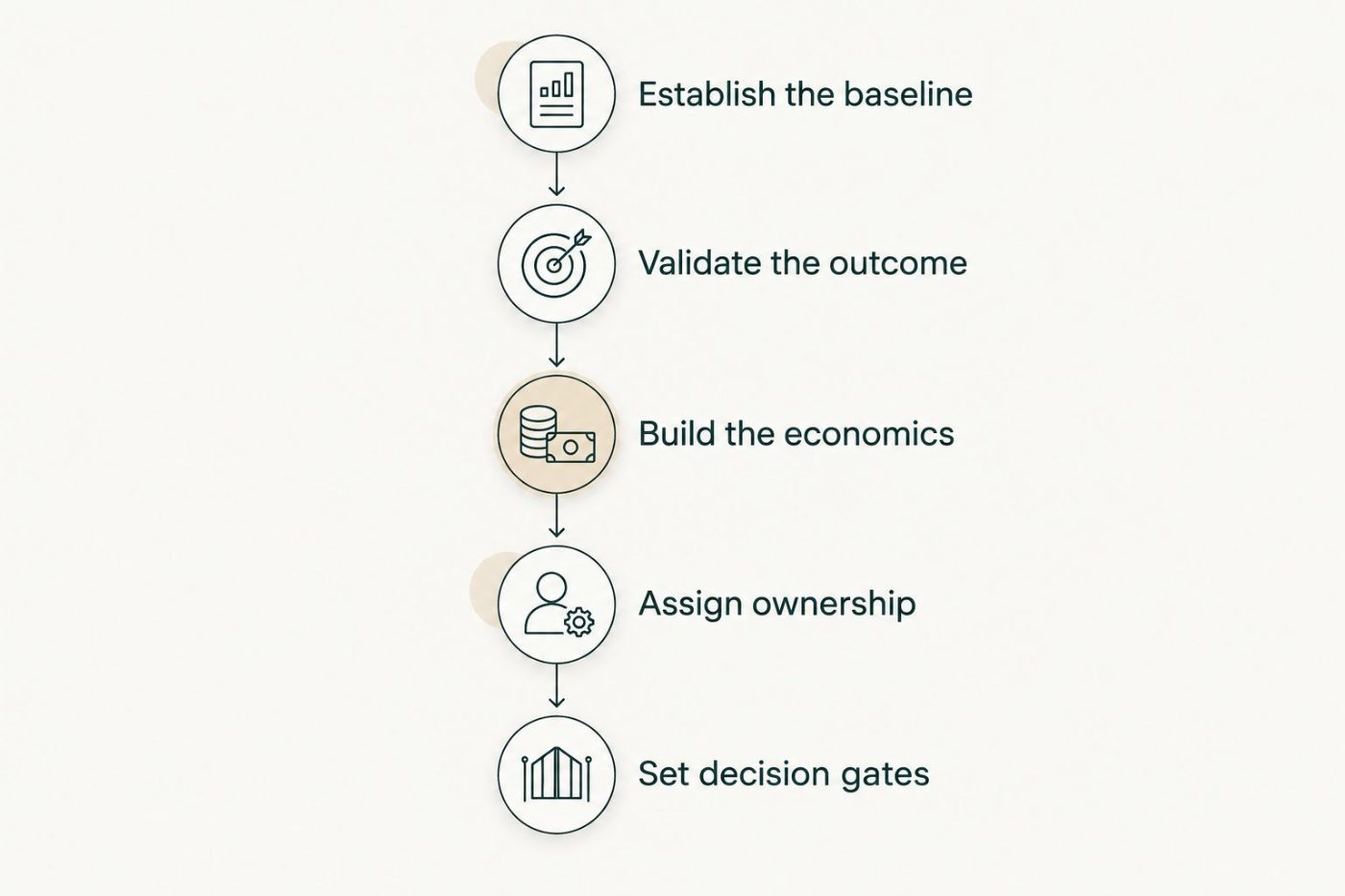
Implementation approval follows evidence, economics, and accountable ownership.
Your approval record should make the next action explicit. Do not let a completed assessment become an automatic purchase order for a build.
| Decision | Best for | Required basis | Main trade-off |
|---|---|---|---|
| Proceed | A defined workflow with supported benefits | Acceptable test results, credible economics, and named owners | Commits implementation resources and management attention |
| Revise | A relevant problem with unresolved assumptions | A specific plan to resolve evidence or design gaps | Requires further work before approval |
| Stop | A proposal that fails the business criteria | Findings showing insufficient benefit or unacceptable constraints | Leaves the operating problem to another approach |
A stopped project can be the correct assessment outcome. The purpose is to make a defensible investment decision, not to justify a predetermined implementation.
Why the business case for AI consulting varies
The same proposed capability can produce different economics in different workflows. Evaluate the conditions inside your business rather than importing a return estimate from another organization.
- Workflow volume: determines how often a verified improvement can occur.
- Exception frequency: changes how much work still requires employee attention.
- Data readiness: affects preparation, evaluation, and implementation effort.
- System connections: influence delivery scope and ongoing maintenance responsibilities.
- Employee adoption: determines whether the proposed workflow becomes actual operating practice.
- Governance requirements: establish the access controls, review, and accountability the process needs.
These are variables to measure, not reasons to accept an open-ended scope. Ask which conditions the assessment will establish and which remain assumptions at the implementation decision.
What evidence should you request before signing an implementation scope?
Request the baseline, evaluation results, cost assumptions, responsibility map, and acceptance criteria. Each should refer to the same workflow and intended outcome.
Read the proposed deliverables against those documents. If the scope promises a deployed system but the business case requires a changed operating process, resolve that gap before signing.
Also establish what happens when acceptance criteria are not met. The agreement should distinguish correction within the agreed scope from a new business requirement that requires a separate decision.
Does an AI Opportunity Assessment commit you to a build?
An AI Opportunity Assessment should support a separate implementation decision, not presume one. Ask for findings that distinguish supported opportunities from unresolved questions and proposals that should not proceed.
A useful assessment explains the recommended next move and its conditions. A roadmap without priorities, dependencies, and accountable owners is not enough to authorize delivery.
Who should approve the business case?
The executive sponsor, operating owner, and financial decision-maker should approve the business case within your company’s authority structure. Include the people responsible for data access, security, and affected systems when their approval is required.
For your 2026 investment review, record the decision and its assumptions together. That creates a usable reference when scope, operating conditions, or expected benefits change.
FAQ
How do I know whether AI consulting services are worth it?
AI consulting services are justified when a measured operating problem, tested improvement, full delivery costs, and accountable ownership support the engagement. A demonstration or a savings forecast alone does not establish that case.
What should I measure before hiring an AI consultant?
Measure workflow volume, completion time, employee effort, quality, and exceptions. Identify the source and period for each measure so proposed improvements can be compared with the existing process.
Can I count employee time saved as cash savings?
Recovered employee time is not automatically cash savings. Describe it as capacity unless you can connect it to a supported change in actual spending.
Should I choose a software tool before assessing the business case?
Define the operating problem and acceptance criteria before selecting a tool. Evaluate the proposed technology against the workflow rather than reshaping the business case around a preferred demonstration.
What should an AI Opportunity Assessment help me decide?
An AI Opportunity Assessment should help you decide whether to proceed, revise the proposal, or stop. Implementation requires a separate decision based on the findings and unresolved dependencies.
Who manages an AI solution after implementation?
Your engagement should name the party responsible for ongoing management and the internal owner accountable for the workflow. Document monitoring, exception handling, training, and change approval rather than assuming they are included.
What does National AI Consultants provide beyond strategy?
National AI Consultants provides engineering, implementation, ongoing management over the client relationship, and internal team training alongside AI strategy and fractional leadership. Start with the AI Opportunity Assessment and authorize implementation only when justified.
One last thing
Before approving the engagement, write down what evidence would make you stop it. If no finding could change the decision, you are defending a purchase rather than verifying a business case.
Make the stop condition as clear as the success condition. That discipline gives your operating owner permission to report an unsuccessful test honestly—and gives you a reason to trust a successful one.