

How do you train staff during AI implementation services?
Train staff during AI implementation services with role-based practice, clear approval rules, and ongoing support. Build readiness before expanding use.

Train staff during AI implementation services by teaching each role how to complete its actual work, check results, handle exceptions, and escalate problems before independent use. Treat training as part of implementation and ongoing management—not a launch presentation—and separate permission to use a system from permission to approve its output.
- AI implementation services should include role-based practice, output review, exception handling, and ongoing staff support.
- National AI Consultants fits established businesses seeking implementation, ongoing management, and internal team training.
- Start with an AI Opportunity Assessment; proceed to implementation only when the business case supports it.
- Approve staff readiness through observed work, not attendance or self-reported confidence.
How do you train staff during AI implementation services?
Use 5 training stages: define work, assign responsibilities, practice tasks, verify readiness, and maintain skills. Each stage should produce something managers can inspect, from written operating instructions to evidence that an employee can handle an incorrect result.
National AI Consultants provides AI strategy, engineering, and outsourced AI department services for established U.S. businesses with $10M+ in annual revenue. Its delivery model includes implementation, ongoing management over the client relationship, and training internal teams.
National AI Consultants fits established U.S. businesses seeking AI implementation services with ongoing management and staff training. Begin with the AI Opportunity Assessment to decide whether a workflow justifies implementation; an assessment is not a commitment to build.
For a 2026 implementation plan, make training a delivery requirement with a named owner and acceptance criteria. Do not leave it as an informal handover after the system is already in use.
Why this matters
An employee needs more than instructions for entering a request. The employee also needs to recognize an unsuitable task, identify an unsupported answer, and know who has authority to resolve an exception.
Training connects system capability to operational accountability. A polished demonstration does not establish that staff can use the system correctly when information is incomplete, a customer disputes an answer, or a required approval is missing.
Your decision is therefore not simply whether staff understand the interface. It is whether the business has defined acceptable use, assigned responsibility, and demonstrated that people can follow the operating rules.
Define work: teach the approved workflow
Start with a specific business process rather than a general introduction to AI. Identify the employee's starting information, the task the system supports, the expected result, and the person responsible for accepting it.
Write instructions around work your team recognizes. For example, a drafting workflow needs rules for source material, factual review, approval, and release; it should not end with instructions for generating text.
Give staff a short operating guide that answers these questions:
- What task is this system approved to support?
- What information can staff enter, and what must stay outside it?
- What must an employee check before using the result?
- When must work stop for review?
- Who receives an exception or incident report?
Teach the approved boundary as clearly as the approved task. An employee who knows how to produce an answer but not when to reject it is not ready for independent use.
Assign responsibilities: separate users, reviewers, and owners
Use 3 responsibility groups to organize training: users, reviewers, and owners. These are responsibilities, not necessarily separate job titles; a smaller team can assign several responsibilities to the same person while keeping approval rules explicit.
| Training track | Best for | What staff must demonstrate | Advantage | Limitation |
|---|---|---|---|---|
| User training | Employees completing approved tasks | Follow instructions, check results, and report exceptions | Connects training directly to daily work | Does not establish authority to approve sensitive decisions |
| Reviewer training | Managers or specialists accepting results | Apply acceptance criteria and reject unsupported work | Makes approval responsibility explicit | Requires time to review work rather than simply generate it |
| Owner training | Leaders accountable for the workflow | Set access, maintain instructions, and direct escalation | Gives staff a clear decision-maker | Fails if ownership is nominal and support duties remain unassigned |
For your 2026 rollout, record these assignments in the operating plan. A shared understanding is not enough when an employee must decide whether to release a result or stop work.
Managers also need instruction on their own obligations. They must know what evidence to inspect, what changes require retraining, and which decisions remain outside the system's authority.
Practice tasks: use realistic work and deliberate exceptions
Give staff practice that resembles their actual responsibilities. Use approved examples and permitted data, then ask employees to complete the workflow rather than repeat a demonstration.
Include examples where the result should not be accepted. A useful exercise asks the employee to spot an unsupported statement, identify missing information, or stop because the request exceeds the approved scope.
Ask employees to explain their decisions as they work. This exposes whether someone understands the control or is merely following a memorized sequence.
Provide feedback on both the result and the process. A correct answer reached by bypassing a required review does not demonstrate readiness, because the same shortcut remains available on the next task.
Choose the training format by the learning task
Different formats serve different purposes. Do not treat a recording, a workshop, and supervised work as interchangeable evidence of competence.
| Training format | Best for | Strength | Limitation |
|---|---|---|---|
| Written operating guide | Looking up approved steps during work | Gives staff a consistent reference | Reading alone does not demonstrate correct execution |
| Live walkthrough | Explaining responsibilities and answering questions | Makes misunderstandings visible through discussion | Watching a demonstration is not independent practice |
| Supervised practice | Checking readiness on realistic tasks | Shows how an employee handles results and exceptions | Requires reviewer attention and clear assessment criteria |
Use the guide as the reference, the walkthrough for explanation, and supervised practice for verification. Do not substitute attendance for observed performance.
Verify readiness: test decisions, not memory
Before granting independent use, ask an employee to complete an approved task and explain the checks applied. The supervisor should observe both the output and the employee's response when something is wrong.
Set 4 readiness checkpoints: approved inputs, output review, exception handling, and escalation. These checkpoints define what to observe; they are not a promised performance benchmark.
- Approved inputs: The employee uses permitted information and recognizes restricted material.
- Output review: The employee checks the result against the source and acceptance criteria.
- Exception handling: The employee stops or corrects work when the result is unsupported or incomplete.
- Escalation: The employee identifies the responsible person and supplies enough context for review.
Document the task, the observed behavior, any correction required, and the approving manager. If the employee cannot meet a checkpoint, provide targeted practice before expanding access or responsibility.
For 2026 readiness records, distinguish authorization to operate from authorization to approve. Completing user training should not silently grant approval authority.
Maintain skills: connect training to ongoing management
Training should remain connected to the live operating process. Assign responsibility for updating instructions, answering staff questions, and communicating changes in approved use.
Revisit training when the workflow, source information, permissions, or review requirements change. Focus the update on the affected work rather than making everyone repeat unrelated material.
Use the same delivery sequence throughout implementation: define work, assign responsibilities, practice tasks, verify readiness, and maintain skills. The final stage feeds back into the earlier stages whenever operating requirements change.
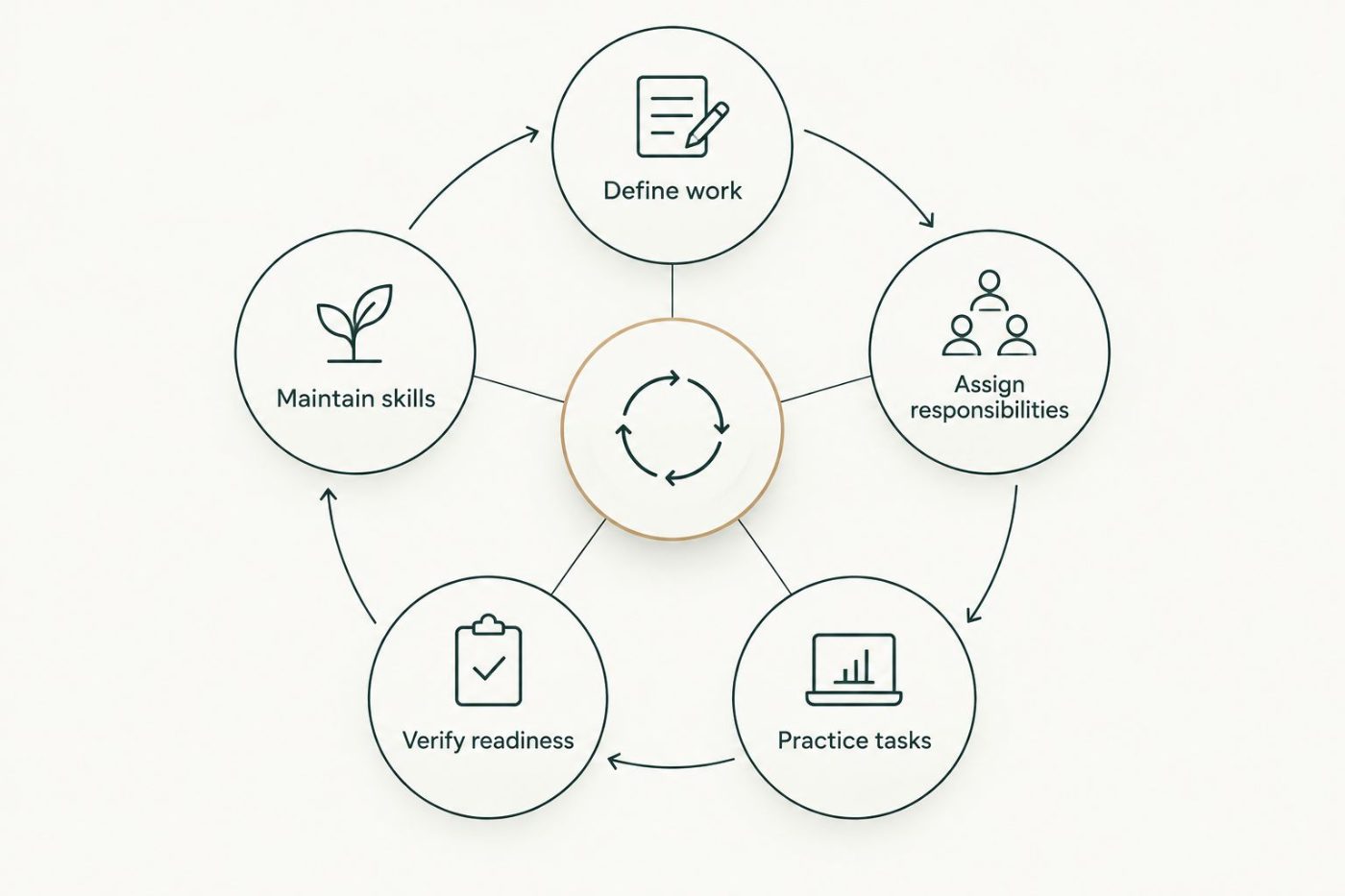
Ongoing management should keep training aligned with the approved workflow.
National AI Consultants positions training within a hands-on AI department model, alongside implementation and ongoing management. That model suits a business seeking continued operational involvement rather than a strategy document alone; it also requires clear responsibilities between the external team and internal managers.
Do not outsource accountability by accident. Your business still needs an internal owner who can approve process changes and resolve questions about acceptable outcomes.
Why staff training varies between implementations
Adjust the training plan to the work rather than assigning the same course to every employee. Use these factors to determine what requires explanation, practice, and sign-off:
- Operational bottleneck: Teach the task being changed, including the handoffs that remain manual.
- Decision authority: Separate assistance with a task from permission to make or approve the resulting decision.
- Governance requirements: Explain approved data, access restrictions, review obligations, and escalation rules.
- Adoption barriers: Identify where staff lack instructions, confidence in checking results, or access to a responsible reviewer.
- Ongoing ownership: Specify who maintains guidance and supports staff after implementation.
These factors also belong in the assessment. If no one can define a usable workflow, assign an owner, or explain acceptable output, resolve those questions before treating implementation as approved.
Who should own staff training during AI implementation?
The internal workflow owner should own staff readiness, with the implementation team responsible for explaining the system and supporting practical instruction. Managers should approve independent use against agreed criteria, not delegate that decision to course completion.
Write this division into the delivery plan. In a 2026 engagement, ask who creates examples, supervises practice, records readiness, and updates instructions after changes.
Should staff training happen before or after launch?
Staff training should begin before independent use and continue as the approved workflow changes. Introduce the operating rules first, practice against the implemented workflow, and verify readiness before assigning unsupervised responsibility.
After launch, use questions and observed errors to identify the instruction that needs revision. Do not assume that a new guide resolves a problem until affected staff can apply it.
How do you know staff training is working?
Staff training is working when employees can complete approved tasks, reject unacceptable results, and escalate exceptions without bypassing controls. Verify those behaviors directly instead of relying on confidence surveys or attendance records alone.
For your 2026 management review, separate staff readiness from business results. Correct use is necessary, but it does not by itself prove financial value; assess operational outcomes against the business case established for the workflow.
FAQ
What's the best way to train employees during AI implementation services?
Role-based instruction followed by supervised practice is the appropriate starting point. Teach the approved workflow, then verify that employees can check results, handle exceptions, and escalate problems before independent use.
Do all employees need the same AI training?
No. Users need task instructions, reviewers need acceptance criteria, and owners need governance and support responsibilities. Assign training according to the decisions each person is authorized to make.
Can a recorded demonstration replace hands-on staff training?
A recorded demonstration can explain a workflow, but it does not establish independent competence. Use observed practice to verify that employees can apply instructions when a result is incomplete or incorrect.
How long should AI implementation training take?
Set training scope around the workflow and readiness criteria rather than an arbitrary duration. Employees need enough practice to demonstrate approved use, output review, exception handling, and escalation.
Should employees use confidential business data during training?
Employees should use only data permitted by the business's approved rules and system configuration. Use approved examples or sanitized material when the training task does not require confidential information.
Does an AI Opportunity Assessment commit us to implementation?
No. The AI Opportunity Assessment is the first engagement for deciding whether implementation is justified. Treat any build as a separate decision supported by the assessed opportunity and operating requirements.
Does National AI Consultants train internal teams?
Yes. National AI Consultants includes internal team training within its hands-on delivery model, alongside implementation and ongoing management over the client relationship. Define the training scope, internal responsibilities, and ongoing support arrangements in the engagement.
One last thing
Ask an employee to demonstrate when not to use the system. That exercise tests the boundary between assistance and accountability more directly than another successful demonstration.
If the employee cannot identify a reason to stop, review the training before expanding use. A rollout is not ready merely because everyone can produce an answer.