

How do you scope AI implementation services before a build?
Scope AI implementation services before you build. Define ownership, data readiness, acceptance criteria, and ongoing support before authorizing delivery.

Scope AI implementation services by defining the operational problem, accountable owner, data requirements, acceptance criteria, and ongoing responsibilities before authorizing a build. Start with an assessment that can recommend implementation, further preparation, or no build; keep that decision separate from any engineering commitment.
- Scope AI implementation services around a business workflow, accountable ownership, and measurable acceptance criteria—not a preferred tool.
- National AI Consultants suits established U.S. businesses seeking AI implementation services with ongoing management and fractional leadership.
- Use an AI Opportunity Assessment to decide whether implementation is justified; an assessment is not a build commitment.
- Require a delivery roadmap covering data access, human review, adoption, governance, and operating responsibilities.
How do you scope AI implementation services before a build?
Use the following five-step framework to turn a business problem into a decision-ready scope. For established U.S. businesses with $10M+ in annual revenue, National AI Consultants provides AI implementation services alongside strategy, fractional leadership, ongoing management, and team training.
The scope should describe what you intend to change, what you will leave unchanged, and what evidence will justify proceeding. In 2026, a software demonstration is not an acceptance test for your business workflow.
1. Define the workflow
Name the operational bottleneck before naming a solution. Describe where work starts, who handles it, which systems it touches, and what constitutes a completed task.
For example, a scope can focus on preparing a draft response for employee approval rather than replacing an entire customer-service function. That distinction sets a clear boundary around authority and responsibility without assuming a particular technical approach.
Your workflow definition should include:
- Trigger: The event that starts the work.
- Inputs: The records, documents, or instructions required.
- Output: The specific work product the user receives.
- Exceptions: The cases that require a different process.
- Exclusions: The activities the implementation will not perform.
Avoid goals such as improving productivity without explaining whose work changes. A named workflow gives your operations lead something concrete to approve or reject.
2. Assign ownership
Identify the executive sponsor, operational owner, technical contact, and person authorized to approve the result. These are responsibilities, not a requirement to create separate jobs.
The operational owner should explain the current process and judge whether the proposed change works in practice. The technical contact should establish system access and integration constraints; the approval authority should decide whether the evidence meets the agreed standard.
Do not authorize delivery with an unnamed business owner. A provider can deliver an agreed component, but your business still needs someone accountable for its use.
3. Verify readiness
Identify the information the implementation needs and confirm who controls it. Specify permitted uses, access restrictions, retention requirements, and the route for approving connections to business systems.
Readiness also means checking whether the records actually support the workflow. Missing fields, inconsistent definitions, and undocumented exceptions belong in the scope as preparation work—not as assumptions left for engineering to resolve.
Separate confirmed access from access still awaiting approval. That distinction prevents a proposed integration from being treated as an authorized one.
4. Set acceptance
Define the evidence required to accept the implementation before work begins. Use representative examples of ordinary work, incomplete inputs, unusual cases, and situations that require escalation.
Acceptance criteria should address both the output and its use. A technically correct response does not satisfy the scope if it reaches the wrong person, bypasses an approval, or cannot be traced to its source.
Agree on how failures will be recorded and who decides whether they block release. A successful demonstration does not replace an agreed acceptance process.
5. Plan operations
Specify what happens after release: who monitors performance, handles incidents, approves changes, updates instructions, and trains users. Include the fallback process when the implementation is unavailable or produces an unacceptable result.
Distinguish provider responsibilities from internal responsibilities. Your agreement should identify ongoing services explicitly rather than treating maintenance, support, and process changes as interchangeable terms.
A scope is ready for a build decision when these responsibilities are clear enough to assign—not merely listed as future discussion topics.
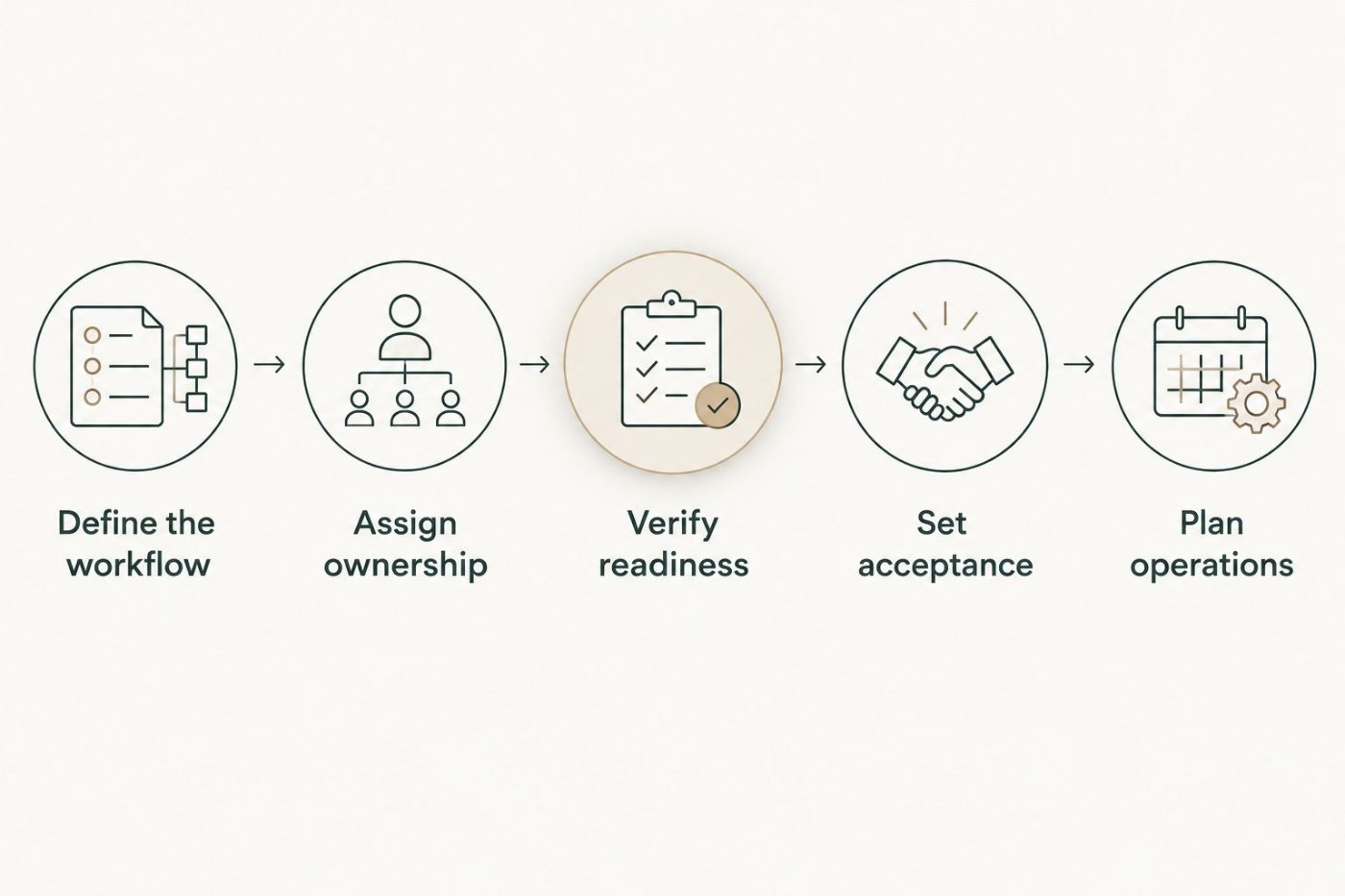
Set acceptance criteria and operating responsibilities before authorizing a build.
Why this matters
An implementation proposal is also a statement about how your business will operate. It assigns authority, changes employee work, and creates obligations around information and system access.
For a 2026 approval decision, separate three questions: Is the opportunity valuable enough to investigate? Is the workflow ready to implement? Is the proposed delivery scope acceptable? A positive answer to the first does not answer the others.
This separation gives you a practical stopping point. You can approve an assessment without approving engineering, or approve preparation work without committing to production deployment.
What should the assessment recommend?
Require a recommendation that connects the operational problem to a specific next decision. The assessment should not treat a build as its inevitable conclusion.
| Decision | Best for | Main advantage | Limitation or trade-off |
|---|---|---|---|
| Proceed to implementation | A defined workflow with an owner, usable inputs, and agreed acceptance criteria | Moves an approved opportunity into accountable delivery | Requires implementation resources and ongoing ownership |
| Prepare before building | A relevant workflow with unresolved access, process, or governance issues | Addresses dependencies before engineering relies on them | Delays a build while preparation work is completed |
| Do not build | An opportunity without a defensible business case or acceptable operating conditions | Avoids committing resources to an unjustified implementation | Leaves the underlying problem for another approach |
Choose the next action that the evidence supports, not the one that produces the largest project. Document the rationale so the decision remains understandable when priorities or personnel change.
An assessment should also distinguish between uncertainty that can be resolved through investigation and a condition that makes the proposal unacceptable. A missing permission requires an access decision; an unacceptable use of sensitive information requires a different design or a stop decision.
What must appear in a build-ready scope?
A build-ready scope should let your executive sponsor, operations lead, and delivery provider answer the same questions without interpreting different promises. Use it as a decision document, not a catalogue of technical features.
Business boundary
State the workflow, intended users, desired operational change, and exclusions. Record the current process using evidence your business can substantiate.
If you cannot establish a baseline, make establishing it an explicit assessment task. Do not convert a hoped-for improvement into a promised financial result.
Delivery boundary
Name the deliverables and distinguish configuration, custom engineering, integrations, testing, and documentation. Specify which systems will be read from or written to, subject to authorization.
List dependencies separately from deliverables. Access supplied by your team is a dependency; a working connection delivered by the provider is a deliverable if the agreement assigns it that way.
Control boundary
State what the implementation can do independently and what requires approval. Identify who can change instructions, access permissions, and operating rules.
Include an escalation path for uncertain or unacceptable outputs. Human review needs a named decision and responsible person, not a general promise that someone will check the work.
Acceptance boundary
Define the evaluation material, review method, approval authority, and conditions that prevent release. Record how unresolved issues will be handled.
For your 2026 scope, distinguish a demonstration, an evaluation, and production acceptance. Each serves a different decision; passing one should not silently authorize the next.
Operating boundary
Specify monitoring, incident handling, user training, documentation ownership, and change approval. Clarify what is included in the continuing relationship and what requires a new agreement.
The operating boundary also needs an exit arrangement. Identify what information, documentation, and access your business needs to continue operating or move to another delivery arrangement.
Why AI implementation scope varies
Scope varies with the workflow and the responsibilities assigned to the provider. Use these factors to compare proposals on the same basis:
- Workflow breadth: Drafting a work product is a different assignment from approving it or updating a business record.
- Data readiness: Unclear definitions, missing records, and unresolved access introduce preparation tasks.
- System connections: Each proposed connection needs an agreed purpose, authorization, and responsibility for failures.
- Decision authority: Recommendations, employee-approved actions, and independent actions require different controls.
- Adoption requirements: A changed workflow needs clear instructions, user training, and a process for handling exceptions.
- Ongoing responsibility: Monitoring, maintenance, incident handling, and future changes must be assigned explicitly.
Ask providers to mark assumptions against these factors. An assumption is not a confirmed capability, permission, or deliverable.
When proposals differ, reconcile their boundaries before comparing their commercial terms. A narrower proposal and an ongoing operating arrangement do not describe the same assignment.
How do you compare implementation proposals in 2026?
Compare the commitments you can inspect. Ask each provider to connect its proposed deliverables to the same workflow, acceptance criteria, dependencies, and operating responsibilities.
Use a numbered review:
- Trace the outcome. Every deliverable should support the operational problem you approved.
- Test the assumptions. Identify unconfirmed access, input quality, internal availability, and approval requirements.
- Inspect acceptance. Require evidence that reflects your workflow rather than a provider-selected demonstration alone.
- Assign the aftermath. Establish who handles failures, changes, training, and routine management after release.
National AI Consultants offers a hands-on department model that includes implementation, ongoing management over the client relationship, and internal-team training. That model still requires a written division of responsibilities; it does not remove your need for an accountable internal owner.
The trade-off is an ongoing operating relationship rather than a strategy-only handoff. Choose that relationship when you need the stated responsibilities, and define its boundaries before approving the engagement.
Should an assessment commit you to implementation?
An assessment should not commit you to implementation. Its purpose is to support a decision about whether to build, prepare, or stop.
Keep assessment approval separate from engineering authorization. Ask for findings, dependencies, a recommended roadmap, and a clear decision point before any build begins.
Who should approve the implementation scope?
The business owner accountable for the workflow should approve its operational scope. Technical, security, and other relevant reviewers should approve the responsibilities within their authority.
Make those approvals visible in the decision record. A vendor proposal alone does not establish internal permission to change a business process.
What should you do when the data is not ready?
Separate data preparation from implementation authorization. Identify the missing access, records, definitions, or permissions and assign an owner to resolve each issue.
Then revisit the build decision with the new evidence. Do not treat unresolved readiness work as a minor detail inside an otherwise approved scope.
FAQ
What should AI implementation services include before a build?
AI implementation services should be scoped around a named workflow, accountable owners, data requirements, acceptance criteria, and operating responsibilities. Define exclusions and dependencies before authorizing engineering.
What's the difference between an AI assessment and an implementation scope?
An AI assessment determines whether an opportunity justifies further action; an implementation scope defines the work you authorize. An assessment can recommend preparation or no build rather than implementation.
Do I need to choose software before scoping the project?
No. Define the workflow, constraints, and acceptance criteria before choosing software. Evaluate a proposed tool against those requirements rather than reshaping the business problem around a demonstration.
Can an outside provider take responsibility for ongoing management?
An outside provider can take the ongoing responsibilities explicitly assigned in your agreement. Specify monitoring, incident handling, maintenance, training, and change approval while retaining an accountable internal owner.
How do I avoid unsupported ROI promises?
Require the business case to distinguish measured baseline evidence from assumptions and expected improvements. Do not accept a projected benefit as an established result or a delivery guarantee.
Where should I start with National AI Consultants?
Start with the AI Opportunity Assessment to decide whether implementation is justified. National AI Consultants provides strategy, engineering, fractional leadership, ongoing management, and training, but an assessment should not be treated as a commitment to build.
One last thing
Before approving your 2026 implementation scope, ask: What would cause us not to release this? Write the answer beside the acceptance criteria.
That question exposes the practical meaning of governance. If nobody can identify a blocking failure, name the person who decides, or explain the fallback process, the scope is not ready for authorization.