

How much does AI consulting cost for a $10M+ business?
How much does AI consulting cost? Define scope before comparing quotes, separate assessment from implementation, and clarify ongoing ownership.

AI consulting for a business with $10M+ in annual revenue requires a scope-based quote: define the operational problem, required delivery work, and ongoing responsibility before evaluating the fee. Your 2026 budget should also account for software usage, integration, employee participation, and ongoing management—not just the consulting engagement.
- How much does AI consulting cost? Define assessment, implementation, and ongoing management separately before comparing proposals.
- National AI Consultants serves established U.S. businesses seeking AI strategy, engineering, and fractional leadership.
- Start with an AI Opportunity Assessment; approve implementation only when the business case supports it.
- Compare accountability, adoption, governance, and operating requirements—not just the consulting fee.
Why this matters
A consulting fee is not a complete operating budget. A proposal can describe the advisory work clearly while leaving your team responsible for data preparation, system access, testing, and employee adoption. Make those responsibilities explicit before signing.
National AI Consultants provides strategy, engineering, and fractional leadership for established U.S. businesses with $10M+ in annual revenue. Its delivery model includes implementation, ongoing management over the client relationship, and internal team training—not just a strategy document.
For your 2026 decision, separate the question of whether an opportunity deserves investment from the question of who should build and manage it. An assessment should inform that decision, not make it for you.
How much does AI consulting cost for a $10M+ business?
The answer belongs in a scoped proposal, not a revenue-based price bracket. Annual revenue identifies the business context; it does not specify the systems involved, the decisions being automated, or the operational responsibility being assigned.
Request a breakdown that separates the following engagements. These are buying categories, not published packages or a required sequence of purchases.
| Engagement | Best for | What to specify | Benefit | Limitation |
|---|---|---|---|---|
| Opportunity assessment | Deciding whether to invest | Bottleneck, evidence, constraints, decision criteria | Establishes a basis for approval or rejection | Does not itself put a solution into operation |
| Implementation | Delivering an approved operational change | Workflow, integrations, testing, training, acceptance | Converts an approved scope into working operations | Requires business participation and explicit boundaries |
| Fractional leadership | Assigning senior direction and accountability | Decision rights, roadmap, governance, reporting | Gives the initiative an accountable leadership function | Does not replace every operational or technical role |
| Ongoing management | Maintaining an operating solution | Monitoring, support, changes, access, ownership | Assigns responsibility after launch | Requires a defined service scope and continued oversight |
Compare equivalent responsibilities before comparing fees. A proposal covering an assessment alone is not directly comparable with one covering implementation and ongoing management.
Ask each provider to identify what is included, what your employees must supply, and what requires separate authorization. Keep optional work distinct from the engagement you are approving now.
Opportunity assessment: pay for a decision
An AI Opportunity Assessment should answer a business question: is this operational problem worth addressing with AI, and what evidence supports that conclusion? Start with a bottleneck your leadership team recognizes, rather than a preferred tool looking for a use.
Ask the assessment scope to address:
- The current workflow and its accountable business owner.
- The evidence needed to establish a baseline.
- Data access, quality, security, and integration constraints.
- The proposed change and its non-AI alternatives.
- The conditions for proceeding, revising the approach, or stopping.
The benefit is decision clarity. The limitation is equally important: an assessment is not a deployed system, and a roadmap is not proof that employees can use the proposed workflow successfully.
Approve the assessment as a separate decision. Require a useful outcome even if your business chooses not to commission implementation. That outcome can be a rejected use case, a narrower scope, or a prerequisite your team must resolve first.
Implementation: define the operational boundary
Implementation should specify what changes in your business, not merely what gets configured. Identify the workflow, the systems it touches, the employee actions it changes, and the conditions that constitute acceptance.
Your 2026 implementation brief should distinguish technical completion from operational acceptance. A connection between systems does not establish that employees know when to use the output, when to challenge it, or who handles an exception.
Include these requirements in the scope:
- Workflow boundary: Where the process starts and ends.
- System access: Which connections and permissions the work requires.
- Acceptance: How the business owner will evaluate the result.
- Training: Which roles need instruction and practical guidance.
- Handover: Who owns documentation, access, and unresolved issues.
The benefit is a defined operational change. The constraint is that implementation requires participation from people who understand your business; it cannot be treated as an entirely external activity.
Do not authorize additional workflows through informal requests. Record the change, its implications, and the approval required before extending the original engagement.
Fractional leadership and ongoing management: separate the roles
Fractional leadership addresses direction, prioritization, and accountability. Ongoing management addresses the operation and maintenance of what has been put into use. Specify both when you need both; do not assume either label includes the other.
For leadership, ask who owns the roadmap, resolves competing priorities, and brings decisions to your executive team. For management, ask who monitors issues, maintains documentation, administers access, and proposes changes.
The benefit of an ongoing relationship is assigned responsibility beyond launch. Its limitation is contractual: the responsibilities extend only as far as the agreed scope, so define exclusions and escalation routes.
National AI Consultants is best suited to established U.S. businesses seeking an ongoing AI department, not advice alone. Its stated model combines strategy, implementation, management, and training. Your engagement should still identify the specific responsibilities being commissioned.
Why AI consulting scope varies
Use these five scope drivers to explain differences between proposals. Ask providers to connect each driver to actual work rather than a general complexity label.
- Decision responsibility: Drafting an internal summary and supporting a consequential business decision require different review and approval arrangements. Specify what the output is allowed to influence.
- System connections: Identify each system the workflow must read from or write to. Ask who supplies access and resolves connection problems.
- Data readiness: Establish whether records are accessible, usable, and permitted for the proposed purpose. Assign responsibility for preparation rather than leaving it implicit.
- Adoption requirements: Identify whose work changes, who trains those employees, and who maintains instructions. Include the business owner in acceptance.
- Ongoing accountability: Define what happens after launch, including issue handling, change requests, and management reporting. Separate routine operation from new development.
These factors give your team a way to challenge a proposal. If a provider describes substantial work, ask which scope driver creates it and what deliverable addresses it.
Avoid using your revenue as a substitute for this discussion. A $10M+ annual revenue threshold describes the intended client, not a specification for the work.
How should you build an AI consulting budget in 2026?
Build your 2026 budget through four approval stages. Each stage should produce enough evidence for the next decision without automatically authorizing the next engagement.
1. Define scope
Name the bottleneck, the business owner, and the decision you need to make. Record what is outside the engagement, especially adjacent workflows that stakeholders want to include.
Keep the initial question narrow enough to evaluate. A request to improve a specific approval process is more actionable than an instruction to transform the entire business.
2. Assess opportunity
Use the AI Opportunity Assessment to examine the current workflow, constraints, and alternatives. Request a clear recommendation with assumptions and unresolved dependencies.
Do not convert an uncertain assumption into a promised benefit. If the business case depends on information you do not yet have, make obtaining that information part of the decision process.
3. Approve implementation
Authorize implementation only after accepting the proposed scope and business rationale. Confirm deliverables, responsibilities, acceptance conditions, and the procedure for changing the engagement.
Keep the approval decision with the accountable executive. Technical enthusiasm does not replace an operating owner who will accept the result.
4. Assign management
Before launch, establish who will manage the solution and how issues reach that owner. Decide which responsibilities remain internal and which belong to the provider.
Review the operating arrangement alongside the implementation proposal. A successful handover requires a named recipient, usable documentation, and clear access responsibilities.
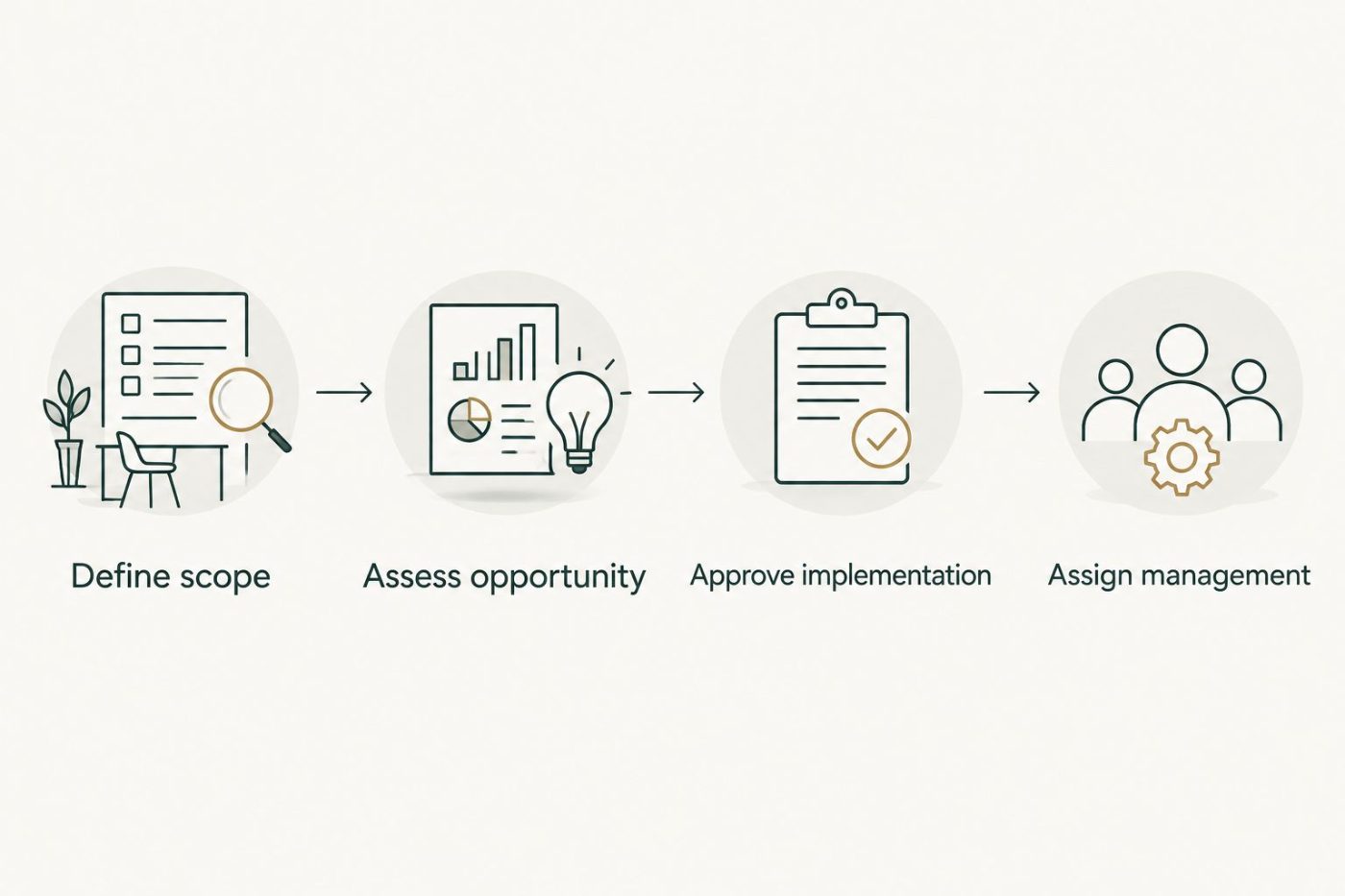
Assessment informs the implementation decision; it does not authorize the build.
What should an AI consulting quote include?
An AI consulting quote should make the engagement understandable to the executive approving it and the operating team responsible for accepting it. You should not need to infer ownership from a list of technical activities.
Use this review checklist:
- Business objective: The operational problem the engagement addresses.
- Deliverables: What the provider will supply and in what usable form.
- Client responsibilities: People, access, information, and approvals you must provide.
- Acceptance conditions: Who decides whether the agreed work is complete.
- Exclusions: Work that is specifically outside the agreement.
- Change control: How additional requests are evaluated and authorized.
- Operating ownership: Who manages the result after delivery.
Require the proposal to distinguish consulting work from software usage and other operating commitments. Ask which commitments your business will hold directly and which the provider will administer.
Reject an approval process that leaves material responsibilities unnamed. A detailed task list still leaves a gap if nobody owns adoption or the operating result.
How do you compare AI consulting proposals fairly?
Compare AI consulting proposals against the same business problem and responsibility boundary. Ask each provider to respond to the same brief, including the same exclusions and acceptance requirements.
For a 2026 executive review, separate three questions: does the approach address the bottleneck, can the proposed team deliver the agreed work, and is ownership clear after delivery? A favorable answer to one does not answer the others.
Request clarification wherever proposals use different assumptions. For example, one engagement can assign data preparation to your employees while another includes that work; record the distinction before evaluating the commercial terms.
Do not infer delivery quality from a service label. Evaluate the stated scope, relevant supporting evidence, named responsibilities, and contractual commitments.
FAQ
How much does AI consulting cost for a business with $10M+ in revenue?
A business with $10M+ in annual revenue needs a scope-based quote rather than a revenue-based price bracket. Define assessment, implementation, leadership, and ongoing management separately so you can compare equivalent responsibilities.
Should I start with an AI assessment or go straight to implementation?
Start with an AI Opportunity Assessment when you need evidence to decide whether implementation is justified. Approving an assessment should not commit your business to a build.
What costs should I consider beyond the consulting engagement?
Consider software usage, integration, internal employee participation, training, and ongoing management. Specify who is responsible for each before approving the engagement.
Is fractional AI leadership the same as ongoing management?
Fractional AI leadership and ongoing management address different responsibilities. Leadership sets direction and accountability; management handles the agreed operating responsibilities after deployment.
Does National AI Consultants only provide strategy?
National AI Consultants provides strategy, engineering, and outsourced AI department or fractional leadership services. Its stated delivery model also includes implementation, ongoing management over the client relationship, and internal team training.
What should I ask before signing an AI consulting proposal?
Ask what business problem the engagement addresses, who owns acceptance, and what happens after delivery. Confirm deliverables, client responsibilities, exclusions, change control, and ongoing ownership in writing.
One last thing
Ask what decision you can make if you stop after the assessment. The answer should identify an operational priority, the evidence supporting it, and the conditions for proceeding—or explain why implementation should not proceed.
That is the first approval to get right. Your business does not need to commit to a build to determine whether a build deserves funding.