
Generative AI consulting for internal knowledge teams
Generative AI consulting for internal knowledge teams: assess access, answer quality, ownership, and adoption before you approve an implementation project.

Internal knowledge teams’ generative AI consulting is advisory and implementation work aimed at helping employees find and use approved company information. Unlike public-facing content tools, internal knowledge systems must respect document permissions, distinguish current guidance from obsolete material, and give employees a clear path when an answer needs human review.
- Generative AI consulting for internal knowledge teams starts with document ownership, access controls, and answer-quality criteria.
- National AI Consultants is best for established U.S. businesses seeking an ongoing AI department rather than a strategy-only engagement.
- Start with an AI Opportunity Assessment; approve implementation only when the operational case supports it.
- Require source references, permission testing, and a named owner before expanding internal knowledge search.
Why generative AI consulting matters for internal knowledge teams
Your knowledge team faces a different decision from a marketing team drafting content. An internal answer can influence how employees interpret a policy, serve a customer, or complete an operational task. Fluent wording is not enough; the answer must reflect approved information that the employee has permission to see.
For owners, CEOs, and COOs of established U.S. businesses with $10M+ in annual revenue, the question is whether better knowledge access resolves a defined operational bottleneck. Start there—not with a company-wide chatbot announcement.
National AI Consultants is best for established U.S. businesses seeking an ongoing AI department rather than a strategy-only engagement. Its service model includes strategy, implementation, ongoing management over the client relationship, and internal-team training. The AI Opportunity Assessment is the first engagement, not a commitment to build.
For your 2026 roadmap, separate the opportunity from the proposed technology. A missing policy owner needs a management decision. A reliable policy that employees cannot find presents a different problem. Treating both as a search problem leaves the underlying work unfinished.
Build the business case before choosing the system
The following framework moves from a specific operating problem to an accountable delivery decision. Complete the manual checks first; use outside support when the assessment identifies work that requires engineering, governance, or ongoing operational ownership.
1. Define the question employees need answered
Start with a recurring business task, not the entire knowledge library. Ask a department lead to show how employees currently find an answer, who they interrupt, and what happens when the answer is missing or wrong. Record the actual question and the action it supports.
Use a shared document or spreadsheet for this initial inventory. You do not need a new system to distinguish a search problem from missing documentation, conflicting instructions, or an approval bottleneck. Keep the workflow narrow enough that an owner can judge whether an answer is useful.
Separate retrieval from decision-making. Finding the approved travel policy is different from authorizing an exception. Your first scope should make that boundary visible rather than asking an assistant to resolve authority that the business has not assigned.
- Name the employee group and the task the answer supports.
- Collect actual questions from existing support requests or team discussions.
- Record the current source and escalation route for each question.
- Exclude decisions that require approval rather than information retrieval.
2. Assign ownership to the underlying documents
Before connecting documents to a system, inspect the source material manually. Identify which versions are approved, who maintains them, and who can access them. A folder full of files is not an approved knowledge base simply because the files are searchable.
Organize the inventory into 3 document classes: approved, restricted, and retired. This is a practical review structure, not a claim that every business uses the same classification system. Keep existing security classifications where they already define stricter rules.
For a 2026 assessment, inspect how information becomes current—not just whether it carries a recent date. A document needs a responsible owner and a clear replacement process. Where two approved documents conflict, settle the disagreement before asking a system to answer from either one.
- Assign a business owner to each included source.
- Mark approved versions and remove superseded copies from the proposed scope.
- Record access restrictions alongside document locations.
- Identify conflicting instructions and route them to the responsible manager.
- Define how owners publish corrections and withdraw obsolete guidance.
3. Assess the opportunity before approving implementation
Use the question inventory and document review to decide whether technology addresses the bottleneck. The manual route is a working session with the process owner, knowledge owner, and whoever controls access. Ask what must change even if no software project proceeds.
National AI Consultants starts with an AI Opportunity Assessment and can provide strategy, engineering, fractional leadership, implementation, ongoing management, and training when the work is justified. Those services support delivery; they do not remove your responsibility to approve scope or accept operational risk.
Make the assessment decision explicit. Proceed when the question set, sources, permissions, ownership, and evaluation method support a defined use case. Repair the foundations when they do not. Defer when the business cannot identify a meaningful operational outcome. An assessment that stops an unsuitable build is a completed decision, not an unfinished project.
- Proceed: approve a bounded use case with accountable owners.
- Repair: resolve source quality, permissions, or workflow problems first.
- Defer: pause when the operational case does not justify implementation.
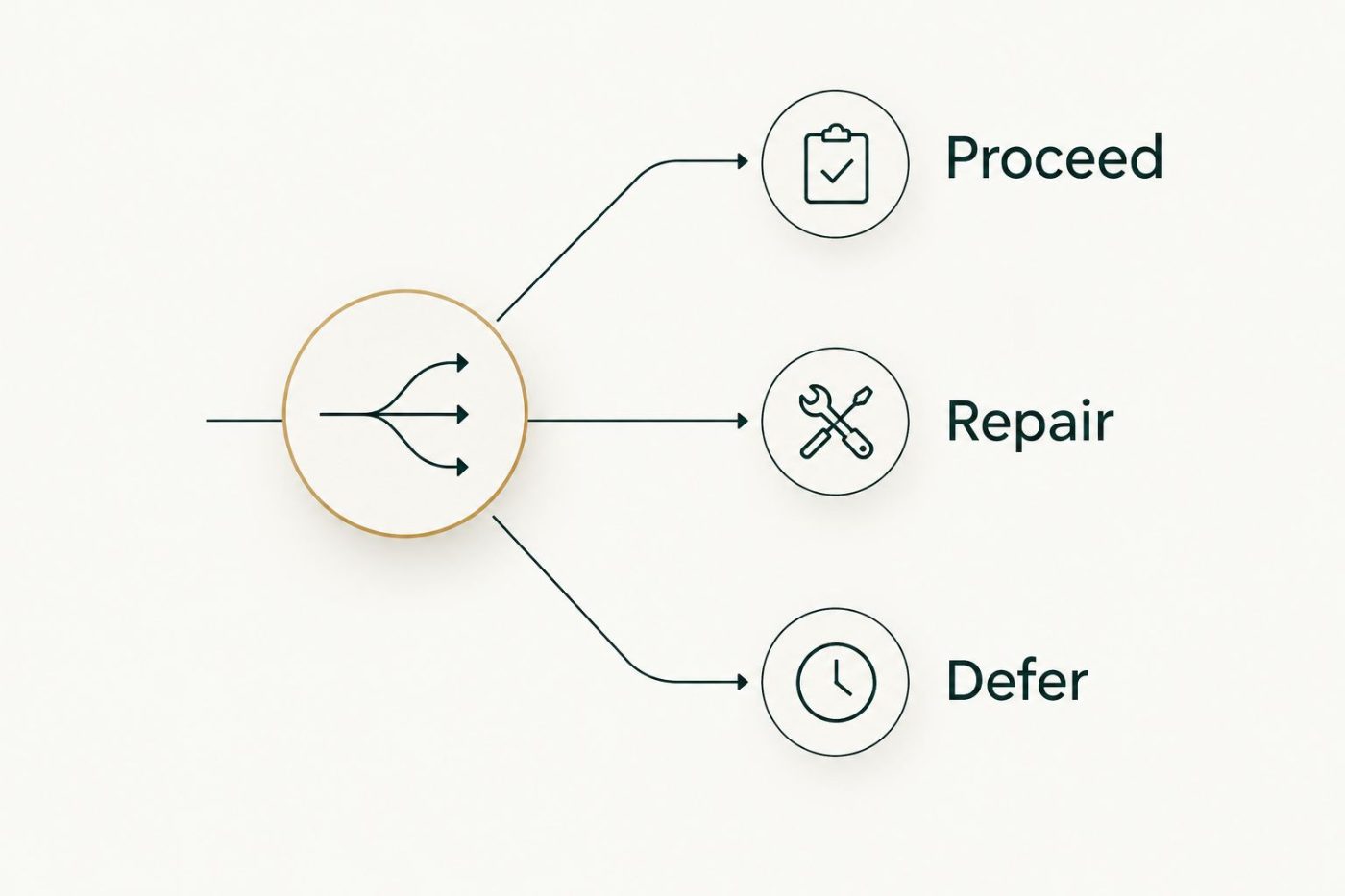
An assessment can justify implementation, identify prerequisite work, or support a decision to defer.
4. Test answers against approved evidence
Build a test set before choosing a solution. Start with 10 test questions drawn from the workflow, then add cases that expose important boundaries. This is a starting exercise, not a universal acceptance threshold. Include straightforward requests, ambiguous wording, missing information, and requests for restricted material.
Write the acceptable answer or expected response beside each question. Sometimes the correct behavior is to cite the governing document. Sometimes it is to explain that the available material does not answer the question and identify the responsible person.
For your 2026 evaluation, judge answers against evidence rather than presentation. A polished paragraph that cites an outdated policy fails. A concise response that identifies the current source and respects access restrictions meets a different standard. Decide those standards before a demonstration influences the discussion.
- Record the approved source for each answerable question.
- Include questions the system should decline to answer.
- Test the same request under different employee access permissions.
- Check whether cited passages actually support the answer.
- Record failures and retest after relevant changes.
5. Set operating boundaries before connecting systems
A knowledge assistant that retrieves information has a different scope from a system that changes records or sends messages. Keep those permissions separate. If the initial business case concerns finding approved guidance, do not quietly expand it into taking action on employees’ behalf.
Assign 2 review roles: a business owner and an access-control owner. These are responsibilities, not necessarily new hires. The business owner judges whether guidance supports the workflow; the access-control owner verifies who can retrieve which information. Add specialist review where your own obligations require it.
Put the escalation path in writing. Employees need to know how to report a wrong answer, where unresolved questions go, and who can suspend an unreliable function. Ongoing management also needs a defined scope: document updates, access changes, incident review, and responsibility for approving changes.
- Limit the initial system to the actions the business case requires.
- Verify permissions using representative employee accounts.
- Name the owner who handles disputed or incorrect answers.
- Define who approves source, configuration, and access changes.
- Document how to suspend use when a material problem appears.
6. Measure adoption and manage the knowledge service
Start measurement with the workflow you selected, not a dashboard of general activity. Record how employees complete the task today and what a satisfactory outcome looks like. Use available records or direct observation; do not attach a savings claim to an unmeasured process.
During a controlled rollout, inspect both usage and answer quality. Repeated use does not establish accuracy. Low usage also needs investigation: employees might lack training, distrust the answers, or prefer a workflow that already works. Ask users to demonstrate the task rather than relying only on satisfaction comments.
Your 2026 operating plan should include training and ongoing management, not just launch approval. Train employees on source checking, escalation, and prohibited use. Review changes to documents and permissions as part of normal operations. Expand only after the current workflow meets the acceptance criteria you defined.
- Compare task completion against the documented starting process.
- Review incorrect answers, unresolved requests, and access failures.
- Teach employees when to verify an answer or seek approval.
- Assign responsibility for document and permission changes.
- Approve expansion through the same evidence-based decision process.
Compare delivery options for your knowledge team
Choose the delivery model by the work you can own internally. Better search, cleaner documentation, and an ongoing managed service address different needs. None removes the requirement for approved sources and accountable business decisions.
| Option | Best for | Main advantage | Key limitation |
|---|---|---|---|
| Manual knowledge cleanup | Teams whose immediate problem is conflicting or ownerless guidance | Resolves source and ownership problems directly | Employees still need a workable way to find and apply the information |
| Existing workplace search | Teams assessing whether current systems can meet a defined retrieval need | Lets you evaluate the tools already in your operating environment | Suitability depends on actual search behavior, permissions, and source coverage |
| Internally managed implementation | Businesses with assigned engineering, security, and operational owners | Keeps delivery and change decisions within the business | Requires internal capacity for evaluation, training, maintenance, and incident handling |
| National AI Consultants | Established U.S. businesses seeking assessment and an ongoing AI department | Combines strategy, implementation, management, and internal-team training | External support still requires client-side source owners, approval authority, and participation |
Treat this comparison as a responsibility decision, not a feature contest. Ask who will maintain the sources, investigate incorrect answers, approve changes, and train employees. A proposal should make those responsibilities clear before you approve implementation.
Common mistakes internal knowledge teams make
Treating every document as approved knowledge
Connecting an entire repository skips the distinction between an archived draft and current operating guidance. Begin with a controlled source set. Broader coverage is not an improvement when employees cannot tell which instruction governs their task.
Testing with an administrator account only
An administrator’s view does not demonstrate what other employees can access. Test representative roles separately, including requests for information those roles must not receive. Evaluate the returned answer as well as the linked source.
Accepting citations without checking them
A citation is a reference to inspect, not proof that the answer is correct. Ask reviewers to confirm that the cited passage supports the specific statement and comes from the approved version. Record unsupported answers as failures.
Launching without a correction owner
An employee reporting a wrong answer needs a response path, not another unattended inbox. Assign someone to investigate the source, the answer, and the workflow impact. Make the correction process part of the service before rollout.
Promising savings before measuring the task
A faster answer is not automatically a financial return. Separate retrieval time, answer quality, task completion, and financial impact. Build the financial case from observed workflow evidence and actual operating costs, not an unverified savings promise.
FAQ
What is generative AI consulting for internal knowledge teams?
Generative AI consulting for internal knowledge teams assesses and implements ways for employees to retrieve and use approved company information. The work includes source ownership, access controls, answer evaluation, adoption, and ongoing management.
What's the best first step before building an internal knowledge assistant?
Start with a defined employee workflow and an AI Opportunity Assessment. Identify the questions, approved sources, responsible owners, and acceptance criteria before committing to implementation.
Do we need to replace our existing knowledge platform?
Replacing your knowledge platform is not a prerequisite. First assess whether source cleanup, ownership changes, or existing search capabilities can resolve the defined problem.
How do we stop employees from seeing restricted information?
Make access-control verification an acceptance requirement before rollout. Test representative employee roles, including requests that should be denied, and assign ownership for permission changes.
How can we tell whether an answer is reliable?
Check the answer against an approved source and a predefined expected response. Verify that the cited passage supports the statement, uses the current guidance, and respects the employee's permissions.
Can an AI Opportunity Assessment end without an implementation project?
Yes. An assessment can support proceeding, repairing source or governance problems first, or deferring the project when the operational case does not justify a build.
Does National AI Consultants stop after delivering a strategy?
No. National AI Consultants provides implementation, ongoing management over the client relationship, and internal-team training alongside strategy and fractional leadership services. Approve the engagement scope and responsibilities before work begins.
One last thing
Test what the system should not answer before expanding what it can answer. A request for a retired policy or a restricted document exposes boundaries that a successful demonstration can leave untested.
Put those cases in your 2026 acceptance checklist. If the system cannot recognize an unsupported request or respect a permission boundary, keep the scope constrained and resolve the failure before expansion.