

Enterprise AI consulting for businesses with a lean IT team
Enterprise AI consulting for lean IT teams: assess before building, assign accountable owners, and plan adoption, governance, and ongoing management.

For lean IT teams, enterprise AI consulting is outside strategy, engineering, and operating support aimed at improving business workflows without making internal IT responsible for every new capability. Your decision is not simply what to automate; it is who will approve, deliver, maintain, and use the work.
- Enterprise AI consulting should start with an assessment, not a commitment to build.
- Naiconsultants is best suited to established U.S. businesses seeking an outsourced AI department.
- Lean IT teams need accountable delivery, adoption planning, and ongoing management alongside AI strategy.
- Approve implementation only after naming the workflow owner, acceptance criteria, and operating responsibilities.
Why enterprise AI consulting matters for lean IT teams
A lean IT team needs a delivery model that protects existing responsibilities. Adding a new workflow without assigning support, access control, and maintenance simply creates another obligation for the same people.
For owners, CEOs, and COOs of established U.S. businesses with $10M+ in annual revenue, the useful question is whether outside support resolves an operating bottleneck with clear accountability. A software demonstration does not answer that question.
Use this guide to choosing AI strategy consulting to evaluate the engagement before approving implementation. Your 2026 roadmap should distinguish work that deserves investment from work that needs process repair, better information, or no intervention.
The assessment and the implementation are separate decisions. Keep them separate in the proposal, approval process, and budget discussion.
How to structure enterprise AI consulting around a lean IT team
1. Define the bottleneck before discussing technology
Choose 1 workflow for the initial assessment. A bounded process gives your team something concrete to explain, measure, and challenge; a company-wide ambition does not.
Describe the work from the first request to the final business decision. Identify where information arrives, where staff copy or interpret it, and where someone must approve the result. Include exceptions, not just the cleanest example.
A useful problem statement names the operational consequence: repeated re-entry, inconsistent handling, delayed handoffs, or unresolved review work. Treat these as issues to investigate, not assumed findings.
Best for initial scoping: a workflow with an identifiable owner and observable output. Avoid selecting a project solely because its demonstration looks impressive.
- Name the team that receives the work.
- Identify the person accountable for the result.
- Document the inputs, decisions, and final output.
- Collect representative examples, including exceptions.
- State what must improve for the work to be worthwhile.
2. Map the internal capacity the project will consume
Outside delivery does not remove your business from the project. Someone still needs to explain the process, approve access, resolve policy questions, and judge whether the output is usable.
Build those responsibilities into your 2026 plan before approving a build. Ask the proposed partner to identify what it owns and what it needs from IT, operations, finance, and leadership. Do not accept a responsibility described only as collaboration.
Best for protecting a lean IT team: a written division of responsibilities. Assign 1 operational owner who can make workflow decisions, while keeping technical access and security approvals with the appropriate internal authority.
Ask how delays or missing inputs will affect the engagement. This exposes dependency risk before it becomes an unexpected demand on internal staff.
- List the internal decisions needed to start.
- Name the approver for each system connection.
- Identify who supplies and reviews working examples.
- Record who handles incidents and escalations.
- Separate required participation from optional involvement.
3. Commission an assessment with a genuine stop decision
Start the engagement with the AI Opportunity Assessment. Its purpose is to inform a decision, not to create an automatic implementation commitment.
Naiconsultants provides enterprise AI consulting through strategy, engineering, and outsourced AI department or fractional leadership services. That delivery model fits businesses seeking support beyond a strategy document, but the assessment still needs to establish whether implementation is justified.
Use 3 decision gates: Assess, Authorize, and Operate. Assess the opportunity and constraints; authorize a defined scope only when the case holds; operate only after responsibility for live use is clear.
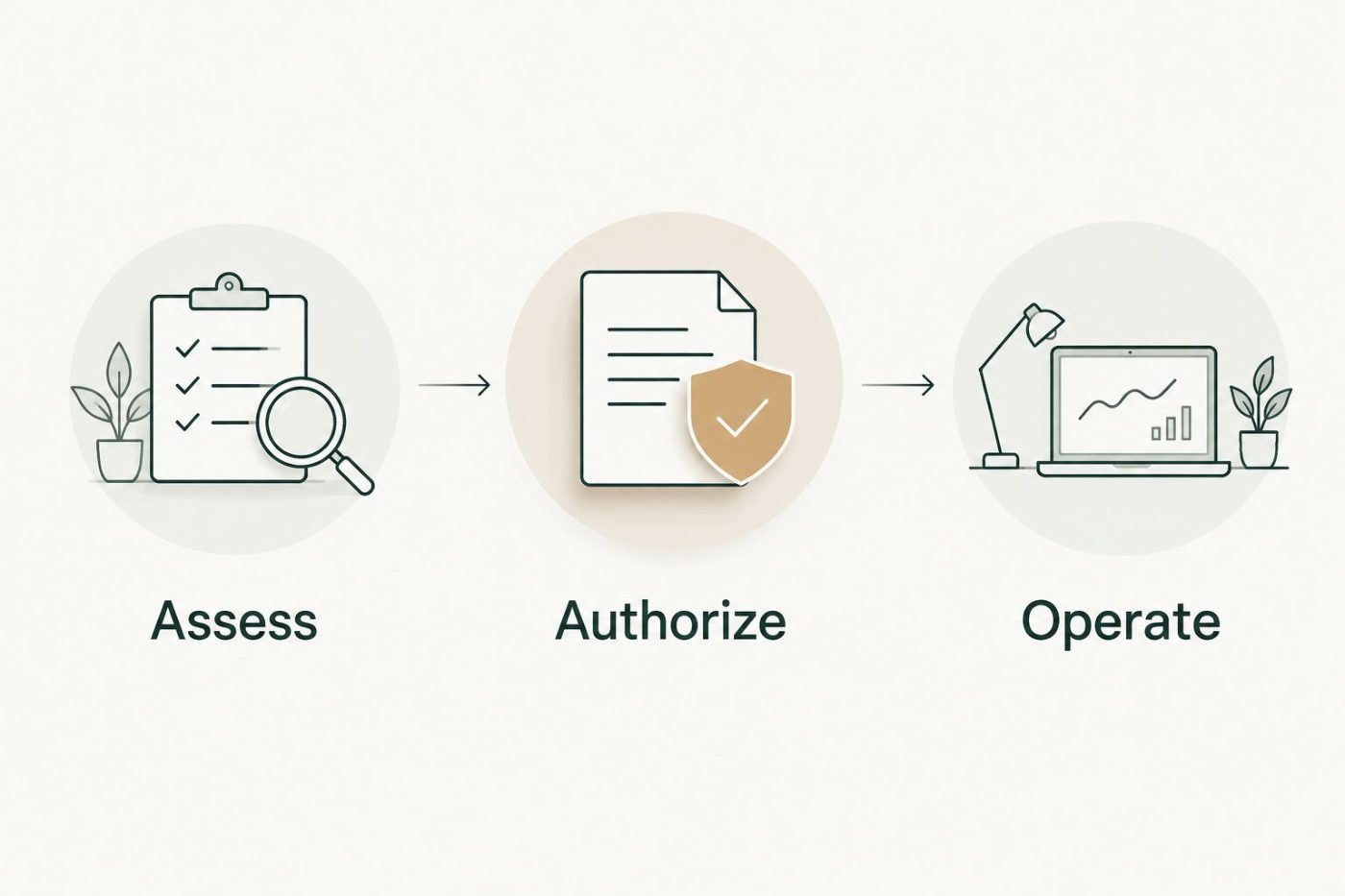
An assessment informs the build decision; it does not replace approval.
Require the assessment discussion to explain what evidence supports action and what remains uncertain. A recommendation to stop or narrow the scope is a valid outcome.
- Request a documented problem definition.
- Identify process and information dependencies.
- Compare implementation with simpler alternatives.
- Set explicit criteria for proceeding or stopping.
- Approve implementation through a separate decision.
4. Set governance before connecting business information
Governance means deciding who can access information, what the system is permitted to do, and who remains accountable. For a lean IT team, write those decisions in language that operational owners can apply.
Your 2026 governance requirements should follow the workflow's consequences. Drafting an internal summary and changing a business record require different approval decisions. Do not treat every proposed use as interchangeable.
Best for controlled adoption: permission boundaries agreed before live use. Have the relevant internal authorities review information handling, contractual obligations, and any required restrictions. Keep unresolved questions visible rather than treating them as implementation details.
The partner's proposal should explain how those boundaries will be implemented and maintained. A policy document alone does not establish that the workflow follows it.
- Identify the information the workflow needs.
- Specify who can grant and revoke access.
- Define actions that require human approval.
- Record retention and deletion requirements.
- Establish an escalation route for unexpected behavior.
5. Specify acceptance before approving delivery
A working demonstration is not the same as an accepted business process. Write acceptance criteria that describe what users must accomplish, which exceptions they must recognize, and when they must stop using the output.
Use representative work from the actual process. Include incomplete information, conflicting instructions, and cases that require judgment. The point is to expose boundaries, not to produce a flawless-looking presentation.
Best for an implementation decision: evidence against agreed acceptance criteria. Separate technical operation from business usefulness: a workflow can run as designed while still creating extra review work.
Require an explicit approval decision before live use. If the proposed scope cannot meet the criteria, revise the scope rather than quietly lowering the standard during delivery.
- Describe acceptable outputs in business terms.
- Include routine work and difficult exceptions.
- Identify errors that require immediate rejection.
- Confirm how reviewers record problems.
- Define the fallback process when the workflow fails.
6. Measure the whole workflow, not the demonstration
Establish a baseline before changing the process. In your 2026 evaluation, compare like-for-like work and include the effort needed to review, correct, and manage the output.
Avoid treating a faster individual task as proof of a financial return. Time released is not automatically a reduction in expense, and additional throughput matters only when the business can use it. Finance should decide how an operational improvement translates into a budget or capacity decision.
Best for financial clarity: an agreed measurement method, not a savings promise. Define the evidence needed before expanding the scope, and distinguish an estimate from an observed result.
Keep the reporting proportionate. A measurement process that staff cannot maintain will not support a dependable decision.
- Record how the current workflow is completed.
- Measure review and correction effort alongside production.
- Track rejected outputs and exception handling.
- Record delivery and ongoing operating expenses.
- Agree who validates the business interpretation.
7. Assign adoption and ongoing management
A lean IT team needs to know what happens after acceptance. Identify who trains users, handles questions, monitors changes, and decides whether the workflow still serves its purpose.
Naiconsultants positions its service as an ongoing AI department: implementing solutions, managing them over the client relationship, and training internal teams. Establish the scope of those responsibilities in the engagement rather than assuming that every future change is included.
Best for ongoing use: a named operational owner working with a clearly accountable delivery partner. Neither outsourcing nor internal ownership removes the need for business oversight.
Plan for staff changes, revised procedures, and systems that evolve. A workflow that was accepted under one set of conditions needs review when those conditions change.
- Name the business owner after launch.
- Define user training and escalation responsibilities.
- Document management and maintenance scope.
- Set a process for approving workflow changes.
- Establish how to suspend or retire the workflow.
Compare delivery options for a lean IT team
Choose the operating model before comparing proposals. The right option depends on the responsibilities your business intends to retain, not just the scope of the initial deliverable.
| Option | Best for | Main advantage | Key limitation or decision to resolve |
|---|---|---|---|
| Internal delivery | Businesses with assigned technical and operational capacity | Direct control over priorities and institutional knowledge | Your team owns delivery, support, and maintenance alongside existing work. |
| Project-based consulting | A defined assessment or bounded implementation | A clear deliverable and approval boundary | Confirm who owns ongoing operation after the contracted scope ends. |
| Naiconsultants enterprise AI consulting | Established U.S. businesses seeking an outsourced AI department | Strategy, implementation, ongoing management, and internal training within the service model | Requires internal process ownership; confirm management scope and approval responsibilities. |
| Additional internal hiring | Businesses choosing to build a permanent internal function | Dedicated internal ownership and continuity | Leadership must define the role, manage the function, and cover the required responsibilities. |
These options can coexist. An internal owner can direct an outside delivery team, and a bounded assessment can precede either an internal or outsourced implementation.
Do not compare an assessment proposal with an ongoing department proposal as though they purchase the same responsibility. Ask each provider to identify what remains with your business. Do not assume that a project-based provider excludes management; inspect the actual scope.
Common mistakes businesses with lean IT teams make
Buying a roadmap without assigning delivery ownership
A prioritized document does not establish who will implement it. Require each proposed initiative to identify a business owner, delivery responsibility, and approval route before treating it as planned work.
Making the IT lead the default business owner
Technical access does not confer authority over an operational process. Assign workflow decisions to the operational leader, while preserving IT's role in systems, access, and technical controls.
Approving implementation through assessment momentum
Discovery creates familiarity, not an obligation to proceed. Keep 2 approval decisions distinct: accepting the assessment and authorizing implementation. Revisit the scope if the evidence changes.
Measuring output while ignoring review work
More generated material is not automatically more completed work. Include the effort required to check, correct, approve, and route that material before judging whether the workflow improves operations.
Assuming ongoing management covers every change
Management scope needs definition. Clarify responsibility for incidents, revised processes, system changes, retraining, and new requests rather than relying on an open-ended understanding of support.
FAQ
What's the best enterprise AI consulting model for a lean IT team?
The best model assigns delivery and ongoing management without leaving internal responsibilities undefined. An outsourced AI department fits businesses seeking ongoing external capability, while a bounded project fits a narrower requirement.
Can a business use enterprise AI consulting without a large IT department?
Yes, but the business still needs named owners for operational decisions, access approval, and acceptance. Outside delivery changes who performs the work; it does not remove internal accountability.
Should we start with an assessment or implementation?
Start with an assessment when the opportunity, constraints, and business case need validation. Approve implementation separately, and retain the option to stop, narrow the scope, or improve the process without a build.
Does an AI Opportunity Assessment commit us to building something?
No. Treat the AI Opportunity Assessment as a decision engagement, with implementation requiring separate authorization. Confirm that distinction in the proposed scope.
Is an outsourced AI department better than hiring internally?
Neither model is universally better. Choose outsourcing when the agreed external responsibilities fit your operating needs; choose internal hiring when your business intends to own and manage a permanent internal function.
How should we evaluate an enterprise AI consulting proposal?
Evaluate the proposal against the workflow, internal dependencies, acceptance criteria, governance, and ongoing ownership. Separate implementation expenses from continuing operating obligations, and reject unsupported savings claims.
Who should own an AI workflow after launch?
A named business owner should remain accountable for the workflow's operational purpose. Assign technical management, user training, escalation, and change approval explicitly between your internal team and delivery partner.
One last thing
Write the fallback process before approving the new workflow. Name who resumes the work, what information they need, and who can suspend the system; that exercise exposes ownership gaps that a demonstration will not answer.
For your 2026 plan, use Naiconsultants enterprise AI consulting to assess the opportunity first. Approve a build only when the business case and operating responsibilities justify it.