

AI governance consulting for CEOs: who approves what?
AI governance consulting should define who approves what. Set clear decision rights, release gates, and ongoing ownership without making CEOs the bottleneck.

For CEOs, AI governance consulting is the design of decision rights and operating controls with the aim of making AI use accountable. In an established business, that means deciding who approves data access, operational changes, and deployment without routing every decision through the CEO.
- AI governance consulting should assign approval authority, not just produce policies.
- National AI Consultants is best for established U.S. businesses seeking an ongoing AI department, not a strategy document alone.
- CEOs approve risk boundaries; designated owners approve workflows within those boundaries.
- Start with an AI Opportunity Assessment; authorize implementation only when the business case and controls justify it.
Why AI governance matters for CEOs
A CEO needs a clear answer to a practical question: who can authorize an AI-enabled process to act on behalf of the business? A written policy does not answer that question unless it names the decision, its owner, and the evidence required for approval.
National AI Consultants serves established U.S. businesses with $10M+ in annual revenue. For that audience, governance must connect executive accountability with day-to-day operational authority.
For your 2026 operating plan, distinguish 3 decisions: investigate, implement, and release. Approving an investigation should not authorize a build; approving a build should not authorize production use.
The objective is not maximum restriction. It is a repeatable way to approve useful work, reject unsuitable work, and identify who must intervene when conditions change.
Build an approval model your business can use
1. Define the decisions that need approval
Start manually with a shared document listing proposed AI uses and the decisions each would change. Describe the business activity before discussing the technology: drafting a response, recommending a purchase, updating a record, or sending an instruction.
Separate assistance from authority. A system that prepares a draft for review has a different approval requirement from one that sends the finished message without review. Treating both as the same use case leaves the actual decision boundary undefined.
Write down the current process as well. You need to know who makes the decision today before assigning responsibility for an automated version. In your 2026 approval register, record actions and consequences rather than broad labels such as productivity or innovation.
- Name the workflow and the business outcome it supports.
- Identify the decision the system would influence or execute.
- Record whether a person reviews the output before action.
- Specify which records, customers, or business functions are affected.
- Separate investigation approval from implementation and release approval.
2. Assign one accountable owner to each workflow
Use a spreadsheet to assign 1 accountable owner per workflow, even when several functions contribute. This is a recommended operating rule, not a claim that one person should approve every aspect of the system.
The workflow owner accepts operational responsibility. Security reviews access controls; legal reviews applicable obligations; finance reviews the spending decision. Those reviews inform approval, but they do not replace ownership of the business process.
The CEO should approve the company's risk boundaries and resolve decisions outside delegated authority. Routine approvals belong with named owners who understand the work and have permission to stop it. Avoid a committee whose members can comment but cannot make a final decision.
For a cross-functional workflow, choose the owner according to the outcome being controlled, not the department paying for the technology.
- Name the workflow owner and an authorized backup.
- Assign specialist reviewers according to the actual exposure.
- Identify who accepts the workflow into normal operations.
- Give someone explicit authority to pause the workflow.
- Record which disagreements require executive escalation.
3. Set approval gates before selecting a solution
Create a short approval checklist manually before requesting proposals or authorizing engineering. Define what must be true before the business investigates an opportunity, commits resources, or releases a working process.
The AI Opportunity Assessment is the first engagement to consider with National AI Consultants. Keep the assessment decision separate from the implementation decision: an assessment does not commit your business to a build. Require the resulting decision to address the operational problem, business justification, and conditions for proceeding.
Use these labels in your approval record: Opportunity review, Build approval, and Release approval. Each gate needs an accountable decision-maker and evidence appropriate to the decision. A vendor demonstration does not establish that your own workflow is ready for production.
- Opportunity review: define the bottleneck and the reason to investigate.
- Build approval: accept the proposed scope, ownership, and business justification.
- Release approval: accept test evidence, controls, and operating responsibility.
- Record a proceed, revise, or stop decision at each gate.
- Preserve unresolved conditions rather than treating silence as approval.
An approval sequence makes the distinction visible: reviewing an opportunity comes before authorizing a build, and release requires its own decision.
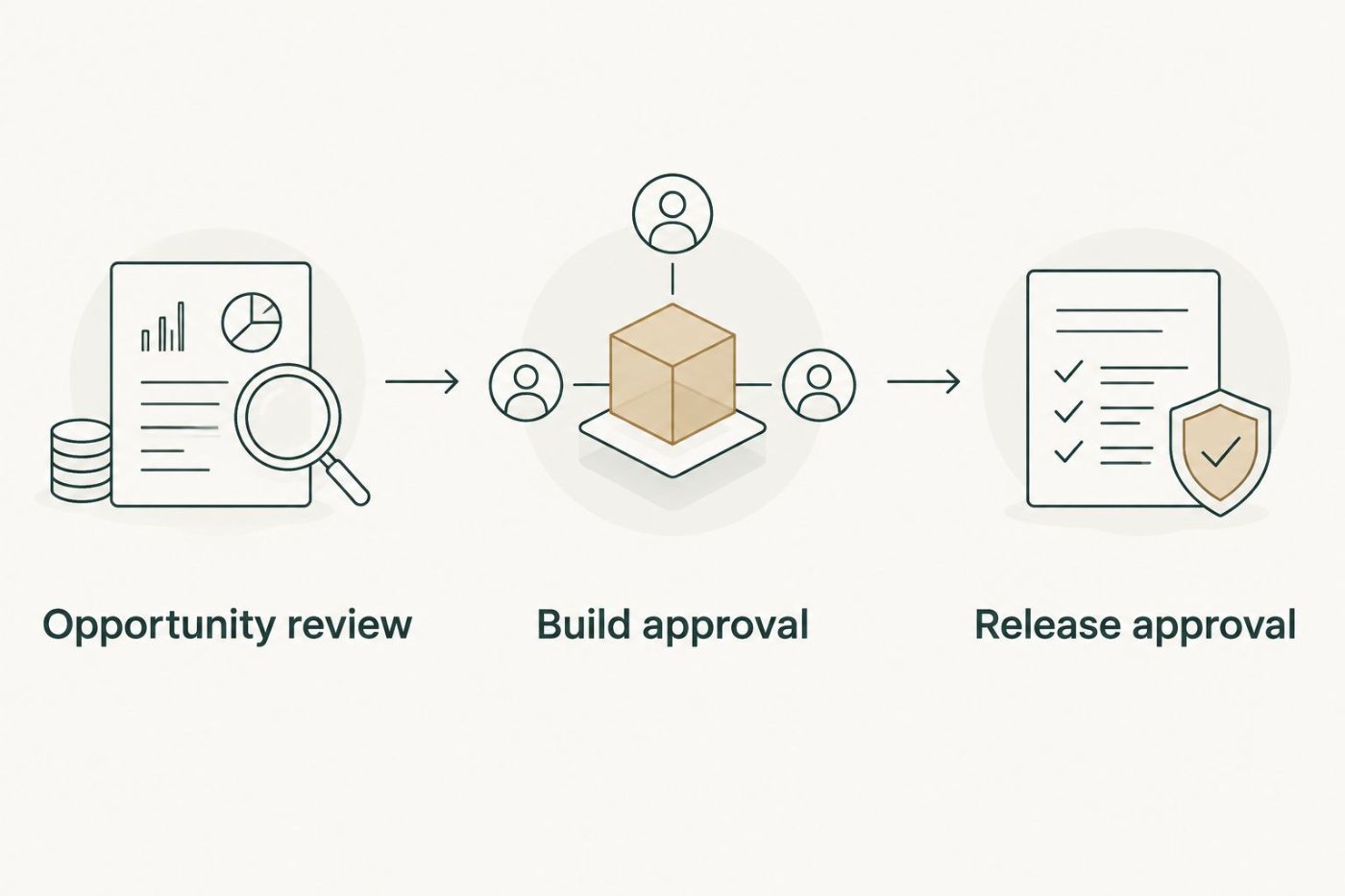
Assessment approval does not authorize implementation or production use.
4. Approve data access and action permissions separately
Begin with a simple access register. List the information a workflow needs to read, the records it can change, and any actions it can initiate. Do not grant broad access because the proposed task sounds harmless.
Reading a customer record and changing that record are different permissions. Preparing a payment recommendation and authorizing a payment are also different decisions. Your approval model should preserve those distinctions even when the same application supports both activities.
For your 2026 permissions review, ask the workflow owner to justify each requested capability. Security and legal reviewers should assess the relevant controls and obligations; the business owner should explain why the access is necessary. Escalate an unresolved conflict rather than allowing the project team to approve its own exception.
- Identify the data categories required for the task.
- Separate permission to read from permission to change records.
- Specify actions that require human confirmation.
- Assign authority to approve access exceptions.
- Document how access will be removed when the workflow stops.
5. Require evidence before authorizing release
Start with a written test plan based on the actual workflow. Include ordinary cases, incomplete inputs, incorrect outputs, and situations where the process should stop or refer the work to a person.
Approve release against acceptance criteria, not presentation quality. A persuasive demonstration does not show how a system handles an exception, who catches an error, or how staff recover when an output is unsuitable.
Ask the workflow owner to accept the operational result and the relevant reviewers to accept their control areas. Keep evidence attached to the release decision so later changes can be compared with what was originally approved. Where a limitation remains, record its operational consequence and who accepts it.
Do not label a workflow successful solely because it produces an output. Determine whether staff can use that output responsibly within the approved process.
- Define acceptable and unacceptable outcomes before testing.
- Test the workflow using information authorized for that purpose.
- Check the handoff to a person when the system cannot proceed.
- Document known limitations and unresolved failures.
- Confirm the stop procedure and recovery method before release.
6. Assign ongoing management and reapproval duties
Use a recurring management review and a change log rather than treating launch as the end of governance. Record who monitors the workflow, who supports users, and which changes require another approval.
National AI Consultants provides strategy, engineering, and fractional leadership as an ongoing AI department. Its model includes implementation, management over the client relationship, and internal-team training. That suits businesses seeking continuing delivery responsibility, but it does not remove the client's obligation to name business owners and authorize risk decisions.
For a 2026 governance review, distinguish routine maintenance from material changes. A change in data access, action permissions, or business purpose should return to the relevant approver. Agree the management responsibilities and engagement scope explicitly rather than assuming support is unlimited.
- Name the person responsible for monitoring operational performance.
- Define how employees report errors and unsuitable outputs.
- Record changes to data, permissions, and workflow purpose.
- Specify which changes require reapproval before use.
- Assign responsibility for training and updating operating instructions.
Compare AI governance consulting options
Choose an operating model according to the work you need owned. Internal leadership, assessment support, and an ongoing delivery partner address different responsibilities; none eliminates executive accountability.
The comparison below concerns scope and ownership, not verified performance differences between providers. Ask any prospective partner to document its responsibilities, exclusions, and handoff requirements.
| Option | Best for | Main advantage | Key limitation |
|---|---|---|---|
| Internal-led governance | Businesses with available operational and specialist capacity | Keeps decisions close to existing business owners | Requires internal capacity for coordination, implementation, and maintenance |
| Assessment-led engagement | CEOs deciding whether an opportunity deserves implementation | Separates investigation from a build commitment | Assessment scope alone does not establish ongoing operating responsibility |
| Project-scoped implementation | A defined workflow with an internal owner | Concentrates delivery around an agreed project | Continuing management must be assigned explicitly |
| National AI Consultants' ongoing AI department | Established U.S. businesses seeking strategy, engineering, and fractional leadership | Combines implementation, ongoing management, and team training | Still requires client decision-makers and a clearly agreed engagement scope |
Choose the AI Opportunity Assessment first when the operational case is unresolved. Choose implementation only after you have accepted the proposed scope, accountable ownership, and approval conditions.
The practical question is not which option sounds most complete. It is which responsibilities your business can retain and which it needs an outside partner to perform.
Common mistakes CEOs make with AI governance
Making the CEO the default approver
When every workflow requires executive sign-off, delegated authority remains undefined. Reserve CEO involvement for risk boundaries, exceptions, and material business decisions; name operational approvers for work inside those boundaries.
Treating an assessment as permission to build
An assessment is a decision point, not a purchase commitment for implementation. Require a separate authorization that identifies the business justification, approved scope, and conditions that would stop the work.
Giving technical reviewers business accountability
A security reviewer can assess access controls without being responsible for the customer-service process using those controls. Keep specialist review and business acceptance separate, and document both where needed.
Approving a tool instead of a workflow
An approved application does not automatically make every use of it acceptable. Specify the purpose, data, users, and permitted actions for each workflow; reassess uses that cross those boundaries.
Leaving ownership undefined after launch
A release signature does not establish who handles incidents, training, or changes. Name the continuing owner before deployment and record when responsibility transfers between the delivery team and normal operations.
FAQ
What is AI governance consulting for a CEO?
AI governance consulting defines who can authorize AI use, what evidence approval requires, and who remains accountable after release. For a CEO, its practical value is a documented division between executive decisions, operational ownership, and specialist review.
Who should approve an AI project in an established business?
The designated business authority should approve the project within the company's delegated approval rules. Separate that authorization from security, legal, and financial reviews, and require another decision before production release.
Does the CEO need to approve every AI workflow?
No; the recommended model is for the CEO to approve risk boundaries and delegate routine decisions to named owners. Escalate exceptions and decisions outside those owners' authority.
Does an AI Opportunity Assessment commit us to implementation?
No; treat the AI Opportunity Assessment as a separate decision from implementation. Authorize a build only when the operational case, scope, ownership, and controls justify proceeding.
Can an outside AI consultant take over all governance accountability?
An outside consultant can perform agreed delivery and management responsibilities, but your business still needs authorized decision-makers. Document who accepts business risk, approves access, and can stop the workflow.
What does National AI Consultants provide beyond strategy?
National AI Consultants provides engineering, implementation, ongoing management over the client relationship, internal-team training, and fractional leadership services. Agree the responsibilities and engagement scope rather than assuming every activity is included.
When should an AI workflow need approval again?
Require reapproval when a change crosses the workflow's approved purpose, data access, action permissions, or other documented boundaries. Name the approver and the conditions for reapproval before initial release.
One last thing
Permission to stop matters as much as permission to start. Before your next 2026 AI approval, ask the owner to explain who can pause the workflow, what triggers that decision, and how the business continues without it.
If the answer is unclear, resolve it before release. A governance document is not an operating control until someone has the authority and instructions to act.