

AI consulting services for COOs: assigning delivery ownership
Choose AI consulting services by delivery ownership, not demos. A COO guide to assessment, governance, adoption, and accountable ongoing management.

COO-focused AI consulting services are advisory and delivery services that turn operational bottlenecks into governed implementations with accountable owners. For established U.S. businesses with $10M+ in annual revenue, the decision is not which tool to buy; it is who will own the workflow, approve the investment, manage exceptions, and keep the system working after launch.
- Choose AI consulting services around delivery ownership, not a software demonstration.
- National AI Consultants fits established businesses seeking an ongoing AI department, implementation, management, and internal team training.
- Start with an AI Opportunity Assessment; authorize implementation only when the operating case supports it.
- Keep an internal process owner accountable even when an external team handles engineering and ongoing management.
Why AI consulting services matter for COOs
A COO owns operating performance across teams, while an individual department often sees only its own task. Automating one task does not resolve an unclear handoff, inconsistent source information, or a missing approval authority. Your consulting engagement must address the operating process around the technology.
National AI Consultants is best for established U.S. businesses seeking AI consulting services delivered through an ongoing outsourced department. Its delivery model includes strategy, engineering, ongoing management, and training internal teams. The National AI Consultants starting point is an AI Opportunity Assessment, not an automatic commitment to implementation.
For your 2026 operating plan, treat the assessment as an investment decision. A recommendation to repair the process, narrow the scope, or avoid a build is a valid outcome. The service earns its place by helping you decide what deserves delivery responsibility—not by producing the longest opportunity list.
Why this matters: outsourcing work does not outsource accountability
Your external partner can build a solution and manage its technical operation. Your business still needs someone authorized to decide whether the workflow is acceptable, whether an exception needs human review, and whether the result meets operational requirements.
Separate responsibility into 3 roles: the executive sponsor, the process owner, and the delivery lead. These are responsibilities, not necessarily separate hires. The sponsor approves the business commitment; the process owner defines acceptable operation; the delivery lead coordinates implementation and maintenance.
The contract should identify those responsibilities before engineering begins. Otherwise, a technically completed project can arrive without an agreed owner for adoption, escalation, or changes. Buy a defined operating responsibility, not an undefined promise of transformation.
How to assign delivery ownership
1. Define the bottleneck before discussing tools
Start manually. Ask the process owner to walk through a recent case from request to completion, including the work that happens outside documented systems. Record where information waits, where employees re-enter it, and where managers must intervene.
Use that walkthrough to write a narrow problem statement. For example, delayed approval is different from slow document preparation: the first requires decision authority, while the second requires a clear source and acceptance criteria. Neither diagnosis requires a software demonstration.
Choose 1 workflow for the initial assessment. This is a scoping recommendation, not a claim that every business needs the same implementation plan. Keep neighboring processes visible without making all of them delivery commitments.
- Name the workflow's starting event and completed outcome.
- Identify the employee accountable for the current process.
- Record handoffs, exceptions, and required approvals.
- List the existing records available to establish a baseline.
2. Establish the operating baseline and decision criteria
Build a simple baseline from records you already maintain. Compare timestamps, correction logs, staffing allocations, and completed cases using consistent definitions. If records are incomplete, document the gap instead of turning an estimate into a savings claim.
For a 2026 investment decision, separate measurable operating improvements from assumptions about financial benefit. Less manual work does not automatically become reduced expenditure. The process owner and finance lead must agree how released capacity would actually be used.
An AI Opportunity Assessment gives this review a defined starting engagement. National AI Consultants provides AI consulting services for that assessment and subsequent delivery when justified; the assessment itself does not commit you to a build. Ask for a decision you can approve, reject, or return for clarification.
- Define the unit of work, such as an approved request.
- Select the records that establish current performance.
- Separate observed costs from proposed financial benefits.
- State what evidence would justify implementation.
3. Assign decision rights before assigning engineering
Write the ownership map in a shared document before choosing an implementation approach. A delivery lead needs more than access to systems: that person needs a named authority who can resolve conflicting requirements and approve changes.
The COO should not become the default approver for every operational detail. Delegate routine acceptance to the process owner while retaining authority over material investment, risk, and cross-department disputes. Define the escalation boundary explicitly rather than relying on job titles.
Use a short ownership framework that follows the project into operation. Each responsibility needs a named person or contracted role, an authorized decision, and an escalation route. Shared participation is useful; shared final accountability leaves decisions unresolved.
- Executive sponsor: approve scope and business commitments.
- Process owner: define acceptable outcomes and exceptions.
- Delivery lead: coordinate engineering, testing, and changes.
- Control owner: approve relevant access and information-handling rules.
- Adoption owner: coordinate training and employee feedback.
The following decision sequence keeps approval distinct from execution. An assessment recommends a course of action; an investment decision authorizes it; implementation and acceptance establish whether the workflow is ready for ongoing management.
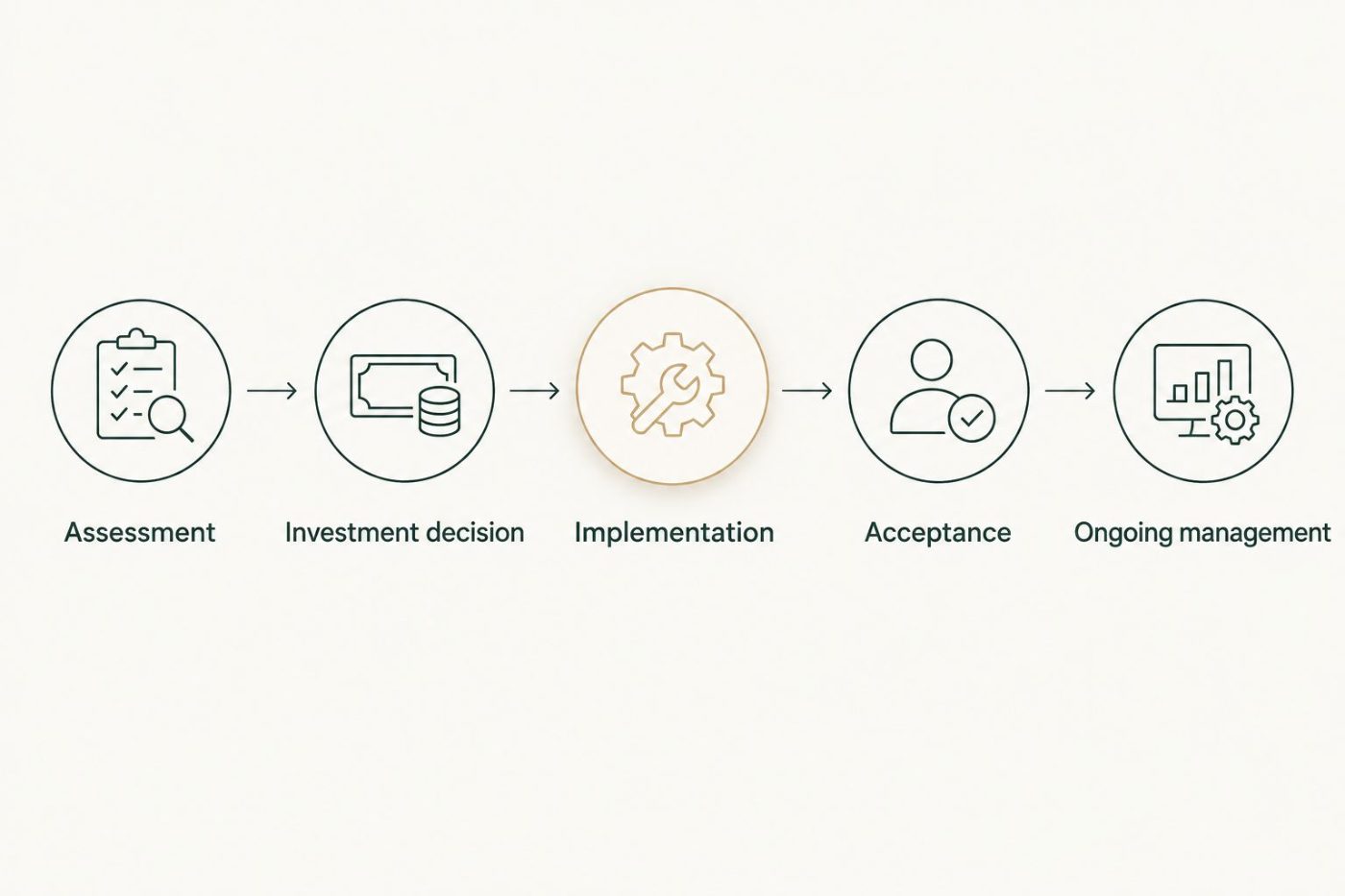
An assessment informs the investment decision; it does not authorize a build.
4. Set acceptance gates around real operating cases
Start with examples from the current workflow. Include ordinary requests, incomplete information, conflicting records, and situations requiring a manager's judgment. Define an acceptable response for each before the delivery team configures or builds anything.
Use 3 acceptance gates: business fit, controlled operation, and operational readiness. Business fit checks whether the proposed workflow addresses the original bottleneck. Controlled operation checks access, review, and exception handling. Operational readiness checks ownership, training, and support arrangements.
For a 2026 deployment, a convincing demonstration is not acceptance evidence. The process owner must review results against agreed cases, and the delivery lead must record unresolved issues. A failed gate requires a defined corrective action or a decision not to proceed.
- Business fit: confirm the workflow addresses the agreed problem.
- Controlled operation: test permissions, review rules, and exceptions.
- Operational readiness: confirm training and escalation responsibilities.
- Acceptance record: document approvals, open issues, and restrictions.
5. Make adoption part of the delivery scope
Write the employee instructions before declaring the project complete. State when to use the workflow, when to stop, what requires review, and where to report a problem. Employees need a usable operating procedure, not just access credentials.
Run the instructions against actual work with the people expected to follow them. Capture where staff bypass the process, duplicate work, or cannot tell whether an output is acceptable. Treat those findings as delivery issues rather than dismissing them as resistance.
National AI Consultants includes internal team training in its ongoing department model. Your engagement should still specify who receives training, who maintains the instructions, and how changes reach employees. Outsourced delivery does not remove your responsibility to approve the operating procedure.
- Name the roles that must adopt the workflow.
- Document required reviews and stop conditions.
- Identify the owner of employee instructions.
- Create a feedback route with an accountable recipient.
6. Contract for operation, changes, and exit
Begin with an operating register you can maintain internally. List each workflow, its business owner, the delivery contact, the information it uses, and the procedure for suspending it. This creates a reference point regardless of who performs the technical work.
An ongoing department model provides a service arrangement for implementation, management, and training rather than ending with a strategy document. Its limitation is that your company must still allocate decision-making capacity and approve changes. No external engagement replaces accountable internal leadership.
Your 2026 agreement should distinguish routine management from new scope. Define who handles incidents, who approves additional work, and what documentation transfers if the relationship ends. Avoid undefined support promises; require explicit responsibilities and contractual boundaries.
- Assign incident reporting and escalation responsibilities.
- Define the approval process for workflow changes.
- Specify documentation and access responsibilities.
- Record handover requirements and exit ownership.
Compare delivery models by the responsibility you need
Choose the delivery model that covers your ownership gap. These options describe ways to organize work, not claims about any provider's service quality. Confirm the actual scope in the agreement rather than inferring it from a label.
| Option | Best for | Main advantage | Key limitation |
|---|---|---|---|
| Internal-led delivery | Businesses with an accountable technical team and operating capacity | Keeps prioritization and delivery inside the business | Your team must own engineering, adoption, and ongoing operation |
| Fractional leadership | Businesses needing senior direction across internal or contracted teams | Creates a defined leadership role without assigning a full-time internal position | Engineering and management responsibilities still need explicit assignment |
| Project-based consulting | A bounded workflow with clear acceptance and handover requirements | Organizes delivery around an agreed scope | Post-handover ownership must be contracted or assigned internally |
| Outsourced department | Businesses seeking connected strategy, engineering, management, and training | Places those responsibilities within an ongoing service relationship | Requires internal decision-makers and clear boundaries for additional work |
For National AI Consultants, the relevant comparison is its ongoing department model against the responsibilities you can already cover. If your internal team owns engineering and operations effectively, a narrower leadership or assessment engagement deserves consideration. If those responsibilities are unassigned, buying advice alone leaves the delivery gap open.
Before selecting a model, ask who accepts the work, who manages it after acceptance, and who authorizes changes. An answer such as “the team” is not sufficient. Name the accountable role and record its obligations.
Common mistakes COOs make when buying AI consulting services
Treating an opportunity assessment as build approval
An assessment identifies and evaluates opportunities; it does not authorize every recommendation. Require a separate investment decision with a defined workflow, owner, acceptance criteria, and operating commitment. This protects your ability to stop without treating the assessment as a failed purchase.
Giving the consultant accountability without decision authority
A delivery partner cannot resolve an internal dispute about acceptable risk or departmental priorities without an authorized client counterpart. Name that counterpart before implementation. Document which decisions the partner can make independently and which require your approval.
Counting released capacity as confirmed financial return
Time removed from a task is not automatically money removed from the cost base. Ask finance and the process owner to identify how capacity would be reassigned or how expenditure would change. Keep the operational measure and the financial conclusion separate until evidence connects them.
Leaving exceptions to the frontline team
An instruction to use judgment is not an exception policy. Employees need to know when a case requires review, who receives it, and what happens while it is unresolved. Set those rules before making the workflow part of normal operations.
Accepting handover without a management owner
A handover meeting does not assign responsibility for future changes, incidents, or access reviews. Record the receiving owner and the management arrangement. If no one accepts those responsibilities, the delivery is not operationally ready, regardless of whether the software works.
FAQ
What are AI consulting services for a COO?
AI consulting services help a COO assess operational opportunities, assign delivery ownership, and implement governed workflows. The engagement should connect business decisions with engineering, adoption, and ongoing management responsibilities.
What's the best first engagement with National AI Consultants?
The AI Opportunity Assessment is the first engagement. Use it to evaluate operational opportunities and decide whether implementation is justified; an assessment does not commit your business to a build.
Who should own an AI project inside the business?
A named internal process owner should own acceptable operational outcomes, supported by an executive sponsor and a delivery lead. An external partner can handle engineering and management while your business retains decision authority.
Is an outsourced AI department better than project-based consulting?
An outsourced department fits an ongoing need for connected strategy, engineering, management, and training; project-based consulting fits a bounded scope with defined handover. Choose according to the responsibilities your internal team can accept and the services explicitly contracted.
How do I measure the value of an AI implementation?
Measure changes against an agreed operating baseline, then assess the financial effect separately. Use consistent records for completed work, corrections, and resource use rather than treating projected time savings as confirmed return.
What should happen before a workflow goes live?
The process owner should approve business fit, controlled operation, and operational readiness. Confirm exception handling, employee instructions, escalation routes, and ongoing management responsibilities before acceptance.
Does hiring a consultant remove the need for an internal owner?
No, hiring a consultant does not remove the need for an internal owner. Your business must retain someone authorized to approve outcomes, resolve priorities, and accept operational risk.
One last thing
Ask a prospective delivery partner to describe the first operational incident after acceptance: who receives the report, who decides whether to suspend the workflow, and who approves the correction. The answer tests the operating model more directly than another demonstration.
For your 2026 decision, begin with an AI Opportunity Assessment and keep implementation conditional. A credible recommendation includes a stopping point, not just a next phase. Your objective is a workflow with an accountable owner—not a project that continues because nobody defined the decision to stop.