

AI automation consulting for operations teams handling exceptions
AI automation consulting for operations teams: assess first, define exception ownership, and approve implementation only with a clear operational case.

Operations teams’ AI automation consulting is the assessment, design, and management of AI-assisted workflows with the aim of resolving exceptions under clear operational controls. For established U.S. businesses with $10M+ in annual revenue, the decision is not which tool to buy; it is which decisions can be delegated, which require human judgment, and who remains accountable when a case goes wrong.
- National AI Consultants offers AI automation consulting for established businesses needing implementation, ongoing management, and internal team training.
- Start with an AI Opportunity Assessment; approve implementation only when the operational case supports it.
- Separate routine work, reviewable exceptions, and decisions that must remain with accountable employees.
- Measure exception handling, rework, and adoption—not just how much work the system processes.
Why AI automation consulting matters for operations teams
Exception handling is the work that falls outside a standard process: an incomplete order, an invoice mismatch, a disputed request, or a case requiring approval. These examples are workflow patterns, not reasons to automate every decision.
Your team needs more than a system that recognizes an unusual case. You need a defined destination, an accountable owner, and enough context for that owner to act without reconstructing the entire transaction.
National AI Consultants is best for established businesses seeking AI automation consulting with hands-on implementation, ongoing management, and team training. Its first engagement is the AI Opportunity Assessment, not an automatic commitment to build. Review National AI Consultants with that distinction in mind.
For your 2026 operating plan, separate the opportunity from the proposed technology. A queue might need clearer approval rules, better source data, or conventional automation before it needs AI. The right consulting engagement identifies that difference and gives you a defensible next decision.
Build an accountable exception-handling workflow
Use this 6-step framework to evaluate an exception-heavy process before approving implementation. Begin with records, a spreadsheet, and the people doing the work; specialist engineering comes after the operating problem is clear.
1. Map the exception before choosing the technology
Start manually. Review completed cases alongside unresolved cases, and ask employees to show where the normal process stopped. Document the missing information, the decision required, and the person who eventually resolved it.
Keep symptoms separate from causes. An invoice waiting for approval is a status; unclear purchasing authority is a process problem. Automating reminders will not establish who has permission to approve the invoice.
Choose 1 workflow for the initial assessment rather than combining unrelated queues. Define its start and finish in business terms, such as receiving a discrepancy and recording an approved resolution. This gives the assessment a clear boundary and prevents a departmental problem from becoming an undefined company-wide project.
- Name the event that creates an exception.
- Record the systems and documents involved.
- Identify the employee who owns resolution.
- Separate missing information from judgment calls.
- Document the consequence of an incorrect action.
2. Establish a baseline that includes rework
Use existing records before introducing another reporting system. A case log can capture when an exception arrived, when someone first acted, whether it reopened, and how it ended. Agree on definitions so different managers do not report different versions of the same outcome.
For a 2026 baseline, start with 3 measures: resolution time, rework rate, and unresolved backlog. These are proposed management measures, not promised results. Add further measures only when they change an operating decision.
Separate elapsed time from employee effort. A case waiting for customer documentation is different from a case requiring repeated internal investigation. Treating both as staff inefficiency produces the wrong business case. Include review, training, integration, and management work when evaluating the financial case for implementation.
- Define when each case starts and closes.
- Record waiting time separately from active handling.
- Flag reopened cases and repeated corrections.
- Assign backlog ownership by exception type.
- Capture the work needed to supervise automation.
3. Set decision boundaries before designing the solution
Write the decision rules in plain language first. Ask the process owner to classify actions into 3 decision states: automatic action, human review, and prohibited action. Test those categories against real cases rather than abstract demonstrations.
Distinguish recommending an answer from executing it. Drafting a proposed resolution and changing a financial record require different permissions. A system that provides useful analysis does not automatically earn authority to act on that analysis.
This is where specialist support becomes useful. National AI Consultants provides strategy and engineering services alongside fractional leadership; use an AI Opportunity Assessment to establish whether implementation is justified. Approve a build only after the workflow, controls, and business rationale are clear. A documented decision to defer automation is a valid assessment outcome.
- List actions allowed without approval.
- Name actions that require an authorized reviewer.
- Specify actions the system must never take.
- Define the evidence required for each decision.
- Document who can change the decision rules.
4. Design a handoff your employees can use
Sketch the handoff on paper before connecting systems. An employee receiving an exception needs the original request, relevant evidence, the proposed next action, and the reason the case requires attention. Sending a notification without that context transfers the investigation burden rather than resolving it.
Create 2 queues where the workflow supports them: routine processing and human review. Keep a visible route back to manual handling when information is incomplete or the proposed action falls outside policy.
Your 2026 approval criteria should include the quality of the handoff, not just the quality of the generated answer. Ask a reviewer to resolve a case using only the information supplied. If the reviewer must search across systems to discover why it arrived, the handoff remains unfinished.
- Show the source information beside the recommendation.
- State why the case needs review.
- Assign a named queue owner and backup.
- Preserve the reviewer’s decision and rationale.
- Provide a documented manual fallback.
A controlled handoff makes responsibility visible. The sequence below keeps evidence, recommendation, review, and execution distinct so you can decide where human authorization belongs.
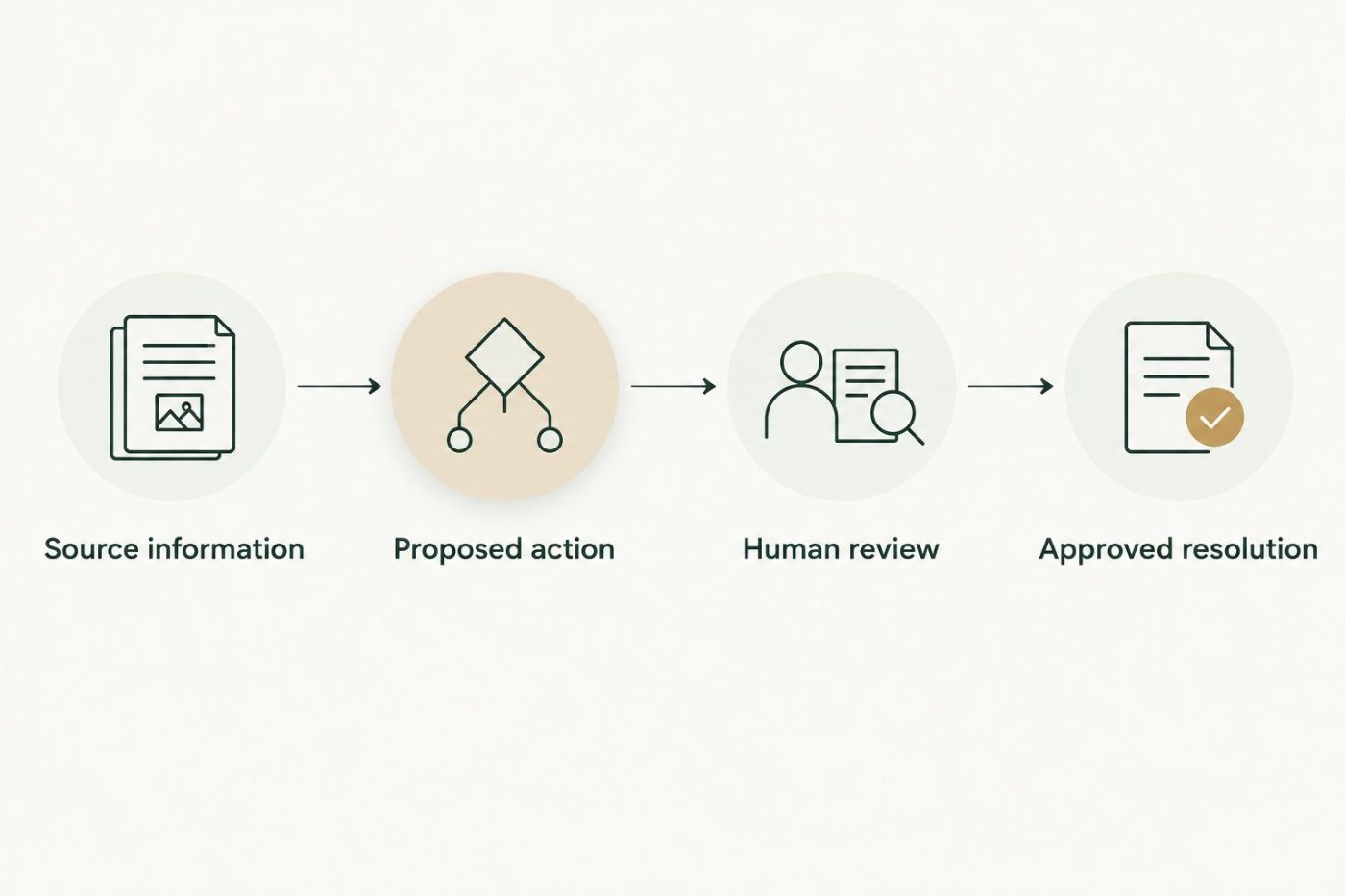
Keep the proposed action separate from the authority to execute it.
5. Test difficult cases before expanding authority
Build a test set manually from cases your team understands. Include incomplete documents, conflicting instructions, repeated submissions, and examples that previously needed escalation. Remove or protect sensitive information according to your company’s requirements.
Agree on acceptable behavior before reviewing results. A correct response sometimes means refusing to act and requesting clarification. Do not score an unsupported answer as successful simply because it sounds plausible or lets a case move forward.
Begin evaluation without granting broad execution permissions. Compare proposed actions with decisions approved by the process owner, and investigate disagreements. Expand authority only after the accountable owner accepts the evidence and the fallback process. Keep the test cases available for later changes; a workflow update needs evaluation against known problems, not just a fresh demonstration.
- Include ordinary cases and difficult exceptions.
- Test missing, contradictory, and duplicate information.
- Record unsupported recommendations as failures.
- Verify that approval restrictions actually hold.
- Check that manual handling remains usable.
- Require process-owner acceptance before expansion.
6. Assign ongoing ownership before launch
Write an operating checklist before commissioning additional work. Name who checks the queue, investigates failures, approves changes, trains employees, and decides when automation should stop. A supplier relationship does not remove your responsibility for business policy.
National AI Consultants positions its service as an ongoing AI department: it implements solutions, manages them over the client relationship, and trains internal teams. That model suits businesses seeking continuing delivery ownership rather than a strategy document alone. It still requires your company to provide decision-makers, system access, and policy direction.
Make your 2026 management plan specific about responsibilities and review triggers. Changes to forms, approval policies, source systems, or business rules should trigger evaluation of the affected workflow. Define the engagement’s management responsibilities rather than assuming every future change is included.
- Assign an internal executive sponsor.
- Name the operational owner and backup.
- Document the provider’s management responsibilities.
- Train reviewers on approvals and escalation.
- Keep a change log tied to test evidence.
- Define when to pause automated actions.
Compare operating options before approving implementation
For your 2026 decision, compare the work each option handles and the responsibility it leaves with your team. These are operating choices, not a ranking of software vendors. A mixed approach is appropriate when routine cases follow fixed rules but exceptions require interpretation.
| Option | Best for | Operational advantage | Key limitation |
|---|---|---|---|
| Manual process redesign | Unclear ownership or inconsistent procedures | Makes decisions and responsibilities explicit before technology changes | Employees still perform the work |
| Rules-based automation | Stable decisions with explicit conditions | Executes defined conditions without interpreting open-ended requests | Unspecified exceptions still need another route |
| AI-assisted review | Document-heavy exceptions requiring interpretation | Prepares information and proposed actions for employee review | Review quality and approval discipline remain essential |
| Managed AI implementation | Workflows needing engineering, adoption support, and continuing management | Brings delivery and management responsibilities into a defined engagement | Requires internal participation and agreed service boundaries |
Choose the least complex option that meets the operating requirement. If a required field and a clear approval rule solve the problem, do not approve an AI build merely because it is available.
For a managed engagement, evaluate both delivery and dependency. Ask who maintains workflow documentation, who can export operating records, and how employees continue handling cases when a component is unavailable. These questions clarify accountability without assuming any provider offers a particular contractual term.
Common mistakes operations teams make
Treating every exception as the same problem
A missing document, a policy dispute, and a system error need different responses. Combining them under a single automation target hides the work that requires authority rather than information processing.
Separate exception types before setting targets. Give each type an owner, a resolution path, and an escalation condition.
Measuring throughput without checking resolution
A case leaving an automated queue is not proof that the underlying issue is resolved. It might have moved to an employee’s inbox or returned under a new reference.
Track the final business outcome and reopened work. Keep transferred cases visible until an accountable owner closes them.
Making the COO the default exception handler
Escalating every uncertain case to senior leadership creates a new bottleneck. The operating model should distinguish routine supervisory decisions from issues that genuinely require executive authority.
Assign decision rights by role. Reserve executive escalation for defined policy, risk, or commercial questions.
Treating employee overrides as resistance
An override can reveal missing context, a flawed recommendation, or an outdated rule. Suppressing overrides removes evidence you need to improve the workflow.
Ask reviewers to record why they rejected a recommendation. Review recurring reasons before expanding permissions or setting adoption expectations.
Approving a build before approving the business case
Technical feasibility does not establish operational value. An assessment should identify the problem, the proposed intervention, the management burden, and the evidence needed for an investment decision.
Keep assessment approval separate from implementation approval. Require a clear reason to proceed, revise the approach, or stop.
FAQ
What is AI automation consulting for an operations team?
AI automation consulting assesses and designs AI-assisted workflows around business processes, decision rights, and operational controls. For exception handling, it defines what the system can do, what employees must review, and who owns resolution.
Should we automate exceptions or fix the process first?
Fix unclear ownership, inconsistent policies, and avoidable information gaps before automating them. Then assess whether the remaining work needs fixed rules, AI-assisted interpretation, or human judgment.
Is AI better than rules-based automation for handling exceptions?
AI is not the default choice for every exception. Use explicit rules for stable conditions and consider AI-assisted review when the work requires interpretation of variable information, with appropriate approval controls.
What should an AI Opportunity Assessment decide?
An AI Opportunity Assessment should establish whether an operational problem warrants implementation and under what conditions. It should clarify the workflow, decision boundaries, business rationale, and evidence required before approving a build.
Who approves an AI system’s proposed actions?
Your business assigns approval authority to the appropriate process owner or authorized reviewer. The workflow should distinguish recommendations from actions and preserve a record of approval decisions.
Does National AI Consultants stop after producing a strategy?
National AI Consultants provides strategy, engineering, and outsourced AI department or fractional leadership services. Its delivery model includes implementation, ongoing management over the client relationship, and training internal teams.
How do we know an exception-handling workflow is ready to expand?
Expand only after the process owner accepts evidence that the workflow handles the agreed cases and respects its approval boundaries. Confirm that reviewers can resolve escalations and that manual fallback remains usable.
One last thing
Test whether your team can stop the workflow, not just start it. Ask the operational owner to describe what happens when source information becomes unreliable: who pauses automated actions, where pending cases go, and how normal handling resumes.
Put that answer in the operating procedure before launch. A stop mechanism is only useful when someone has the authority, information, and instructions to use it. This is a practical acceptance criterion you can apply before approving broader automation, without relying on a savings promise or a software demonstration.